

Other
- +5
Frances Z. Brown, Zainab Usman, Erin Jones, …
{
  "authors": [
    "Ashley Quarcoo"
  ],
  "type": "commentary",
  "centerAffiliationAll": "",
  "centers": [
    "Carnegie Endowment for International Peace",
    "Malcolm H. Kerr Carnegie Middle East Center"
  ],
  "collections": [],
  "englishNewsletterAll": "",
  "nonEnglishNewsletterAll": "",
  "primaryCenter": "Carnegie Endowment for International Peace",
  "programAffiliation": "",
  "programs": [],
  "projects": [],
  "regions": [
    "North Africa",
    "Sudan"
  ],
  "topics": [
    "Political Reform",
    "Security"
  ]
}
Source: Getty
A newly formed government offers South Sudan’s best chance for peace in years, but it must contend with endemic corruption and a severe humanitarian crisis.
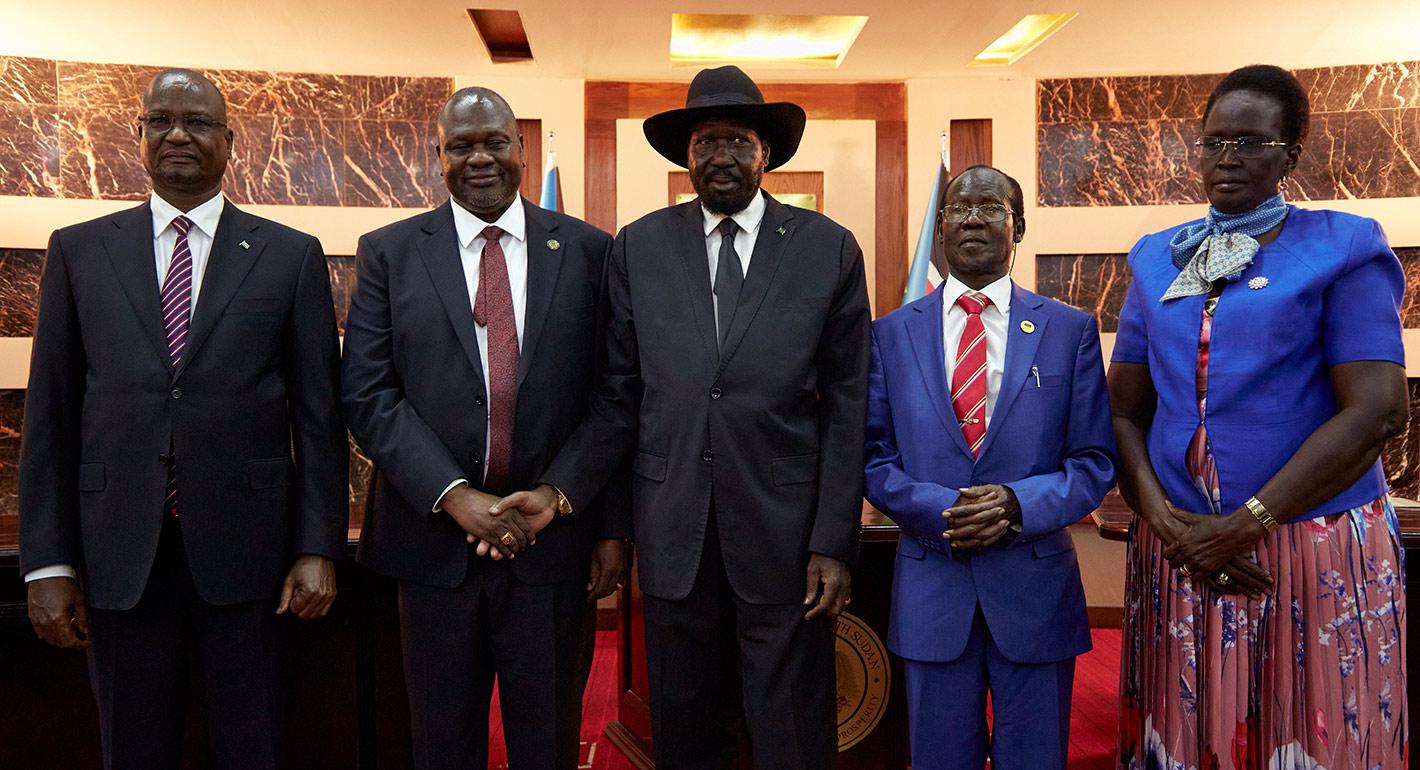
South Sudan took new steps last week on its shaky path to peace, swearing in opposition leader Riek Machar as first vice president on February 22. Machar will serve in a unity government alongside his chief rival, President Salva Kiir, and three lower-ranking vice presidents, under the terms of the country’s current peace agreement.
This is the third time Machar has taken the oath of office as a vice president since South Sudan’s independence and the second time since the outbreak of civil war in 2013. Many are hoping that this latest détente between Kiir and Machar proves a lasting one.
The inauguration of the new government marks South Sudan’s most concrete progress toward peace in six years of conflict. It was made possible by major concessions from both parties, finalized just ahead of a critical deadline that had already been extended one hundred days. Most notably, Kiir agreed to reestablish the country’s ten original states, reversing an expansion to thirty-two states that was seen to benefit his Dinka ethnic group and their control of land and other natural resources. Machar, meanwhile, agreed to return to South Sudan without his personal security force and to rely on Kiir’s provision for his safety, addressing fears of a repeat of the violence that derailed the last peace agreement and forced Machar to flee the country on foot.
Despite these reasons for hope, many challenges to peace remain. Corruption has been widespread, as detailed in a report released on February 20 by the UN Commission on Human Rights in South Sudan. Investigators found that government officials have profited amid the country’s long conflict, diverting millions of dollars from government coffers through tax evasion, bribery, money laundering, and other crimes.
One of the new government’s most urgent tasks is to unify opposing military forces into a national army. The prior government failed to fully fund this effort, and though some progress has been made, most garrison sites lack adequate food, water, or medical supplies, and soldiers lack basic equipment. Improving these garrison conditions, described as “deplorable” in the UN report, could quickly bolster confidence that peace is producing tangible progress in the security sector and guard against the risk of desertion.
South Sudan also faces a dire humanitarian crisis. The conflict has claimed the lives of roughly 400,000 people and left over 4 million displaced from their homes. Humanitarian conditions have been exacerbated by military strategies on both sides that deprived enemy populations of food. The UN reports that “more than 55 percent” of people in South Sudan “face acute food insecurity” because warring factions pursued a “deliberate policy of preventing humanitarian aid from reaching civilians.”
Addressing these challenges requires a continued commitment to meeting the milestones of the peace agreement and focused investment in improving the living conditions of the people of South Sudan. It will be essential to root out the kleptocratic behavior that has cost the government both sorely needed funds and public trust. In this moment of opportunity, South Sudan could at last have within its grasp a framework for reform, accountability, and peace.
Former Nonresident Scholar, Democracy, Conflict, and Governance Program
Ashley Quarcoo was a nonresident scholar with the Carnegie Endowment for International Peace’s Democracy, Conflict and Governance Program. She is also the senior director for democracy programs and pillars with the Partnership for American Democracy.
Recent Work

Frances Z. Brown, Zainab Usman, Erin Jones, …
Ashley Quarcoo, Medina Husakovic
Carnegie does not take institutional positions on public policy issues; the views represented herein are those of the author(s) and do not necessarily reflect the views of Carnegie, its staff, or its trustees.

Russia’s AI-driven propaganda campaigns operate in a fragmented, chaotic, and often illogical manner. That’s not necessarily a problem for the Kremlin, though: It’s much easier to mimic genuine public debate that way.

Ilya Klishin

Russian strikes are weakening the economy sustaining Ukraine’s war effort. Closing the growing funding gap will require more European support and politically contentious reforms in Kyiv.

Balázs Jarábik

Ex-president Gurbanguly Berdimuhamedov remains interested in politics, but his son Serdar, Turkmenistan’s current president, is becoming increasingly independent and willing to break with his father’s legacy. If their covert rivalry goes too far, both risk losing power.

Galiya Ibragimova

Europe is facing rising populism internally as well as external pressures from Russia, China, Turkey, and the United States.

Dimitar Bechev

A notable degree of participative democracy has firmly arrived in Europe. But to have more far-reaching impact, democratic deliberation needs to move into a radically new phase.

Richard Youngs