

Commentary
Dmitri Trenin
{
  "authors": [
    "Dmitri Trenin"
  ],
  "type": "commentary",
  "centerAffiliationAll": "",
  "centers": [
    "Carnegie Endowment for International Peace",
    "Carnegie Russia Eurasia Center"
  ],
  "collections": [],
  "englishNewsletterAll": "",
  "nonEnglishNewsletterAll": "",
  "primaryCenter": "Carnegie Russia Eurasia Center",
  "programAffiliation": "",
  "programs": [],
  "projects": [],
  "regions": [],
  "topics": [
    "Economy"
  ]
}
Source: Getty
The main thrust of U.S. policy toward Russia has not changed much with the advent of a new administration. U.S.-Russian interaction on strategic stability issues will go hand-in-hand with persistent condemnation and retribution for what Biden calls Russia’s determination to damage and disrupt American democracy.
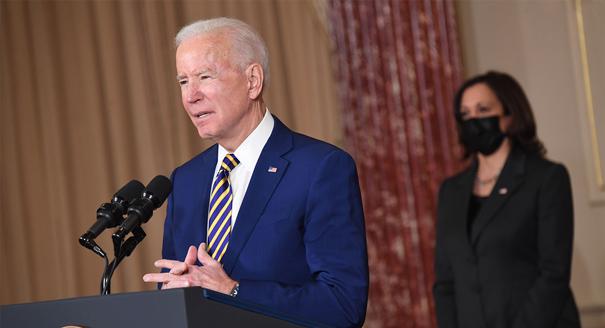
U.S. President Joe Biden’s first major foreign policy speech did not contain any surprises. So far, Biden has been consistent in his talking points. America is back. Diplomacy will be at the center of foreign policy. Washington will regain leadership of the Western world and consolidate it once again in the name of democracy. The United States and its allies will deal with the principal challenge of authoritarianism, represented by China’s ambitions and Russia’s disruptive behavior.
At the same time, Washington will engage with its rivals and adversaries in Beijing and Moscow on U.S. interests or where U.S. national security demands it. America will also lead the world in responding to global challenges such as climate change, the pandemic, nuclear proliferation, and cyber security.
One genuinely new conceptual element in the presidential speech is the idea that U.S. foreign policy should correspond to the interests of the bulk of the American people—its middle class—but this is a domestic issue. Certainly, Biden also made it clear that the United States will not cede its global primacy to China. So, the counter-offensive has begun.
What should Russians make of it? The idea that America is back may sound uplifting to a number of forlorn U.S. allies who for the past four years looked abandoned or neglected by their leader. To those sitting in Moscow, and probably Beijing, the United States under Donald Trump appeared very active indeed, of course, albeit in a spectacularly chaotic way.
The notion of diplomacy as foreign policy’s centerpiece is intriguing and somewhat perplexing. It should mean that military measures take a back seat to diplomatic and other non-violent action, but the Trump presidency actually stood out as a rare four-year period in which the United States did not initiate any new wars. In this context, the Kremlin will probably interpret Biden’s message as meaning that the United States will double down on waging non-military campaigns against its designated adversaries, including Russia.
Another likely conclusion is that the main thrust of U.S. foreign policy has not changed much. The Trump administration called China and Russia America’s major power rivals; Biden calls those two countries the principal opponents of the liberal and democratic order that the United States supports and leads. In material terms, there is no change. There may and probably will be stylistic differences, but hardly substantial ones.
Beijing may encounter more flexibility in the future U.S. approach, but the fundamental antagonism will persist. Russia will continue to be subject to packages of U.S. sanctions, which under Biden promise to be smarter and more strategic. U.S.-Russian interaction on strategic stability issues, which the Democratic administration intends to address more seriously than its Republican predecessor, will go hand-in-hand with persistent condemnation and retribution for what Biden calls Russia’s determination to damage and disrupt American democracy. Hopefully those two tracks will run in parallel, without linkages leading to a train wreck.
Like China, Russia will face a more united front of American allies. Biden’s call for the immediate release of the jailed Kremlin critic Alexei Navalny has been echoed by Angela Merkel, Emmanuel Macron, Boris Johnson and many other Western leaders. The recent Navalny trial in Moscow was attended by diplomats from about twenty embassies.
To Moscow, this is a sign of blatant foreign interference in Russian domestic politics, and it is pushing back by refusing to listen to lectures and dismissing all accusations. This Western front, of course, is likely to be more unified on ideological issues than on issues of interest, but it will be harder for Moscow to play on inter-allied differences. The distinction between Russia’s confrontation with the United States and its alienation from the European Union is growing narrower.
At the same time, some elements of President Biden’s speech suggest that there may be room for Russia to cooperate with the United States beyond strategic stability and arms control. This applies to such global issues as climate change; the COVID-19 pandemic; and nuclear non-proliferation.
Russia is affected by global warming more than many others, and while making use of its benefits, like melting Arctic ice, it is also seeking to deal with the negatives, such as melting permafrost in much of its territory. With its Sputnik V COVID-19 vaccine, Russia has demonstrated its capacity to deal with viruses.
Be that as it may, cooperation on climate and public health issues is not going to be very close or intense, and it will certainly not change the overall climate in U.S.-Russian relations, which is growing harsher. Nuclear non-proliferation, however, is a different story.
Russia would welcome a U.S. return to the Iran nuclear deal, but it is not clear what exactly the Biden administration intends to do. The one major decision announced by the U.S. president in his first foreign policy address was stopping U.S. support for Saudi Arabia’s war against the Yemeni Houthis, Iran’s allies. At the same time, however, Biden reaffirmed Washington’s commitment to Saudi security vis-à-vis Iran.
Moscow, which has been keeping in close contact with Tehran, continues to be a major player on the Iranian nuclear issue, and would have to be engaged by Washington if the United States wants to resume its diplomatic efforts. Russia has far less influence in North Korea, of course, where Beijing is the principal outside actor, but Biden’s White House is yet to roll out its strategy for dealing with that issue.
Overall, the Kremlin sees the Democratic administration as more predictable and more professional on foreign and security policy than its predecessor. President Biden himself has been a well-known quantity in Moscow since the days of Leonid Brezhnev: not a friend of Russia by any stretch of the imagination, but, as a Cold War veteran, a safe pair of hands.
The U.S. government, torn apart under Trump, suddenly looks consolidated now. Biden’s key foreign policy figures, including Secretary of State Antony Blinken and National Security Adviser Jake Sullivan, are his former aides and will be loyal to their boss. The Democratic Party controls both houses of U.S. Congress. Both traditional media and social media companies are overwhelmingly Democrat-friendly, adding to the victors’ bloc.
That said, the general attitude in Washington toward Russia will remain adversarial, and openly supportive of the Kremlin’s domestic opponents. At the same time, Biden’s policy is expected to be cautious when it comes to U.S. national security, and potentially even pragmatic where U.S. interests are involved. The Kremlin will be on its guard, but can probably live with that.
This article was published as part of the “Relaunching U.S.-Russia Dialogue on Global Challenges: The Role of the Next Generation” project, implemented in cooperation with the U.S. Embassy to Russia. The opinions, findings, and conclusions stated herein are those of the author and do not necessarily reflect those of the U.S. Embassy to Russia.
Former Director, Carnegie Moscow Center
Trenin was director of the Carnegie Moscow Center from 2008 to early 2022.
Recent Work
Dmitri Trenin
Dmitri Trenin
Carnegie does not take institutional positions on public policy issues; the views represented herein are those of the author(s) and do not necessarily reflect the views of Carnegie, its staff, or its trustees.

The Bureau of Industry and Security needs to adjust its focus and practices to maintain its position as the U.S. government’s primary champion of international technological competition.

Geoffrey Irving

Depleted financial reserves and a shrinking tax base mean it is no longer possible to simultaneously deliver high defense spending, price stability, and economic growth.

Alexandra Prokopenko

U.S. trading partners in Asia are closely watching the dispute for signs of how it may affect their own interests.

Barbara Weisel
Amid celebrations of bilateral ties was a deeper focus on stability in the Middle East.

Amr Hamzawy

Xi, Putin, and other regional leaders are back-slapping in Bishkek, but the SCO has yet to answer the most serious questions about continental Asia's economic future.

Evan A. Feigenbaum