

Commentary
Shana Tabak, Alejandro Martin Rodriguez
{
  "authors": [
    "Alejandro Martin Rodriguez"
  ],
  "type": "questionAnswer",
  "centerAffiliationAll": "dc",
  "centers": [
    "Carnegie Endowment for International Peace"
  ],
  "collections": [
    "Climate Mobility"
  ],
  "englishNewsletterAll": "ctw",
  "nonEnglishNewsletterAll": "",
  "programAffiliation": "SCP",
  "programs": [
    "Sustainability, Climate, and Geopolitics"
  ],
  "topics": [
    "Climate Change",
    "Economy",
    "Foreign Policy"
  ]
}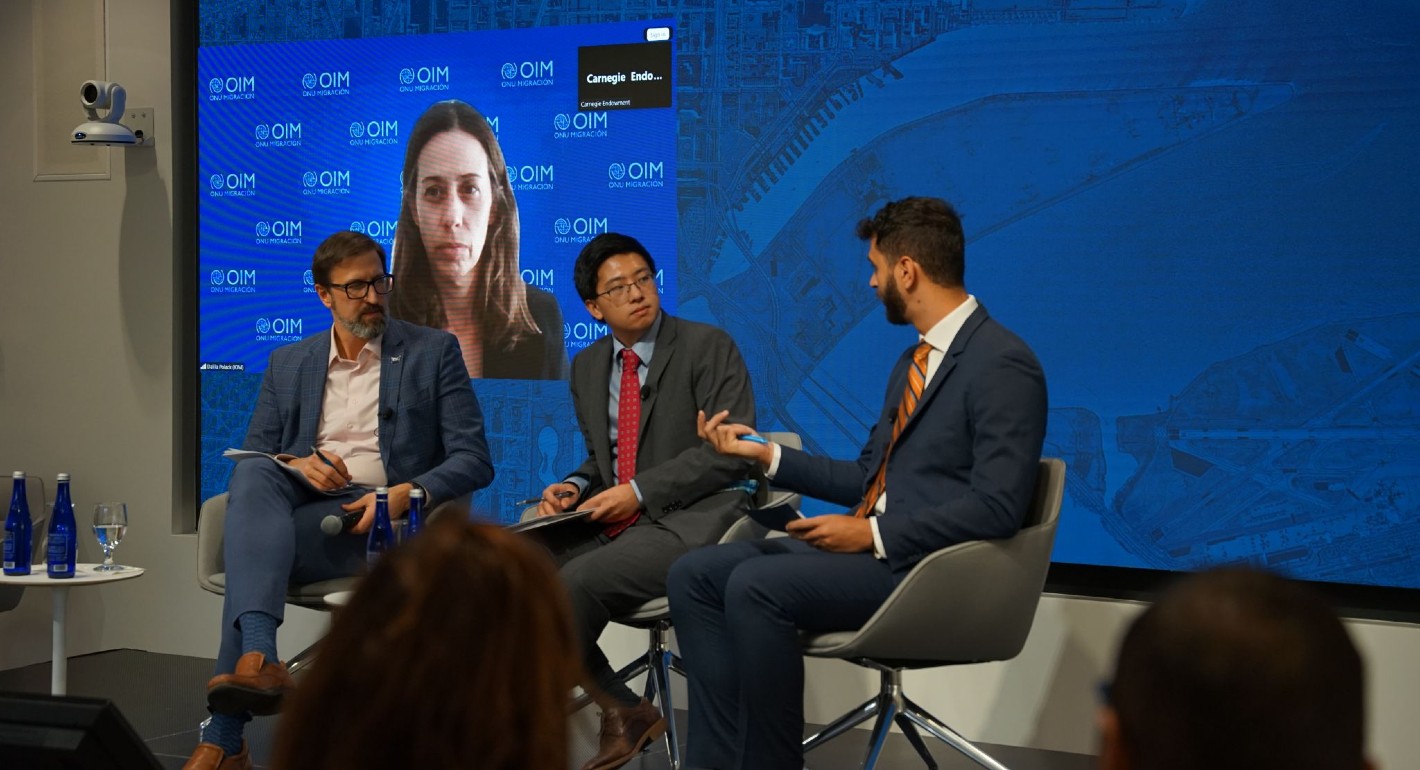
Photo by Carnegie Endowment
Senior climate, finance, and mobility experts discuss how the Fund for Responding to Loss and Damage could unlock financing for climate mobility.
Climate impacts—through both slow and rapid-onset events—are influencing people’s decisions about where to live, causing economic and non-economic loss and damage to affected populations. These include loss of income, housing, and savings; separation from traditional lands or cultural assets; and a lack of social support systems, among others. In December 2025, the Fund for Responding to Loss and Damage (FRLD) opened its first call for requests from developing countries for financing to respond to these challenges. With $250 million for the FRLD to distribute under the Barbados Implementation Modalities (BIM), this moment represents a unique opportunity to unlock resources for recovery and to meet the needs of those impacted across the climate mobility spectrum.
To discuss this opportunity, Carnegie fellow Alejandro Martin Rodriguez spoke with former president Carlos Alvarado Quesada of Costa Rica, Refugees International’s Jeremy Konyndyk, Migration Policy Institute’s Lawrence Huang, and International Organization for Migration’s (IOM) Dalila Polack. The deputy executive director of the FRLD, Mathilde Laurans, joined the discussion and delivered closing remarks.
Portions of their conversation are below and have been edited and condensed for clarity.
Carlos Alvarado Quesada: Climate mobility represents one of the biggest opportunities to move the climate and environmental agendas forward, even in the complicated geopolitics we are experiencing now. Climate mobility is another facet of human adaptation, and that human adaptation is at the core of change that we need to see happening. This is an opportunity to define on the ground projects that change positively the lives of people and demonstrate how [those projects are] changing things for the people, with the people—putting them at the helm of this adaptation. Climate mobility is not one model. It’s a way in which people explore how they are going to adapt, confronted with the changes that we are experiencing and that we will experience in the next couple of decades. The important part is that the people have to be at the helm of it. They have to be empowered and make decisions with agency on their own futures. All adaptation is local, and if the adaptation is a positive one created by the community, endorsed by the community, what we need to do is empower it, enable it, be there backing it—never imposing it from the outside, but strengthening the agency of communities to define their own journey of adaptation and make it a reality. That’s the possibility we have now with the FRLD. That, I believe, is one of the most exciting edges we have now in the environmental and climate discussion, because it’s an opportunity to demonstrate on the ground with the people executing funds and enabling those examples to unlock others. If we put the emphasis on the people and on the ground and on the adaptation, I see vast reasons to be hopeful. Let me tell you that in any of these causes, in any way that we can contribute to this, we’ll be doing something positive for the planet, for this generation, and for the next one.
Alejandro Martin Rodriguez: Thank you very much, President Alvarado, for those inspiring opening remarks. This past year has seen significant budget cuts to both climate and migration funding, as well as development aid and humanitarian aid. How are these cuts affecting the climate mobility field, and what are the main challenges that the field is currently experiencing?
Jeremy Konyndyk: With the closure of USAID and wider cutbacks across the U.S. government, total U.S. financing for humanitarian response dropped from 14 billion in 2024 to 3 billion in 2025, so 10 billion dollars of missing aid financing. We know in the humanitarian sector that climate is driving humanitarian need. When you are walking away from climate adaptation and climate mitigation interventions, what that means on the other end is more people displaced, more people hungry, more people in humanitarian need. It is creating a sort of pincer movement on vulnerable populations in climate-vulnerable countries, where on the one hand, the support that they used to be able to turn to for climate mitigation and adaptation, that’s gone. And the relief needs that then increase as a result of that are also not being met because of the larger collapse in global humanitarian financing. These things are all connected.
Alejandro Martin Rodriguez: In what ways does climate mobility represent a form or a catalyst for loss and damage? What does investing in climate mobility look like?
Lawrence Huang: Loss and damage experts at climate financiers, donors, and partners recognize—on paper, at least, in theory—that climate mobility can be a form of loss and damages. So the question is: How do we get it done on paper, operationally, on the ground? And how do we get it prioritized in a world of incredibly shrunken foreign aid resources and climate resources, humanitarian and otherwise? There are incredibly clear entry points for funding climate mobility out of loss and damage. A few years ago, the Asian Development Bank and the Internal Displacement Monitoring Center did a study on disaster displacement due to weather-related disasters in the Asia-Pacific. That modeling predicts about 9.5 million people will be disaster-displaced each year in the region. Their estimate is that each day of displacement causes an income loss of $29 a day. At a low estimate, the GDP loss from disaster displacement in that one region alone, from one day of disaster displacement per person, is $275.5 million per year, which is higher than the entire startup phase of the FRLD. The scale of loss and damage related to climate mobility is far exceeding the amount of funds we have. In the context of climate change, most people want to stay at home or as close to home as possible. So what are the investments in early warning systems, climate-smart agriculture, environmental peacebuilding, that allow people who want to stay to stay? On the other end of the spectrum, there’s how to help people move to safety. So in our climate mobility conversations, we talk about planned relocations of households and communities. But also, what are the options within regular migration policies, like free movement, labor migration pathways, humanitarian protection? So when we’re thinking about climate mobility solutions, it’s also about how to be migrant-inclusive and refugee-inclusive in your loss and damage programming, in your adaptation and resilience programming. It’s ultimately up to the partner countries and up to the FRLD, what [the partner countries] prioritize in their proposals to the fund and what the fund chooses to give resources to. There is way too much demand across the sector and not nearly enough funding. We often talk about the need to get the donors to think about climate and migration as a priority. We also need to think about how can we provide support and arguments and data and technical assistance to partner countries, so they can see how climate mobility is in their interest, how responding to climate mobility is in their interest, and how they should be prioritizing it within their requests for loss and damage funding.
Alejandro Martin Rodriguez: One challenge that we hear when we talk about climate mobility in the context of loss and damage is the extent to which it is difficult to quantify the economic cost, but also the non-economic cost. IOM recently developed a tool to help with precisely this. How can it help partner countries and other stakeholders seeking financing to quantify the cost and present it accurately?
Dalila Polack: We developed, in 2025, this costing tool for funds (CTF), which is a standardized tool aimed at supporting governments in accessing international resources. It addresses two types of climate mobility: disaster displacement and planned relocation. We pilot-tested the model on planned relocation in Costa Rican communities affected by coastal erosion and floods, and the one on disaster displacement in Chile in the context of wildfires exacerbated by climate change (particularly droughts). The CTF estimates the enhanced reposition cost. In the case of house damage, the cost would be given for rebuilding the house in a more resilient and sustainable way. And when it comes to non-economic losses and damages, let’s say mental health or losses of school days, the cost would be given for a program that could address those impacts. The CTF has three phases. The first one is the government data collection, and this phase includes interviewing authorities and an extensive desk review. The second phase would be community data collection, and this phase involves going to the field to apply a standardized survey we developed for this purpose to identify community needs. The third phase will be filling in a matrix with all the information gathered to estimate the cost of addressing those losses and damages identified. So it also helps to build stronger financial proposals in terms of sustainability and national engagement.
Alejandro Martin Rodriguez: As we look ahead to the next six months, when decisions will be finalized and the $250 million from the BIM will be allocated, what would success look like?
Jeremy Konyndyk: I think part of success should be assessing how much of the funding reaches front-line climate-affected communities directly. How engaged are they, both in the prioritization of the interventions and in the delivery of the interventions? This is an important moment, while we await some of those larger forces, to also be making the case for why these investments are important and to be able to show impact so that there is a strong investment case in the future.
Lawrence Huang: From a mobility perspective, I think the more we can see a diversity of approaches being tested, the better. I think we’ll be particularly interested in the number of proposals that have strong mobility elements versus the number that get funded. I think that will be an interesting point for those of us on the outside. And I hope we can get some sort of transparency around that. The question of monitoring evaluation, both from a very technical [standpoint of] what’s the impact on the ground, and also from a narrative and persuasion [perspective on] how you raise the profile of these issues. That’s really important. The amount of funding that’s allocated to loss and damage and to the FRLD right now is tiny. The question is going to be on replenishment and everything we should be doing has to be with that view in mind.
Dalila Polack: It means having a process that is responsive to needs. From a climate mobility perspective, it would be interesting to have lots of projects addressing migration induced by climate change, planned relocation, and disaster displacement. Recognizing that this topic is a priority for the fund, [it is important] also to have such an effective and efficient process that it demonstrates the impact of this fund and attracts new contributions and larger contributions from governments.
Alejandro Martin Rodriguez: It is my pleasure now to invite the deputy executive director of the FRLD, Mathilde Laurans, to deliver a response to the panel.
Mathilde Laurans: We heard already a lot from the panel and from President Alvarado on how climate change is, quietly and not so quietly, redrawing the map of where people can live. This is not a future threat. We know that. It’s a present reality. And when a home is lost, whether to sea level rise or storm, it’s a sudden fury of a storm—the foundations of peace, stability, and human dignity are shaken. We know there are 45 million [people] in 2024 displaced due to climate disasters and it’s only a part of what can be considered due to climate change. The FRLD board working under the [United Nations Framework Convention on Climate Change] mandate has indeed provided for the fund to cover human mobility. It’s in our governing instruments. It’s on the list of eligible activities of the first call for proposals. It means that, for the first time, we have a global instrument which has this explicitly recognized in its mandate. We talk about equitable, safe and dignified mobility. This is also very central to our fund because the fund has the specificity to work and to have a mandate clearly about economic and non-economic loss and damage. The BIM is built on several principles. Our approach is bottom-up, country-led, and country-owned. We do not presume what is going to be and how the countries will prioritize their requests to the FRLD. Countries need to be empowered to design their own solutions and to tell us what [they consider to be] loss and damage. It means empowering the countries at the national level on what [loss and damage] means, getting to put their focus on how [climate risk] impacts their population. The second principle is measuring impacts. The last principle is testing and learning. The BIM is in a start-up phase. We don’t expect to have everything perfect. We know there are questions, topics, and even some frustration, notably on direct access at community levels. The issue is how to support the countries building up their own systems. We will learn from the BIM and will build up a long-term model with all these targets in mind and this flexibility in mind. My advice at this stage is, first, keep engaged with countries. They need support to articulate their vision for managing climate mobility, and they need this in the framework of their own national dialogues on loss and damage. Second would be to help us build coherence. It’s important to have the discussion with all the stakeholders involved—whether in the funding arrangement or in the implementation or in the knowledge—in building on what loss and damage is and especially on climate mobility. And third, thank you for championing the cause and for creating this type of event. The work is immense, but at FRLD we are no longer just talking, we are acting. Let’s continue working together on this topic.
For more, watch the video of the event.
Invalid video URL

Fellow, Sustainability, Climate, and Geopolitics Program
Alejandro Martin Rodriguez is a fellow in the Sustainability, Climate, and Geopolitics Program at the Carnegie Endowment for International Peace. His research focuses on the social dimensions of climate change, and he manages projects on climate mobility, peace, and security.
Recent Work

Shana Tabak, Alejandro Martin Rodriguez


Alejandro Martin Rodriguez, Joy Arkeh, Sarah Yerkes
Carnegie does not take institutional positions on public policy issues; the views represented herein are those of the author(s) and do not necessarily reflect the views of Carnegie, its staff, or its trustees.

Ahead of a tough winter for Ukraine, Donald Trump’s swing back toward Russia bodes ill. But instead of panicking, Kyiv’s European allies are focusing on action.

Rym Momtaz

Without a ceasefire with Ukraine on attacking each other’s energy infrastructure—to which the Kremlin is unlikely to agree—the diesel agreement between Putin and Trump is largely for show, rather than representing a genuine increase in the volumes of Russian diesel on the global market.

Sergey Vakulenko

Despite its flop at the box office, the film raises important questions for the climate community to answer.
Leonardo Martinez-Diaz

Funding Ukraine remains a priority for European leaders. As Russia’s war of aggression heads into another winter, two feasible options to mobilize support for Kyiv should be fast-tracked.


Vladyslav Rashkovan, Gregory P. Wilson

Russian strikes are weakening the economy sustaining Ukraine’s war effort. Closing the growing funding gap will require more European support and politically contentious reforms in Kyiv.

Balázs Jarábik