

Commentary
Tatiana Stanovaya
{
  "authors": [
    "Tatiana Stanovaya"
  ],
  "type": "commentary",
  "centerAffiliationAll": "",
  "centers": [
    "Carnegie Endowment for International Peace",
    "Carnegie Russia Eurasia Center"
  ],
  "collections": [],
  "englishNewsletterAll": "",
  "nonEnglishNewsletterAll": "",
  "primaryCenter": "Carnegie Endowment for International Peace",
  "programAffiliation": "",
  "programs": [],
  "projects": [],
  "regions": [
    "Russia"
  ],
  "topics": [
    "Economy"
  ]
}
Source: Getty
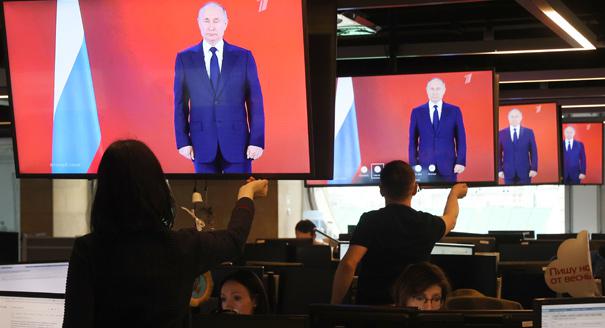
The communication channels between the president and society are shrinking. Some events are apparently too important for the president to discuss seriously with the public, while others are uninteresting or unpleasant for him, so they aren’t discussed either, no matter how big those issues might be.
Ahead of Russian President Vladimir Putin’s state of the nation address on April 21, there were rumors of a sensational announcement: perhaps official recognition of the self-declared Donetsk and Luhansk people’s republics in war-torn Donbas, or even unification with Belarus.
In the end, no such dramatic declaration was made. The focus of the address was markedly on domestic policy, and even smacked of electioneering ahead of the September elections to the State Duma: the main takeaway was a promise of large-scale social support. That, it seems, is the regime’s response to growing social discontent and the conflict with the political opposition.
Just like in last year’s address ahead of the constitutional reform, most of the promised handouts were for families with children: new benefits for single-parent families (of which there are about 5 million in Russia) and for low-income pregnant women; a one-off payment for every school-age child in August ahead of the new school year (i.e., a month before the Duma elections); full pay during maternity leave, regardless of how long the woman has been employed; and so on. This focus on motherhood, the family, and children is also an act of political support for conservative values, a financial boost for the ideological union between the president and the traditionalists.
The list of various benefits announced may have been long, but most of them will be temporary or one-off payments, and many social groups were not included. The support package won’t genuinely improve the social situation by creating better standards of living or stable growth in real incomes and employment.
Accordingly, the potential of the promised support to defuse social frustration and bridge the chasm between society and the authorities is extremely limited. Putin apparently underestimates the severity of Russia’s social problems and believes that overall, the situation is satisfactory. Therefore, there can be no legitimate grounds for protest.
It follows, then, that nothing needs to be changed in terms of politics: it’s not just the United Russia ruling party that’s onside, but the “in-system” opposition, too: parties that are nominally opposition, but which don’t challenge Putin personally, and play by the Kremlin’s rules. (The real—or “non-system”—opposition was entirely absent from the address, and indeed has been removed from the presidential agenda.) Putin expressed hope in his address that the parliamentary factions would support the initiatives he had outlined, and listed them by name, starting with the smallest faction, A Just Russia. The president clearly intends to preserve the status quo following the Duma elections, with little change to the makeup of the current parliament.
What is changing, however, is the nature of Putin’s leadership. He’s gone from a figure who set the rules of the game for the development of society to a therapist whose function is to convince society to reconcile itself to the inalterability of those rules. In his latest address, Putin came across not as a politician and a doer, but as a doctor prescribing his patients meditation, vaccination, and tranquilizers to help them bear their troubled reality.
This year, the feeling was stronger than ever that these presidential addresses do not so much reflect the true agenda as conceal it. While everyone was expecting detailed comments on hot topics—Ukraine, Belarus, protests, and falling incomes—Putin instead put up a smokescreen of the long, drawn-out list of secondary social measures that took up most of the speech.
The next—and most substantial—section of the address was devoted to infrastructure and regional policy, but here Putin put the onus on the government. A source close to the cabinet says that the president effectively read out the plan for Russia’s strategic development through 2030: a document that the government is due to finish work on by the summer. That’s below the presidential paygrade, as Putin’s spokesman Dmitry Peskov likes to say.
The third part of the speech was devoted to Putin’s main interest—geopolitics—yet it was also the shortest. The reason isn’t just that Russian society is tired of foreign policy, according to all the polls. The president is increasingly unwilling to discuss his foreign policy plans and decisions in public. Everything that is truly important to Putin becomes a series of clandestine special ops.
Instead of unveiling the real agenda, the speeches are used to show the public mock-ups that create the necessary perceptions. A sting operation by the intelligence agencies against members of the Belarusian opposition becomes, in Putin’s telling of it, a dangerous coup against his Belarusian counterpart—and organized by the West to boot. Meanwhile, what’s really going on with Belarus goes unseen: despite heightened expectations of his summit with his Belarusian counterpart Alexander Lukashenko the very next day after his address, Putin revealed nothing.
Meanwhile, the key issue of Russia’s confrontation with the West was reduced to a geopolitical interpretation of Rudyard Kipling’s Jungle Book, with “all sorts of petty Tabaquis” (the name of the obsequious jackal in the story—a reference to Russia’s critics abroad) “howling along to please their master”—the United States, or in this reimagining, Shere Khan, the wicked and dangerous tiger. This is the level at which the president is prepared to discuss the real agenda with his voters.
Putin was even less willing to talk about another important and widely discussed topic: the opposition. Neither the issue of the imprisoned opposition leader Alexei Navalny’s health (he is believed to be dangerously ill following a lengthy hunger strike), nor discussion of that issue in the West, open letters in support of Navalny from diverse public figures (including Nobel laureates), the hardline crushing of protests, or plans to categorize the non-system opposition as extremist got a look-in in Putin’s address.
Indeed, the Kremlin wants to distance itself entirely from the non-system opposition. A day before the state of the nation address, Peskov said he would no longer be answering questions about Navalny, citing a lack of information, and added that all questions should be directed to the Federal Penitentiary Service instead.
Consequently, the communication channels between the president and society are shrinking further and further. Some events are too important for the president to discuss seriously with the public, so discussion is substituted with simplified images from a children’s book. Other issues are, on the contrary, uninteresting or unpleasant for the president, so they aren’t discussed either, no matter how big those issues might be.
The end result of this is that Putin is removing himself from the current reality—which will increasingly be determined by outside factors—and leaving himself with fewer and fewer opportunities to show that he is up to the job of dealing with it.

Senior Fellow, Carnegie Russia Eurasia Center
Tatiana Stanovaya is a senior fellow at the Carnegie Russia Eurasia Center.
Recent Work
Tatiana Stanovaya
Tatiana Stanovaya
Ongoing uncertainty in the Middle East allows Moscow to both increase its influence in Tehran and continue to enjoy the financial windfall of higher oil prices.

Nikita Smagin
If it proves impossible for the Russian authorities to avoid a gasoline deficit, the question then becomes how they will organize the distribution of a scarce resource.

Sergey Vakulenko
This year’s wars have made alternative routes to transit through Russia no less risky for Central Asian countries.

Galiya Ibragimova
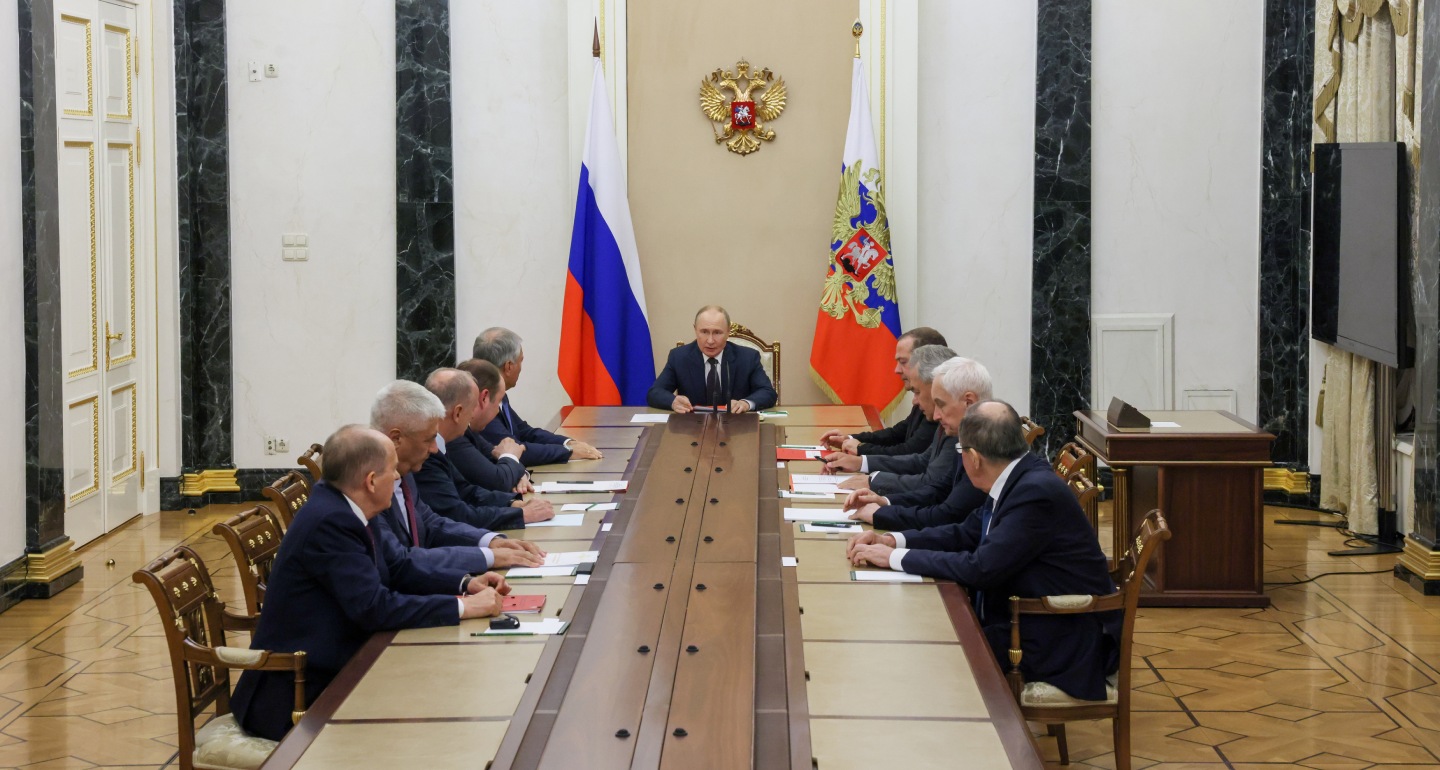
The ruling elites in contemporary Russia are not a political class, but a community of managers who are not subject to competition or public accountability. The state is becoming an operating apparatus without any internal autonomy.

Alexandra Prokopenko
How did Putin co-opt Russia’s political and economic elites, ensuring no more than fitful resistance to the regime’s war on Ukraine?
Alexandra Prokopenko