

Commentary
Alexander Gabuev, Temur Umarov
{
  "authors": [
    "Temur Umarov"
  ],
  "type": "commentary",
  "centerAffiliationAll": "",
  "centers": [
    "Carnegie Endowment for International Peace",
    "Carnegie Russia Eurasia Center"
  ],
  "collections": [],
  "englishNewsletterAll": "",
  "nonEnglishNewsletterAll": "",
  "primaryCenter": "Carnegie Endowment for International Peace",
  "programAffiliation": "",
  "programs": [],
  "projects": [],
  "regions": [
    "Central Asia",
    "Kazakhstan"
  ],
  "topics": [
    "Economy"
  ]
}
Source: Getty
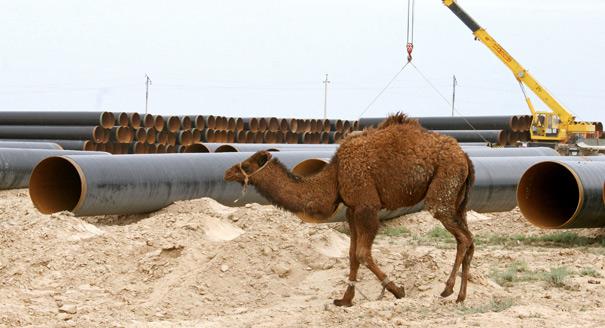
For Kazakhstan, cordial relations with the United States are an important part of its strategy for counterbalancing Russian and Chinese influence.
Wedged between Russia and China—the two biggest powers in Eurasia—Kazakhstan also manages to play the role of the United States’ biggest partner in Central Asia. In maintaining consistently good relations with Russia, China, and the United States all at the same time, Kazakhstan is performing a unique diplomatic balancing act. Yet as the confrontation worsens between the global powers, it’s becoming increasingly difficult for Kazakhstan to maintain that geopolitical balance without getting drawn into the fray.
Kazakhstan is unquestionably one of Russia’s greatest allies. It unfailingly takes part in all of Moscow’s integration projects, such as the Commonwealth of Independent States, the Shanghai Cooperation Organization, the Eurasian Economic Union (EEU), and the Collective Security Treaty Organization (CSTO). Russian President Vladimir Putin has visited Kazakhstan twenty-eight times during his long reign: more than any other country.
At the same time, Kazakhstan is also China’s main partner in Central Asia, and a key participant of Beijing’s grand regional initiatives. It was in Kazakhstan that the Chinese leader Xi Jinping first announced the launch of the land part of China’s epic Belt and Road Initiative.
The relationship between the United States and the Central Asian countries is not what it once was. The Central Asian states no longer see America as a counterbalance to Russia and China, and Washington has lost interest in the region. U.S. attempts to influence political developments have hit a wall; economically, the region is not so attractive; and with the U.S. withdrawal from Afghanistan, military ties are also becoming weaker.
Kazakhstan, however, is bucking this regional trend. Its relationship with Washington was never centered on Afghanistan or building democracy, but on economic factors. U.S. companies are leading producers in Kazakhstan’s oil industry, which contributes up to 44 percentof the country’s budget. In 2019, they accounted for about 30 percent of the total oil extracted in Kazakhstan, compared with about 17 percent produced by China’s CNPC, Sinopec, and CITIC, and 3 percent by Russia’s Lukoil.
Kazakhstan’s trade turnover with the United States (almost $2 billion in 2020) can’t be compared with its turnover with China ($21.4 billion), or with Russia ($19 billion). But it’s still three times the size of the trade with the United States that all the other Central Asian states do put together (about $0.6 billion).
Washington viewed Kazakhstan as its priority partner in Central Asia right from the start. It was the first foreign government to open an embassy there, and then president Nursultan Nazarbayev was the first president from Central Asia to visit the United States. There are regular summits between the two countries’ foreign ministers, as well as on energy and science and technology.
Since 2003, Kazakhstan has held annual military drills with NATO, dubbed Steppe Eagle, and from 2004 to 2019, the United States supplied Kazakhstan with $43 million worth of arms: more than all the other countries in the region put together. The close cooperation between Kazakhstan and the United States is also helped by the fact that the anti-Western narrative inherent in Russia and some other former Soviet countries is absent from Kazakh state ideology and rhetoric.
For Kazakhstan, cordial relations with the United States are an important part of its strategy for counterbalancing Russian and Chinese influence, since both of its giant neighbors periodically give the Kazakh leadership cause for concern. Putin, for example, has described former Soviet territory that is now part of independent countries as “generous gifts from the Russian people.” Moscow has also criticized the Kazakh authorities for allowing the transit of U.S. goods through its ports en route to Afghanistan, and agreeing to the Pentagon financing the reconstruction of two biological laboratories in Kazakhstan, among other things.
China has also alarmed Kazakhstan in the past, such as with the publication last year of an article titled “Why Kazakhstan Is Eager to Return to China,” alleging that the territory of Kazakhstan historically belongs to China.
Part of Kazakhstan’s strategy for dealing with such utterances is to maintain friendly relations with Russia, China, and the United States, enabling it to exchange favors for its loyalty. Washington, for example, continues to cooperate with Kazakhstan, despite all of the latter’s problems with democracy and human rights. Moscow supplies Kazakhstan with arms, and China has since 2018 granted Kazakh agricultural producers access to its enormous domestic market.
The flip side of this maneuvering is that each power constantly invites Kazakhstan to take sides. Moscow is the most active in this regard, even though Nur-Sultan rarely supports it in international affairs, and tries to remain neutral. It does not recognize Crimea as Russian territory, for example, yet President Kassym-Jomart Tokayev rejects the term “annexation.” Nor will Kazakhstan join in with Russia’s counter-sanctions, arguingthat Western sanctions are politically motivated and directed against individual states rather than the EEU as a whole.
China would also like to see Kazakhstan on its side in its standoff with the United States. On the contentious subject of the treatment of the Uyghurs in Xinjiang, Kazakhstan refuses to believe the reports of mass persecution. On the other hand, it has not signed letters in support of Chinese policy there (as Russia has), and has recently provided asylumfor Chinese refugees who have illegally crossed the border into Kazakhstan.
Nor is the United States above seeking solidarity from Kazakhstan, especially in the confrontation with China, and particularly under the Trump administration. When then secretary of state Mike Pompeo visited Kazakhstan in February 2020, he spoke of little other than how important it was for the country to resist Chinese influence.
As the confrontation between China and the United States grows, it’s getting harder and harder for Kazakhstan to maintain its equilibrium. Yet there’s no other option than to remain on friendly terms with everyone while maintaining a certain distance from them all. The great powers have no way of forcing Kazakhstan to demonstrate absolute loyalty to any one of them.
Russia and China are going nowhere—quite literally. And Russia has no interest in burning its bridges with one of its last remaining loyal partners, without whom it’s impossible to imagine either the EEU or the CSTO.
For Beijing, it’s important that a large neighbor of the Xinjiang Uyghur Autonomous Region should remain conducive to stability in the region, allow in Chinese investors, and carry out a crucial transit function among China, the post-Soviet space, and Europe. Kazakhstan also plays a key role in Xi’s flagman infrastructure project, the Silk Road Economic Belt.
For the United States, Kazakhstan is its only partner in Central Asia that has an interest in a U.S. presence, and whose decisions aren’t constantly changing in pursuit of short-term advantages, like Kyrgyzstan or Uzbekistan under its former president Islam Karimov.
This balancing act is at the heart of Kazakhstan’s foreign policy strategy, and any attempts from the outside to overturn it would encounter fierce opposition. This course of action is unlikely to change in the foreseeable future, despite the ongoing transition of power. Indeed, Kazakhstan’s second president is the living embodiment of that course: Tokayev is a Sinologist who studied at the prestigious Moscow State Institute of International Relations (MGIMO), and who forged his diplomatic career at the United Nations.
This article was published as part of the “Relaunching U.S.-Russia Dialogue on Global Challenges: The Role of the Next Generation” project, implemented in cooperation with the U.S. Embassy to Russia. The opinions, findings, and conclusions stated herein are those of the author and do not necessarily reflect those of the U.S. Embassy to Russia.

Fellow, Carnegie Russia Eurasia Center
Temur Umarov is an expert on China and Central Asia, and a fellow at the Carnegie Russia Eurasia Center.
Recent Work

Alexander Gabuev, Temur Umarov
Temur Umarov
Carnegie does not take institutional positions on public policy issues; the views represented herein are those of the author(s) and do not necessarily reflect the views of Carnegie, its staff, or its trustees.
Even if the Iran war stops, restarting production and transport for fertilizers and their components could take weeks—at a crucial moment for planting.

Noah Gordon, Lucy Corthell
Tehran’s attacks are reshaping the security situation in the Middle East—and forcing the region’s clock to tick backward once again.

Amr Hamzawy
Only collective security can protect fragile economic models.

Andrew Leber
In a volatile Middle East, the Omani port of Duqm offers stability, neutrality, and opportunity. Could this hidden port become the ultimate safe harbor for global trade?
Giorgio Cafiero, Samuel Ramani
Arguing that Chinese policy is hung on alliances—with imputations of obligation—misses the point.

Evan A. Feigenbaum