

Commentary
Andrei Kolesnikov
{
  "authors": [
    "Andrei Kolesnikov"
  ],
  "type": "other",
  "centerAffiliationAll": "dc",
  "centers": [
    "Carnegie Endowment for International Peace"
  ],
  "collections": [],
  "englishNewsletterAll": "ctw",
  "nonEnglishNewsletterAll": "",
  "primaryCenter": "Carnegie Endowment for International Peace",
  "programAffiliation": "russia",
  "programs": [
    "Russia and Eurasia"
  ],
  "projects": [],
  "regions": [
    "Russia",
    "Eastern Europe",
    "Ukraine"
  ],
  "topics": [
    "Political Reform",
    "Foreign Policy"
  ]
}
Source: Getty
Those who approve or stay silent bear, at the very least, collective responsibility for what is happening in their own country and what the state is doing.
“Let others shout in despair,
In outrage, in pain, in hunger!
For we know it pays to stay silent,
For silence, after all, is golden!”
Alexander Galich, The Gold Prospector’s Waltz, 1963
Knowledge of what had happened at Auschwitz was a wake-up call for the post-war German public, which had not wanted to hear anything about it while the war was on. Since February 24, the Russian public has also refused to know anything, barricading itself off from the world behind the letter Z—which in Russia has become a symbol of the war—like a crucifix that might ward off evil.
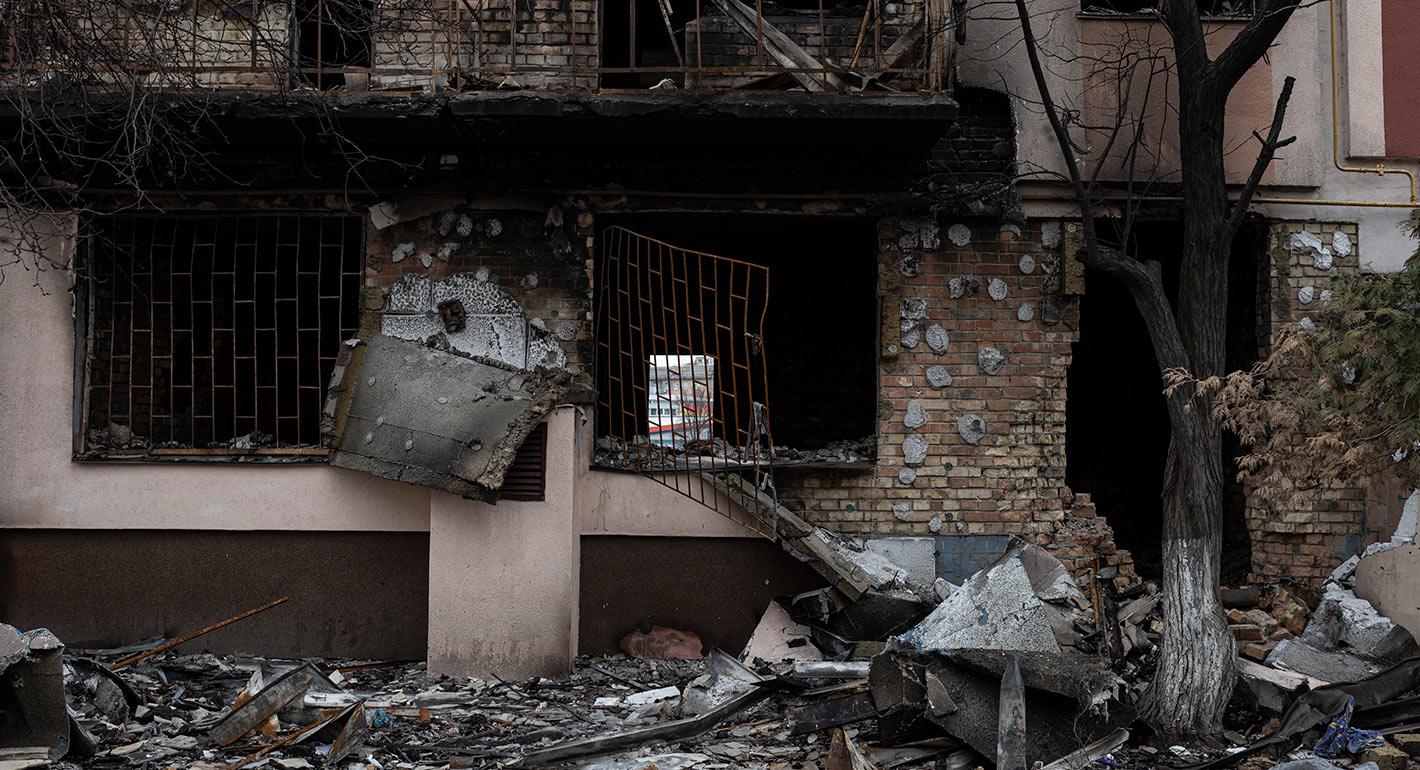
There is no certainty that knowledge of what has been going on in the Ukrainian cities of Mariupol and Bucha will be a wake-up call for Russians that forces them to think about peace in terms of repentance. Despite Theodor Adorno’s assertion that after Auschwitz, writing poetry had become impossible, after Auschwitz and the Babi Yar massacres of Jews by the Nazis in Ukraine, plenty of good poetry was written. After the bombing of Guernica by Nazi Germany’s Condor Legion in 1937, Picasso produced his iconic painting of the same name. After Mariupol, talk shows on Russian state TV channels continue to spew hate at the entire rest of the world.
The tragedy of a nation that has a priori vindicated the ideology of Putinism is that there will be no one in Russia to repent for Mariupol. The historicism of Putinism, its ideological focus on the past and on whitewashing the darkest pages of the country’s history, knows only heroes, not victims. As a result, the cult of Russia’s victory in World War II has turned not into a lesson on avoiding war, but into a cult of war itself. The lessons of history have been distorted, turned inside out, debased, and turned into agitprop.
Putinist ideology is entirely lacking in any positive content. It has no positive goals or image of the desired future. The whole identity of Putinists is based on something negative, and so militarism is an important part of it. Under this kind of ideology, a hero is not Yury Gagarin, the first man in space, but a nameless thug going by a moniker, such as “Motorola,” the Russian Donbas fighter. Someone who, instead of paving the way to a humanistic future, has driven us back into an archaic past, complete with trenches, blood, lice, and murders.
Killing and violence are being heroicized. The main institutions of trust are becoming institutions of violence: the army and the FSB secret police. And all of this is blessed by the official Russian Orthodox Church. If in Soviet times, destruction for the sake of lofty goals was sanctioned by the propaganda department of the Communist Party’s central committee, now it is done by the Church.
An ideology that involves the idea of a unified Russian nation that also includes Ukrainians has killed that idea, having created a negative identity for Ukrainians. After Bucha and Mariupol, there can be no unified nation, ever. And Russians will bear the stigma of the people who allowed Putinism to come to pass, and who supported it.
With this, the question arises of guilt and responsibility, including collective guilt and responsibility for what has happened between Ukraine and Russia. For the fact that Russia has been cast back into the same moral state as during the most repressive and paranoid years of the Stalinist terror, when denouncing another person was considered a virtue and a duty, when black was white. For the fact that Russia is undergoing an anthropological catastrophe.
Normal feelings for a normal citizen of the Russian Federation—not a subject of Vladimir Putin—are a dreadful internal inferno of horror and shame. Shame for what Putin has done, and for the boneheaded obduracy with which many of our compatriots support him, profaning the very concept of patriotism in doing so. The majority, led by the female death squad headed by state media mouthpieces Olga Skabeyeva and Margarita Simonyan and Foreign Ministry spokeswoman Maria Zakharova et al, are not ashamed. On the contrary, they are gleeful. The minority is ashamed, both for themselves, and for these cheerleaders of death.
These same emotions were felt by people who retained the ability to think, doubt, and feel compassion in 1968, when Soviet tanks rolled into Prague during the invasion of Czechoslovakia. Back then, just like now, people were also detained and convicted simply for unfurling a placard. Putin’s Russia, however, has left the Brezhnev era in the dust in terms of the number of its victims and arrests.
Back in 1968, the dissident Larisa Bogoraz took part in a demonstration on Moscow’s Red Square against the invasion. In her final statement at her trial in October that year, she said something very important that remained relevant for many years to come, and is important once again today.
“For me, it wasn’t enough to know that they didn’t have my voice supporting them. For me, it mattered that they wouldn’t hear my voice against it … If I hadn’t done it [protested on August 25, 1968], I would have considered myself responsible for those actions by the government, just as all adult citizens of our country bear responsibility for all the actions of our government.”
In a free and democratic Russia, schoolchildren should have had to learn these words off by heart, and August 25 should have been celebrated as the anniversary of the awakening of a national conscience. But instead, schoolchildren live in a different Russia: one where the truth is derided as a fake, and where those children are taught to denounce “national traitors.”
After being rudely interrupted by the judge, Bogoraz continued: “There was one other consideration I had against going to the demonstration … That was the practical futility of the demonstration, that it would not change the course of events. But in the end, I decided that for me, it was not a question of what good it would do, but of my personal responsibility.”
Similarly, the dissident Soviet songwriter Alexander Galich sang “How many times were we silent in various ways—and not ‘against,’ of course, but ‘for.’” For him, silence, just as in Bogoraz’s interpretation, is complicity with the actions of the regime.
Under Larisa Bogoraz’s logic, therefore, those who approve or stay silent bear, at the very least, collective responsibility for what is happening in their own country and what the state is doing. And this, most likely, is the difference between collective guilt and collective responsibility: something the philosopher Hannah Arendt wrote about a lot in her work on the responsibility of Germans following World War II.
“In post-War Germany … the cry ‘We are all guilty’ that at first hearing sounded so very noble and tempting has actually only served to exculpate to a considerable degree those who actually were guilty. Where all are guilty, nobody is,” Arendt wrote in her article “Collective Responsibility,” drawing a line between political (collective) responsibility and moral and/or legal guilt. Which is not to absolve the German people of responsibility for what happened.
All of this is yet to come for the Russian people, who are already equated with 1930s-40s Germans in the eyes of public opinion in much of the world (not only in the West). In the quest for “denazification,” they have acquired the infamy of “nazifiers.”
In extreme situations, such as Putin’s “special military operation,” any silence is for, not against. This is the case for collective responsibility. This is why the majority—the so-called public opinion—doesn’t want to believe in “fakes” (i.e., the truth) and justifies Putin’s actions.
Passive conformity is no less terrible than active and aggressive conformity. Collective lack of responsibility (“it has nothing to do with me”) gives rise to collective responsibility. It’s collective voluntary blindness. The nation follows Putin like the blind leading the blind. When a nation becomes blind, deaf, and dumb, Mariupol and Bucha become possible.
This is what in Nazi times was termed Gleichschaltung: the cowardly adaptation of ordinary people to the political regime in which they exist. The German philosopher Jürgen Habermas described it as the “voluntary switching to the prevailing ideology.” The concept characterized the mass consciousness of the nation from 1933, when Hitler became chancellor. A similar phenomenon was seen under Stalin, and in the twilight years of the Soviet Union.
Gleichschaltung explains the latest polls, which show that 80 percent of Russians support their country’s “special military operation.” Not all of those who said they backed it really support the fighting, destruction, and killing, of course. But in saying that they do, they have joined the silent “for,” so we must take these numbers seriously.
Larisa Bogoraz also talked about this in her final statement in court. “The prosecutor finished his speech by suggesting that the sentence he seeks will be approved of by public opinion … I don’t doubt that public opinion will approve of this sentence, just as it has approved similar sentences before, as it would approve any sentence … Public opinion will approve a guilty verdict, firstly because we will be presented to it as parasites, as heretics, and transmitters of an enemy ideology. And secondly, if anyone does have an opinion that differs from the ‘public’ one and finds the courage to express it, they will soon find themselves standing where I am.”
If a nation ever stops to think about what has happened to it, and what has been done with its consent, it will find thousands of ways to justify it. Of what she called the “mob man,” Arendt wrote: “when his occupation forces him to murder people, he does not regard himself as a murderer because he has not done it out of inclination but in his professional capacity. Out of sheer passion he would never do harm to a fly,” she wrote in her article “Organized Guilt and Universal Responsibility.”
This explains both the rally at Moscow’s Luzhniki stadium in support of the war, and the scenes in Bucha, as well as the 80 percent of people who support the war or are silent. “It’s nothing to do with us.” “That’s just the way things have worked out.” “We were told that there are Nazis there.” “We were just carrying out orders.” “We were afraid of losing our jobs.” “We had a mortgage to pay.”
And indeed, there was nothing they could do. Because they voluntarily gave up free elections and democracy: a tool for maintaining the nation’s conscience and ensuring the efficiency of the administration. Because they stopped thinking, and made endless compromises. And those compromises ended in the disaster of a general Gleichschaltung.
A version of this article was first published in Russian in The New Times.
Former Senior Fellow, Carnegie Russia Eurasia Center
Kolesnikov was a senior fellow at the Carnegie Russia Eurasia Center.
Recent Work
Andrei Kolesnikov
Andrei Kolesnikov
Carnegie does not take institutional positions on public policy issues; the views represented herein are those of the author(s) and do not necessarily reflect the views of Carnegie, its staff, or its trustees.

A leak of Russian gas price data helps establish that China is paying Russia far less than Central Asian countries and Gazprom’s former European customers.

Sergey Vakulenko

China’s political future will be shaped between now and next October. As the Communist Party enters its intense “campaign season” to prepare for a major political transition in 2027, reading Beijing's actions and responses may become more difficult as domestic politics weigh on its behavior more than usual.

Damien Ma

The EU can impose sanctions but struggles to enforce them without the United States. With Washington increasingly disinterested in backing European interests, the bloc must now fend for itself.


Nicu Popescu, Tiago Antunes
Global and rising powers will need to engage with Africa’s priorities and agency in order to secure the continent’s increasingly attractive partnerships.
Fonteh Akum

Rubio’s recent visit brought welcome attention, but more capital requires governance changes that may be a hard sell for regional governments.

Jennifer B. Murtazashvili