

Article
Kenji Kushida
{
  "authors": [
    "Kenji Kushida"
  ],
  "type": "commentary",
  "centerAffiliationAll": "dc",
  "centers": [
    "Carnegie Endowment for International Peace"
  ],
  "collections": [],
  "englishNewsletterAll": "asia",
  "nonEnglishNewsletterAll": "",
  "primaryCenter": "Carnegie Endowment for International Peace",
  "programAffiliation": "AP",
  "programs": [
    "Asia"
  ],
  "projects": [],
  "regions": [
    "East Asia",
    "Japan"
  ],
  "topics": [
    "Political Reform",
    "Democracy"
  ]
}
Source: Getty
An underappreciated aspect of Abe Shinzo’s administration was in creating specific, forward-looking, actionable goals involving innovation, technology, and start-up ecosystems.
Former prime minister Abe Shinzo’s legacy will continue to shape Japan’s trajectory for years to come. The country’s longest-serving prime minister leaves much to analyze: his leadership, the forces that shaped his administration, and his final impact. As numerous scholars, observers, and those close to him reflect on his legacy and the power vacuum he leaves, here I focus on his legacy from a technology and innovation perspective.
Abe’s remarkable success began with a spectacular setback. In 2006, Abe became the youngest prime minister in the postwar era at age fifty-two, yet he ended up stepping down only a year later. His approval ratings sank during a massive bureaucratic scandal, with a shocking number of citizens’ pension records (50 million) getting lost in the transition to digital records. He was also criticized for allowing the old guard back into the Liberal Democratic Party (LDP) after his immensely popular predecessor, Koizumi Junichiro, had expelled those who opposed his reform agenda. Abe at that time did not have a strong economic policy, and was unable to manage the internal coalition dynamics of the LDP.
Yet, that failure was not game over—it was an opportunity for learning.
Five years and five prime ministers later, after the LDP lost power in an election for the first time since it took power in 1955, Abe staged an improbable comeback. He had spent the time out of office surrounding himself with a group of sharp-minded and strategic advisers. Even though he was from a powerful political dynasty, that alone did not guarantee a successful comeback.
Abe had an unusually catchy economic plan promising bold action after several years in which Japan had lacked strategic visions for economic growth. “Abenomics” framed reform as an easy-to-understand “three arrows” metaphor, promising monetary expansion, aggressive fiscal spending, and structural reforms. Economists’ evaluations of Abenomics are largely positive, despite the real risks of expanding Japan’s fiscal deficit. The first annual economic growth strategy document in 2013 was titled “Japan Is Back,” a surprisingly optimistic title given the economic situation at the time. The Abe government presided over a period of sustained recession-free economic growth (albeit at a low rate), robust stock market value increases, and rising corporate profits until the pandemic hit in 2020.
In the foreign policy realm, Abe coupled a nationalist vision of a strong Japan with successful management of the U.S.-Japan security relationship and promoting a “Free and Open Indo-Pacific,” a rare recent occasion when a Japanese framing became popular in Washington and elsewhere. Despite protests erupting over national security legislation passed in 2015 that essentially reinterpreted the constitution to allow a greater role of the Self-Defense Forces, Abe also aggressively developed a personal relationship with Donald Trump upon the latter’s electoral victory in order to cement the security alliance.
The Abe administration was notable for strengthening the power of political leadership, especially the prime minister’s office, over elite bureaucracies—a long-standing power struggle that had been tilting toward political leadership for the past couple of decades.
Abe was also very polarizing. Many Japanese and non-Japanese journalists and free speech advocates were outraged at the pressure his administration exerted on the media. Yet, his second administration enjoyed an unusually long period of popular support, in a context where approval ratings dipping below disapproval ratings almost inevitably quickly lead to a new prime minister.
In the technology and innovation realm, Abe’s administration took steps previously unseen in Japan. The third arrow of Abenomics included a large number of key performance indicators (KPIs) that had specific numerical targets and target dates. Despite the political logic of avoiding numerical targets for fear of criticism if they are not met, the third arrow of Abenomics contained approximately 100 to 150 specific KPIs each year from 2013 to 2020.
Some were fairly obvious and were likely to be achieved without any government action, such as “by 2020, extend the ‘healthy lifespan’ of citizens by more than one year” (2013 KPI). Several KPIs were aspirational, such as those aiming to increase the number of women in upper management: “By 2020, achieve 10 percent female executive officers across all listed companies,” and “by 2020, achieve a 15 percent female ratio for manager-level positions across all private sector firms” (2013 KPIs). (A comprehensive English translation and longer analysis is forthcoming from the Carnegie Endowment for International Peace. Excerpts of KPIs in English may be found here.)
Many of the KPIs were achieved—roughly 40 percent according to our forthcoming analysis—while many were updated with new goals (25 percent). Plenty were not achieved while others disappeared along the way, such as aiming for more women in executive officer positions.
Taken together, these KPIs painted a very specific picture of where Japan was headed—a focal point for government policy and private sector action. In particular, the technology deployment KPIs were refreshing—for example, “by 2030, utilize sensors and robots to efficiently conduct high level inspections and repairs for all domestic critical and ageing infrastructure” (2013), and “by 2025, almost all agricultural work utilizes data” (2017). Some had longer time horizons, such as “by 2030, enable more than 100 locations nationwide with local autonomous driving services achieved” (2018). Others were quite immediate, and likely included because private sector actors were just about to accomplish them: “by 2015, commercialize fuel cell vehicles” appeared in 2013, and Toyota released its hydrogen fuel cell powered car the following year, achieving the KPI.
Some elite government officials viewed these KPIs as a mechanism for the Abe administration to increase its power over elite bureaucracies by forcing them to set and pursue concrete goals. Beyond that, however, the KPIs helped provide beacons to the private sector by highlighting the government’s aspirations and trajectory.
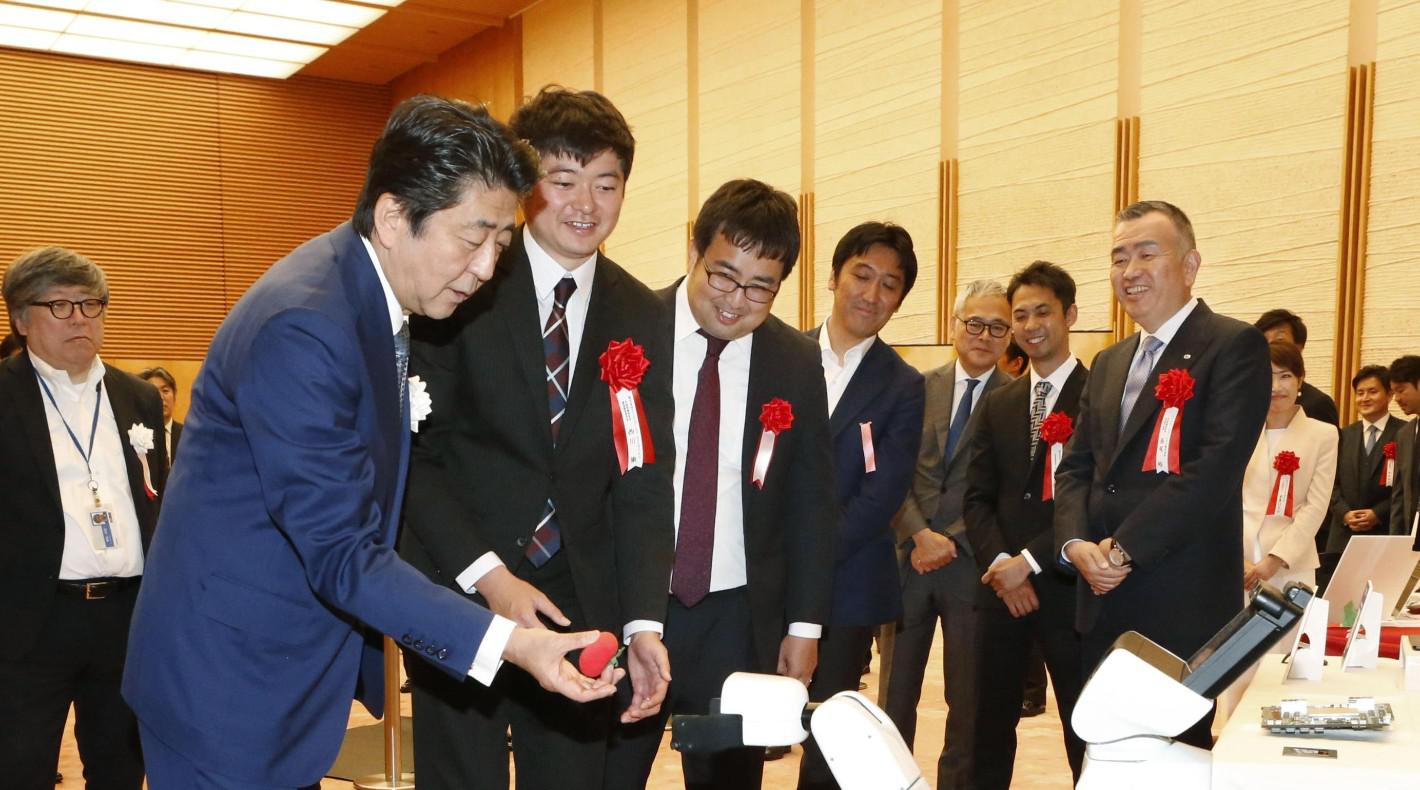
Several KPIs pertained to the start-up ecosystem, like increasing the amount of venture capital available in Japan. This, along with other measures taken by the Abe administration such as the annual award to promising start-ups, served to legitimize the start-up ecosystem and its participants in a way that no previous administration had done.
While the KPIs were not widely advertised or touted, their specificity and ambition provided a series of concrete visions that go well beyond the common narrative of “lost decades.” After a series of fourteen prime ministers between 1991 and 2011, Abe’s almost eight years in office provided a degree of stability that allowed long-term strategic plans, many of which had five-, ten-, or fifteen-year achievement timelines. It was also a focal point for private-public partnerships, where the private sector could expect support from, or at least active discussions with, parts of the government that had put forth specific technological goals.
Japan faces many challenges, but one of Abe’s legacies in the technology and innovation arenas includes a much needed forward-looking, realistic, and ambitious set of concrete visions that help build a far more global and innovative narrative for Japan than is commonly assumed—a narrative that Carnegie’s Asia Program will continue to explore.

Senior Fellow, Asia Program
Kenji Kushida is a senior fellow in Carnegie’s Asia Program, primarily directing research on Japan along the theme of Innovative Japan, Global Japan, including the new Japan-Silicon Valley Innovation Initiative@Carnegie.
Recent Work
Kenji Kushida
Kenji Kushida
Carnegie does not take institutional positions on public policy issues; the views represented herein are those of the author(s) and do not necessarily reflect the views of Carnegie, its staff, or its trustees.

China’s political future will be shaped between now and next October. As the Communist Party enters its intense “campaign season” to prepare for a major political transition in 2027, reading Beijing's actions and responses may become more difficult as domestic politics weigh on its behavior more than usual.

Damien Ma

Japan’s long-term security policy is driven by concerns about China, and there is little appetite for (or interest in) pursuing a confrontation with Moscow.

James D.J. Brown

China has showcased its engineering prowess with small modular reactor demonstration projects. But turning these technological achievements into commercial success will be a greater challenge.

Tong Zhao

Putin’s conservative staffing policies and search for ever greater control have cemented parliament’s transformation into a bureaucratic appendage of the executive branch.

Andrey Pertsev

Ex-president Gurbanguly Berdimuhamedov remains interested in politics, but his son Serdar, Turkmenistan’s current president, is becoming increasingly independent and willing to break with his father’s legacy. If their covert rivalry goes too far, both risk losing power.

Galiya Ibragimova