

Commentary
Oliver Stuenkel, Adrian Feinberg
{
  "authors": [
    "Oliver Stuenkel"
  ],
  "type": "commentary",
  "centerAffiliationAll": "dc",
  "centers": [
    "Carnegie Endowment for International Peace"
  ],
  "collections": [],
  "englishNewsletterAll": "democracy",
  "nonEnglishNewsletterAll": "",
  "primaryCenter": "Carnegie Endowment for International Peace",
  "programAffiliation": "DCG",
  "programs": [
    "Democracy, Conflict, and Governance"
  ],
  "projects": [],
  "regions": [
    "North America",
    "South America"
  ],
  "topics": [
    "Political Reform",
    "Democracy"
  ]
}
Source: Getty
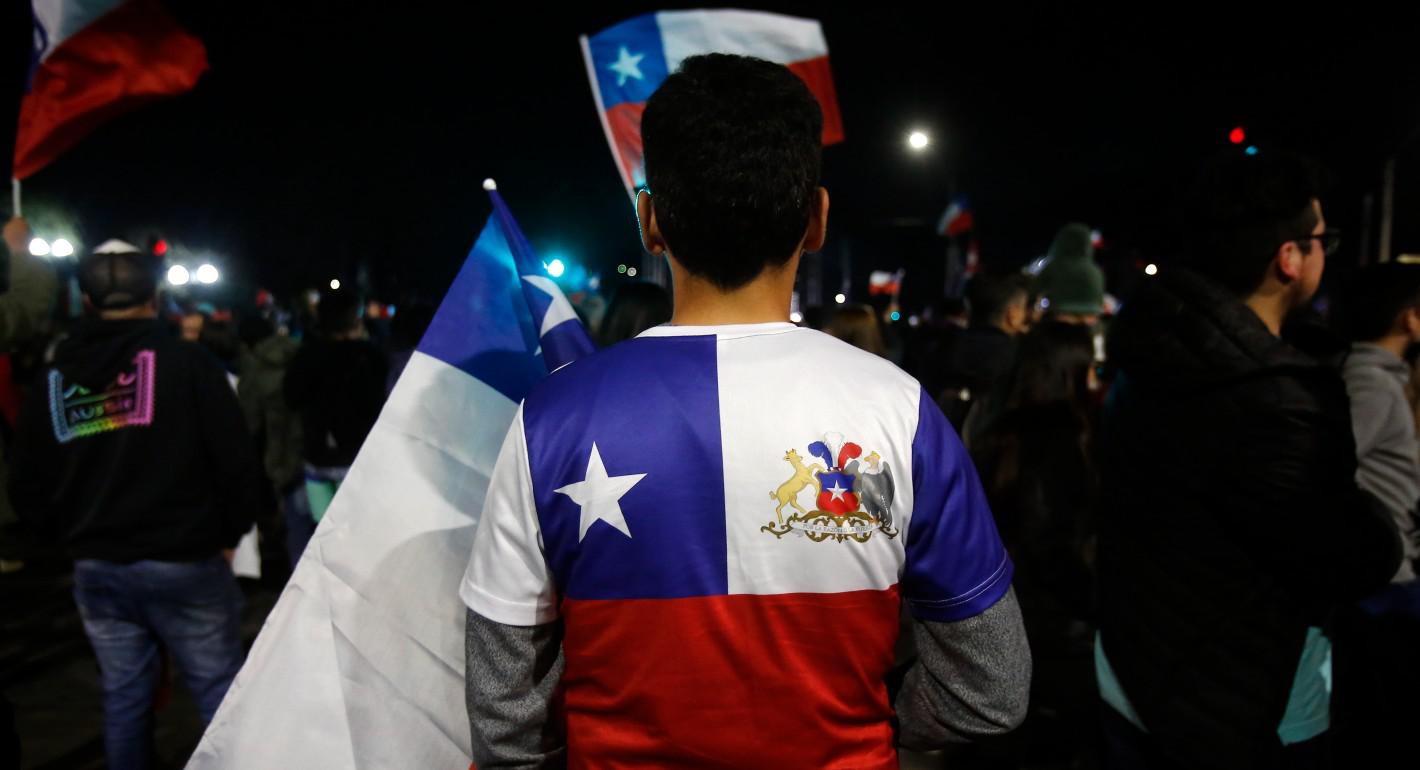
The utopian proposal must give way to a more moderate vision, voters say.
When Chile experienced mass protests in late 2019, many feared the country could be pulled into the vortex of polarization and political instability that Latin American countries often experience after large-scale upheaval. After millions of angry Brazilians took to the street in 2013, for example, the country entered a period of extreme polarization that contributed to the emergence of an antiestablishment president with authoritarian tendencies. In the same way, the traumatic instability in the aftermath of the 2019 elections in Bolivia deepened polarization further. Neither Brazil nor Bolivia have been able to address the root causes that led to public discontent and could very well experience similar bouts of public protests in the future.
Chile, on the other hand, has sought an alternative tonic to discontent, embarking on a risky but courageous path to rewrite the constitution in an effort to better address the many challenges the country faces, ranging from profound inequality, a lack of social mobility, and insufficient public services. After a remarkably broad and inclusive debate about the best path forward, voters approved, in October 2020, the creation of a constituent assembly, which included reserved seats for Indigenous candidates and, in a global first, gender parity. In what perhaps proved to be the most controversial element, the largest bloc of the 155 members of the constituent assembly were independents, most of whom had very limited political experience.
In retrospect, the strong presence of politically inexperienced independents and the large number of leftists in the special assembly—a reflection of the strong rejection of the center-right government under Sebastián Piñera—was crucial to explain why the constituent assembly presented, after months of deliberations, a constitution that was largely described as unwieldy and “utopian” and that could put at risk the country’s many achievements, particularly in the economic realm, over the past decades. It included numerous rights—such as to “neurodiversity” and “digital disconnection”—that were seen as bizarre by many Chileans. Ignoring the fact that most Chilean voters identify as centrists, members of the constituent assembly turned out to be overconfident that citizens would approve their draft: indeed, over the past centuries, the vast majority of constitutional plebiscites approved the texts put up for the vote. Most voters likely approved of the constitution’s progressive character, but its vagueness, sheer length—with 388 articles and 57 transitional clauses—and the legal insecurity it would have produced explain why it was soundly rejected in the constitutional plebiscite on September 4. Those who dislike the old constitution from Augusto Pinochet’s era but also had concerns about the new version were encouraged to vote “no” after leftist President Gabriel Boric signaled that he’d be open to discuss an alternative version if the draft presented by the constituent assembly were rejected.
While critics may be right to point out that Chile wasted three precious years during which investors naturally adopt a more cautious approach, uncertain about what kind of constitution the country would eventually adopt, the public debates since the wave of protests in 2019 also produced tangible gains and led to broad consensus in areas such as Indigenous rights and women’s rights. At the same time, perhaps most encouragingly, the result—a rebuke for Boric’s support for the “approve” campaign—did not produce animosity or polarization. The president, who had publicly supported the document prior to the plebiscite, recognized the need for “a constitution that unites the country.”
Boric and members of Chile’s Senate and National Congress now face two significant challenges: First, they need to articulate a process to come up with a new constitutional draft that is seen as legitimate by the population. Second, they must move quickly to avoid a situation where citizens and international investors lose patience, negatively affecting the country’s growth prospects at a time when the economic uncertainty in China has put pressure on the global price of copper, of which Chile is the world’s largest producer.
The chances are relatively high that a new draft will be a better one than the current one. It is unlikely that Chile’s president and legislators will repeat the mistakes made during the first constitutional process. “It will be a ‘woke’ text, but not a state-centric text,” predicts Patrício Navia, a Chilean professor of political science. Provided that he is right, Chile stands a chance to build a constitutional framework that attends popular demands for greater rights without affecting the country’s stellar reputation among international investors.
Significant risks, of course, remain. Despite Chile’s democratic maturity, political polarization deepened since the wave of protests that shook the country in 2019. During the weeks prior to the plebiscite, fake news flooded social media in the country, including false information that the new constitution would allow abortions up to the ninth month of pregnancy and would abolish private property. Similar tactics may affect public opinion about the next drafting process, too. According to Marta Lagos of Latinobarómetro, a polling organization, August 2022 was “the dirtiest and most violent month of electoral campaigning that Chile has had since 1989.”
For an agreement to materialize, the extremes will have to be willing to negotiate. Numerous politicians on the right campaigned against a new constitution, arguing that the old one was just fine. Far-left leaders, most of whom supported the utopian draft rejected by voters on September 4, will have to accept settling for more moderate change. Boric, whose coalition includes both centrists and members of the Communist Party, will have to ensure that the topic does not lead to government infighting. If he succeeds, Chile’s reaction to the mass protests in late 2019 remains, despite the failed first attempt, a potential model for the region, where numerous countries remain stuck in a seemingly endless cycle of rage and regret.
Senior Fellow, Democracy, Conflict, and Governance Program
Oliver Stuenkel is an associate professor at the School of International Relations at Fundação Getulio Vargas (FGV) in São Paulo, Brazil. He is also a senior fellow affiliated with the Democracy, Conflict, and Governance Program at the Carnegie Endowment for International Peace.
Recent Work
Oliver Stuenkel, Adrian Feinberg
Oliver Stuenkel, Adrian Feinberg
Carnegie does not take institutional positions on public policy issues; the views represented herein are those of the author(s) and do not necessarily reflect the views of Carnegie, its staff, or its trustees.
Fatima El Mansouri is the country’s first female prime minister. She’s also a privileged insider in a largely ceremonial position.

Sarah Yerkes

The domestic impacts of how long it is taking to end the war in Ukraine have pushed the French electorate to the political extremes and compromised the country’s diplomatic capacity.

Rym Momtaz

Sergei Kiriyenko used Russia’s parliamentary vote to further hone his strategy of corporate mobilization that is designed to maximize votes for United Russia.

Andrey Pertsev

Before the next wave of EU enlargement takes place, the union needs to grapple with thorny questions of how power is distributed among its members.


Emil Sondaj Hansen, Ditte Brasso Sørensen

The European far right might fail to steer EU policy in the direction Russia wants, but they will create enough chaos inside Europe to benefit the Kremlin.

Dimitar Bechev