

Paper
Noah Gordon, Liana Schmitter-Emerson
{
  "authors": [
    "Noah Gordon"
  ],
  "type": "commentary",
  "centerAffiliationAll": "dc",
  "centers": [
    "Carnegie Endowment for International Peace"
  ],
  "collections": [],
  "englishNewsletterAll": "ctw",
  "nonEnglishNewsletterAll": "",
  "primaryCenter": "Carnegie Endowment for International Peace",
  "programAffiliation": "SCP",
  "programs": [
    "Sustainability, Climate, and Geopolitics"
  ],
  "projects": [],
  "regions": [
    "North America",
    "United States",
    "Western Europe"
  ],
  "topics": [
    "Climate Change"
  ]
}
Source: Getty
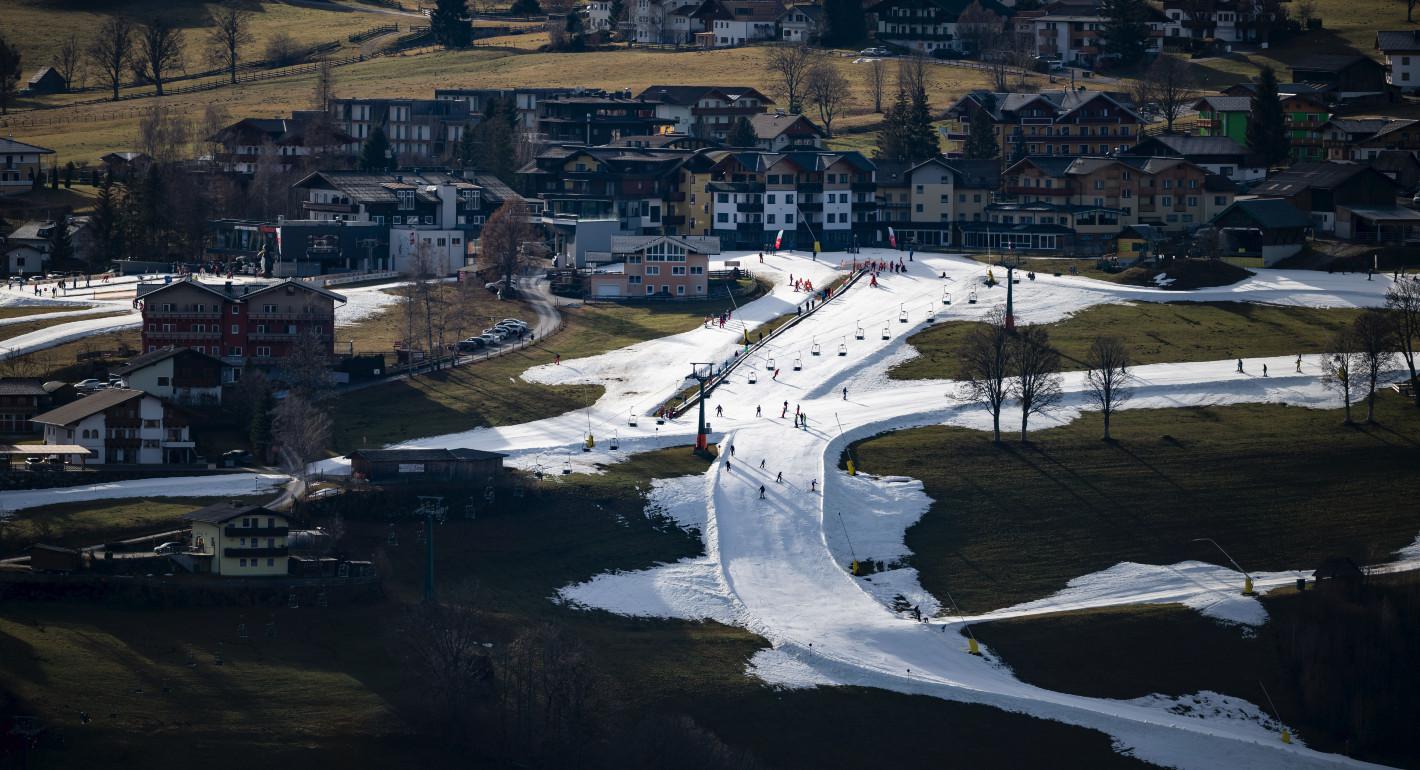
An aborted ski season in Switzerland is likely to do more to drive climate politics than a heat wave in India, even if the latter causes immensely more human suffering.
Among the various reasons why the threat of climate change fails to unite citizens in the same way that the threat of invasion or terrorism does is that poor and powerless people are much more vulnerable than the rich and powerful. People sitting in air-conditioned, open-plan kitchens tend not to die in heat waves, which climate change is making more extreme. People who can afford clean water and quality healthcare tend not to suffer from diseases like cholera, which climate change is making more prevalent. People with 401Ks tend not to go broke when the harvest fails.
But the images from the Alps this winter, where well-off tourists are shedding their jackets and skiing down depressingly narrow slopes of artificial snow, could disproportionately galvanize climate action. Direct climate impacts on the lives of the comfortable can help bring about political change in the capitals with the resources for mitigation and adaptation. That’s why an aborted ski season in Switzerland is likely to do more to drive climate politics than a heat wave in India, even if the latter causes immensely more human suffering.
The truth that the world’s elite are currently well insulated from direct climate impacts is an uncomfortable one, and various political actors have reasons for keeping it quiet. The scientists who write reports about climate impacts are careful only to make the reverse claim, writing sentences like “the most vulnerable people and systems are observed to be disproportionately affected,” or “observed impacts are concentrated amongst the economically and socially marginalized.” But it’s easy for the reader to flip these statements around. In addition, opponents of climate action are wary of saying the quiet part out loud. It’s more effective to argue that fears of climate catastrophe are generally overblown or that the economy will suffer if the government implements new climate regulations than to admit one’s indifference about what happens to people living next to coal mines or overflowing rivers.
Climate activists and policy advocates, meanwhile, have an interest in pretending that everyone should be equally concerned about climate change. They fear that overstating the potential of adaptation could discourage aggressive mitigation efforts—moral hazard. After all, it is technically possible to make more artificial snow in Switzerland or for the wealthy to fly to Norway to ski instead, but doing so does nothing to address the underlying climate problem and requires burning more fossil fuels. Many researchers and campaigners instead highlight second-order effects of droughts or floods—for example, the collapse of a climate-vulnerable country near the U.S. border and an ensuing exodus of refugees—or “securitize” the issue in order to justify emergency action to protect a low-lying military base, if not the neighboring public school.
However, with record temperatures leaving the Alps short on snow—and owners of mansions in the American West being told they can’t have lawns or fountains because of the megadrought, and some well-off Canadians and Australians being told their homes are becoming uninsurable due to flood and fire risk—direct climate impacts are becoming more of a factor in the circles of the powerful. Protesters responding to climate change are increasingly targeting the elite as well. The UK-based Tyre Extinguishes are vandalizing luxury SUVs, while the Dutch arms of Greenpeace and Extinction Rebellion recently rode their bicycles into Amsterdam’s Schiphol airport to shut down private jets.
Of course, climate change is not solely responsible for any of these weather-related damages. Some locals from the French Alps remember years back in the 1960s when there was hardly any snow, and meteorologists say that the ongoing La Niña event is partially responsible for the unprecedented heat in Europe this January. The main reason that hurricanes are doing more economic damage in the United States is that there are simply more people and more valuable buildings in harm’s way.
But the directness of the link between climate change and an individual weather event is less determinative of the political reaction than might be expected. According to Pew polling, most Americans who have faced extreme weather see a link to climate change. Perception is political reality, whether it’s shifting baseline syndrome making people think it’s always been this hot in the summer or people now attributing most environmental problems to human action or inaction. Because climate policy is now so salient, and because humans have so radically altered the planet that many scientists argue Earth has entered the new geologic era of the Anthropocene, many people understandably expect that humans have caused a given environmental problem—and believe that humans could and probably should do something to solve it.
Increasingly, those people are the rich and powerful. When the elite encounter environmental problems that they cannot buy their way out of, they will demand more public resources to limit the damage and more forceful policies for adaptation—such as the new and expensive program in parched Los Angeles County to capture rainwater before it runs into the Pacific. There will still be intense debates about how society should respond—restrictions on private jets to lower emissions, or diverting funding from community college professors to firefighters? But with climate change now coming for the elite, there will be greater agreement, from all classes of society, that something needs to be done.
Former Fellow, Sustainability, Climate, and Geopolitics Program and Fellow, Europe Program
Noah J. Gordon was a fellow in the Sustainability, Climate, and Geopolitics Program at the Carnegie Endowment for International Peace in Washington, DC.
Recent Work
Noah Gordon, Liana Schmitter-Emerson



Sophia Besch, Eric Ciaramella, Steve Feldstein, …
Carnegie does not take institutional positions on public policy issues; the views represented herein are those of the author(s) and do not necessarily reflect the views of Carnegie, its staff, or its trustees.

Despite public disputes over trade and immigration, the strategic partnership’s foundations remain sturdy.

Sameer Lalwani
It signals a new era of tech diffusion and warfare.
Steve Feldstein

Ahead of a tough winter for Ukraine, Donald Trump’s swing back toward Russia bodes ill. But instead of panicking, Kyiv’s European allies are focusing on action.

Rym Momtaz

Without a ceasefire with Ukraine on attacking each other’s energy infrastructure—to which the Kremlin is unlikely to agree—the diesel agreement between Putin and Trump is largely for show, rather than representing a genuine increase in the volumes of Russian diesel on the global market.

Sergey Vakulenko

Despite its flop at the box office, the film raises important questions for the climate community to answer.

Leonardo Martinez-Diaz