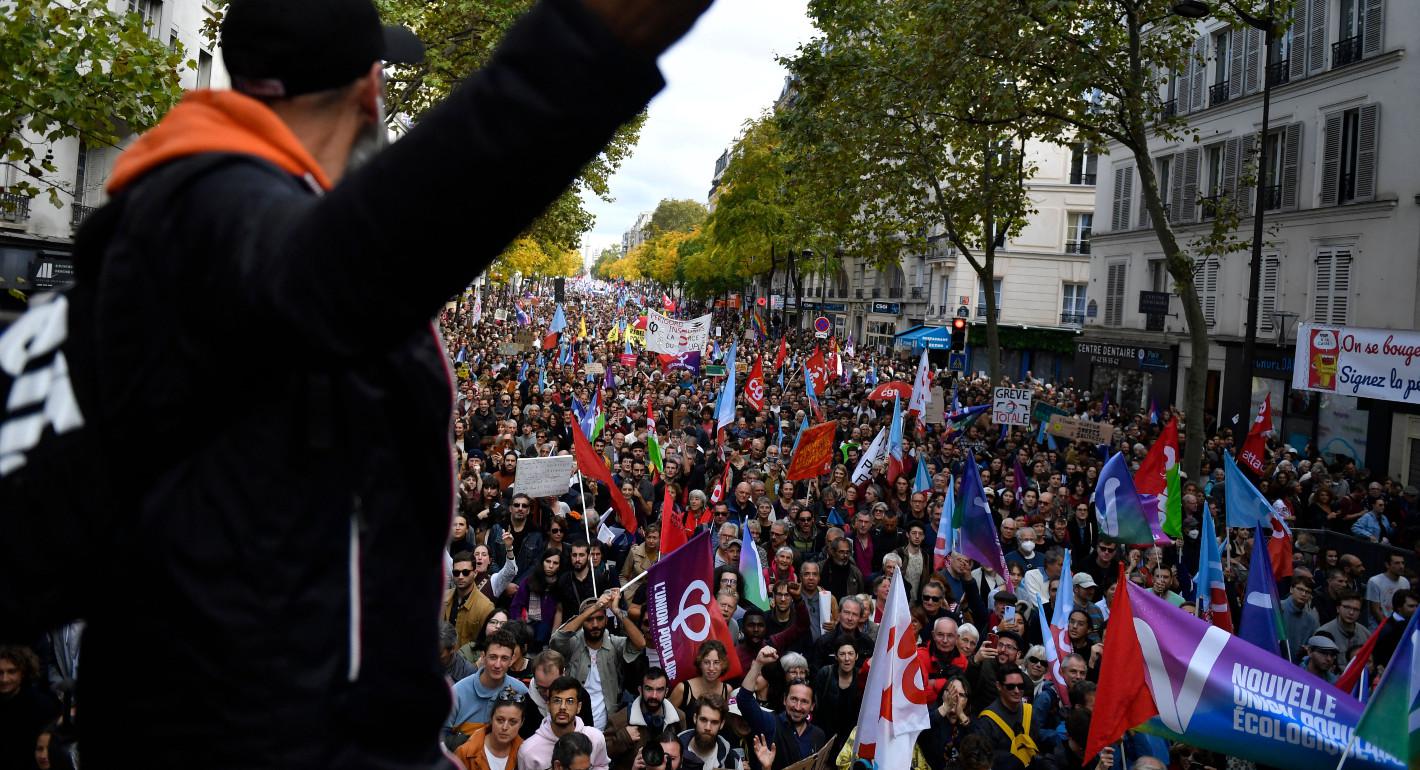
In France, more than 100,000 demonstrators took to the streets, demanding that the government both take action against the rising prices of fossil fuels and do more to combat the climate crisis. In Hungary and Brazil, protesters sought to prevent their right-wing governments from relaxing anti-logging restrictions, while in the Netherlands, demonstrators pushed their center-right government to drop plans to cut greenhouse gas emissions by forcing farms to keep fewer livestock.
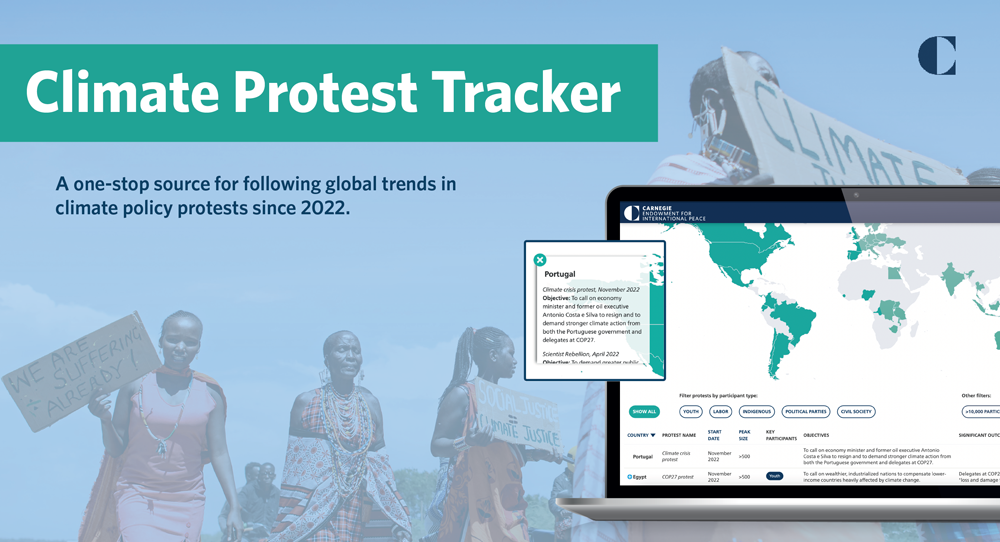
These are just a few of the large-scale climate protests that Carnegie tracked in 2022. As climate impacts get worse and climate politics become more salient and invidious, such protests will likely become even more numerous and influential. Building on Carnegie’s existing protest research, the Climate Protest Tracker has identified nearly two dozen climate protests—which we define as episodes of mass action relating primarily to climate policy—in at least forty-one countries. It will be updated regularly to act as a resource for journalists, researchers, and activists.
Climate policy has proven to be a potent protest motivator for a simple reason: demonstrators view the stakes of climate policy as existential. Some see a direct link between inaction on climate change and their lives and livelihoods. Already in the first few days of this year, Germany has sent hundreds of police officers to protect a coal mine whose expansion requires the demolition of the small town of Lützerath—unless the climate protesters can stop the diggers. Yet policies undertaken in the name of mitigating climate change can spur a furious backlash. In New Zealand last October, a proposed tax on biogenic methane spurred protests by the country’s farmers, who complained that the measure could put them out of business.
As with so many of the topics being investigated by Carnegie’s new Sustainability, Climate, and Geopolitics Program, climate protests often defy national borders. Transnational protest movements like Fridays for Future, the Global Climate Strike, and the Scientist Rebellion attracted participants in dozens of countries in virtually every region of the world. Other protests called on international actors to change their approach: in Egypt, a rare public protest staged in conjunction with COP27 demanded that governments of rich nations compensate lower-income countries suffering from climate change, while in the Czech Republic, tens of thousands of protesters objected to EU efforts in Brussels to curb fossil fuels, which they argued were contributing to inflation.
And with the advent of the war in Ukraine, climate activism has increasingly taken on a geopolitical dimension: protesters in Brussels, Berlin, Paris, and other European capitals have demanded that their governments ban Russian gas imports not only to benefit the people of Ukraine but to help the climate as well. We will likely see more of this as the transnational impacts of climate policy become clearer. It is easy to imagine more protesters shouting in front of embassies to oppose foreign taxes on the carbon embedded in exports, export bans on key battery metals such as nickel, or foreign decisions to spray tiny particles into the atmosphere to dim the sun.
Yet mass action is hardly the only form of climate activism. Although not included within the tracker’s data set, small-scale climate policy protests were often highly visible and controversial in 2022. Small groups of protesters have attracted significant media and political attention, whether they are occupying U.S. Senate Majority Leader Chuck Schumer’s office, throwing soup on priceless paintings in the UK, blocking highways in Australia, or even sabotaging cement plants in France. Protesters from groups like Extinction Rebellion and Just Stop Oil have been instrumental in pioneering these deliberately provocative protest techniques as they seek to call attention to what they view as insufficient climate action.
Another notable finding is the degree to which formal networks and groups have been instrumental in driving climate activism. In contrast to the broader political protest landscape, which is largely dominated by “leaderless” protests that emerge without much central coordination, most large climate protests have been convened or heavily influenced by civil society. In some countries, for example, labor unions have played a significant role in climate protests; in others, political parties, activist networks, and environmental NGOs were instrumental in organizing demonstrations. The central coordination of climate action and the deliberate diffusion of protest techniques stands in contrast to the broader global protest landscape.
True to its name, the Climate Protest Tracker identifies protests that aim to influence climate policy rather than environmental or energy policy. To be included in this tracker, a protest must be framed around the issue of climate policy by the protesters themselves. It is, though, getting increasingly difficult to tell where climate policy end and another area of policy begins. When protesters in Iran demonstrated against the government’s mismanagement of water resources after a severe drought—a problem almost certainly exacerbated by climate change—were their protests more about resources or their government’s broader failure to adopt policies to respond to a changing climate? The fact that climate change is affecting nearly every area of international politics is a guiding principle for both the tracker and Carnegie’s Sustainability, Climate, and Geopolitics program.
As the perceived stakes of climate policy continue to surge, activism around climate is all but certain to continue to grow. We hope that the new Climate Protest Tracker can become a one-stop source for following political disruption in the Anthropocene.