

Commentary
The EU can impose sanctions but struggles to enforce them without the United States. With Washington increasingly disinterested in backing European interests, the bloc must now fend for itself.
Nicu Popescu, Tiago Antunes
{
  "authors": [
    "Joshua Shifrinson"
  ],
  "type": "commentary",
  "centerAffiliationAll": "dc",
  "centers": [
    "Carnegie Endowment for International Peace"
  ],
  "collections": [
    "Debating NATO Enlargement",
    "A More Disciplined American Global Leadership"
  ],
  "englishNewsletterAll": "americanStatecraft",
  "nonEnglishNewsletterAll": "",
  "primaryCenter": "Carnegie Endowment for International Peace",
  "programAffiliation": "ASP",
  "programs": [
    "American Statecraft"
  ],
  "projects": [],
  "regions": [
    "North America",
    "United States",
    "Russia"
  ],
  "topics": [
    "NATO",
    "Security",
    "Defense"
  ]
}
Source: Getty
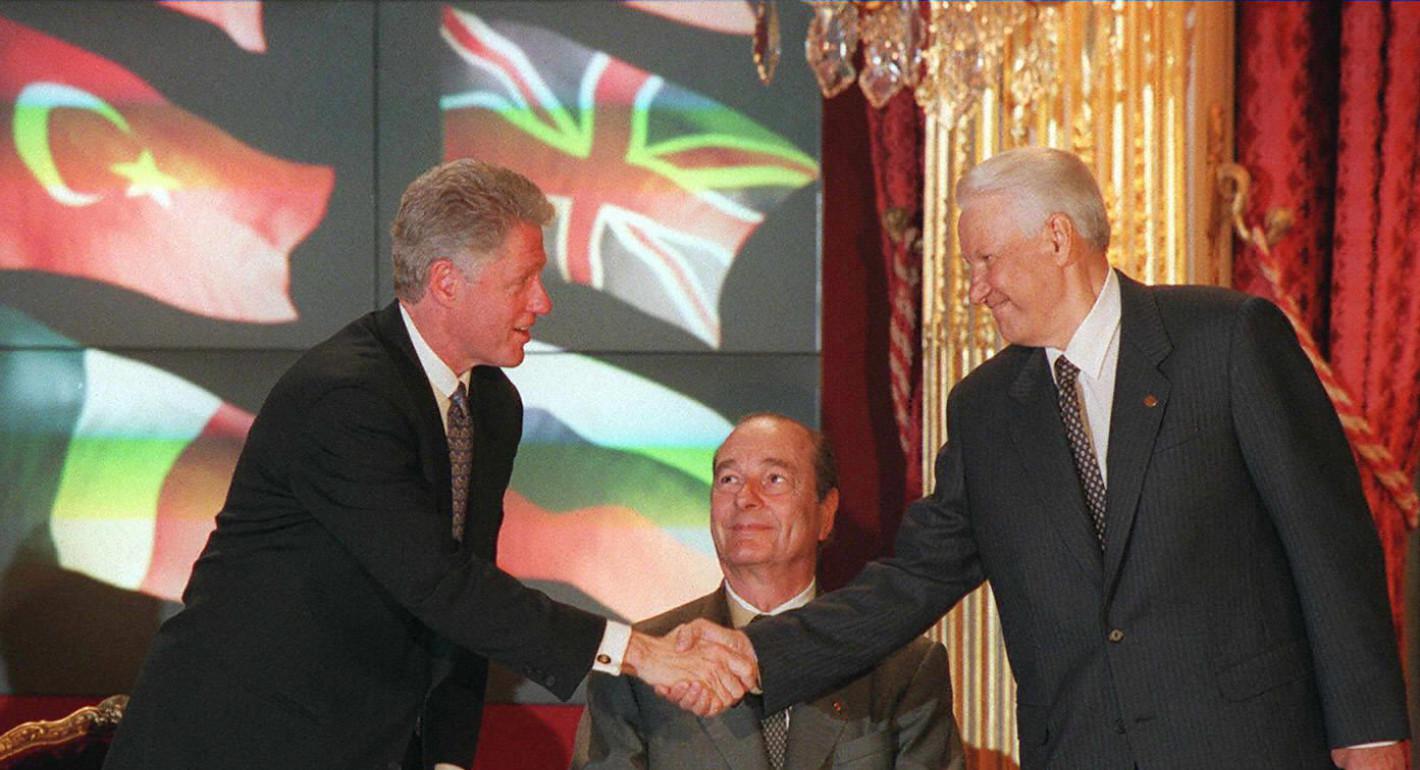
The United States engaged Russia on secondary matters while antagonizing it on vital issues.
In this series from the American Statecraft Program, James Goldgeier and Joshua Shifrinson discuss and debate the issues surrounding NATO enlargement in a twenty-first-century exchange of letters. Read the previous entry here.
Dear Jim,
Apologies for the delay. I had the pox (starting the semester).
As you say, Washington took steps in the 1990s to make NATO enlargement palatable to Moscow. Still, this does not mean the United States accommodated key Russian interests. After the Cold War, U.S. policymakers had to decide whether to respect or challenge two vital Russian concerns. First, Russia wanted to have at least equal influence to the United States, Germany, France, and other major players in Europe’s security system. Second, Russia sought a security buffer (as distinct from its prior sphere of influence) in East-Central Europe.
Respecting these interests would have provided the best chance of creating a Europe whole, free, and at peace, though of course such an outcome cannot be guaranteed. Yet Washington made a different choice. Rather than accept Russia’s key interests, the United States bypassed them: it enshrined an enlarging NATO as the core of Europe’s security architecture, and it offered Moscow various consolation prizes. This approach made a rupture of East-West relations likely once Russia recovered from its economic nadir in the 1990s.
NATO enlargement challenged both of the core Russian interests I’ve mentioned. Because Russia was not a NATO member and was not going to become one (at least in any policy-relevant time frame), making NATO the focal point of European security left Moscow fundamentally on the outside looking in. Despite the creation of mechanisms such as the NATO-Russia Council, Russia could enjoy at best informal and indirect influence over security dynamics in the region. Meanwhile, expanding NATO in a process that had no defined limits ensured that Russia’s security buffer would progressively diminish over time, to be replaced by a military alliance that new members valued for protection against Moscow.
It’s no surprise that then Russian president Boris Yeltsin and his entourage, echoing the Soviet leadership they replaced, reacted negatively to NATO’s eastward march. The move isolated Russia from the core of Europe’s security system and reinforced Russian threat perceptions. American policy was thus accommodating only in a tactical sense, not a strategic one. On the vital Russian interests at play, the United States gave no ground. NATO’s expansion became, as you wrote, a question of “not whether but when”—at times and in places of the West’s choice—irrespective of Russian objections. In effect, the United States reserved to itself the right to determine which Russian interests were legitimate and would be addressed, and which were illegitimate and would be ignored.
Frankly, I think then U.S. president Bill Clinton and other leaders should have recognized the problems they courted with this policy. As archival work has shown, Russian leaders were hardly quiet about the dilemmas NATO enlargement posed to their country and warned that an eventual crack-up could result. Equally striking, as former deputy secretary of state Strobe Talbott documents, Clinton acknowledged U.S. policy wasn’t as conciliatory as some others retrospectively claim, observing in 1996, “We keep telling Ol’ Boris, ‘Okay, now here’s what you’ve got to do next—here’s some more shit for your face.’”
You ask whether Clinton was right to reject Yeltsin’s request for a gentleman’s agreement against enlargement to former Soviet republics, such as the Baltic states, Georgia, and Ukraine. Clinton’s decision strikes me as short-sighted, and not just because the United States has no vital interests in the countries in question that would justify a U.S. security commitment. On one level, it again underscored to Moscow that Washington would not truly balance enlargement with respect for Russia’s interests. At the same time, it ignored that if the United States had a strong reason to want greater influence in the former Soviet republics, it could do so even if NATO membership was off the table, through bilateral engagement or the Partnership for Peace. By telling Yeltsin no, Clinton was in effect deeming the entire post-Soviet space in play for NATO enlargement.
Ultimately, I’m persuaded by the assessment of Robert Gates, who was deputy national security adviser from 1989 to 1991 (and later secretary of defense). As Gates put it in 2000, “If you don’t get it right with Russia and China, none of the rest matters. And at a time of a special humiliation and difficulty for Russia, pressing ahead with expansion of NATO eastward . . . I think probably has not only aggravated the relationship between the United States and Russia but made it much more difficult to do constructive business with them.”
Indeed. The United States engaged Russia, but did so on secondary matters while making choices on issues of primary importance that were prone to antagonize Moscow. The result: NATO’s eastward move committed the United States to defend an ever-growing number of Eastern European countries while making it more likely that Russia would become hostile toward those same countries (not to mention that non-NATO countries like Ukraine were left especially vulnerable).
A better policy would have aimed to limit points of major friction with Russia. The cost would have been to ignore the understandable and justified desires of Central and Eastern European states to join NATO. These states may have been left somewhat more vulnerable to Russian influence, but Russian aggression itself would have been less likely to materialize. At any rate, this approach would have been better for the United States, which would not now be committed to defend countries all across Europe, fearing a loss of face should it back down from NATO’s continued enlargement, and grappling with intense security competition against an increasingly robust Russo-Chinese partnership.
A question for next time: what kind of hypothetical evidence could convince you that NATO enlargement was a major cause of (and not just a trigger or excuse for) Russian aggression? That is, when we consider the past three decades of NATO enlargement, how would Russia have had to behave differently in that time for you to reach such a conclusion?
With fond’st regard,
Josh
Read more from Debating NATO Enlargement:
Joshua Shifrinson
Joshua Shifrinson is an associate professor of international policy with the University of Maryland’s School of Public Policy and a nonresident senior fellow with the Cato Institute’s Defense and Foreign Policy program. A graduate of Brandeis University and MIT, he is the author of Rising Titans, Falling Giants: How Great Powers Exploit Power Shifts and co-editor (with Jim Goldgeier) of Evaluating NATO Enlargement: From Cold War Victory to the Russia-Ukraine War.
Carnegie does not take institutional positions on public policy issues; the views represented herein are those of the author(s) and do not necessarily reflect the views of Carnegie, its staff, or its trustees.

The EU can impose sanctions but struggles to enforce them without the United States. With Washington increasingly disinterested in backing European interests, the bloc must now fend for itself.


Nicu Popescu, Tiago Antunes

Rubio’s recent visit brought welcome attention, but more capital requires governance changes that may be a hard sell for regional governments.

Jennifer B. Murtazashvili

America’s foreign-policy objectives have grown more demanding while Americans have demanded greater focus on their own affairs.
Stephen Wertheim

Japan’s long-term security policy is driven by concerns about China, and there is little appetite for (or interest in) pursuing a confrontation with Moscow.

James D.J. Brown

Russia is testing the waters of NATO’s mutual defense clause. What do strikes in Romanian territorial waters mean for the alliance’s posture toward Moscow?

Dimitar Bechev