

Paper
- +2
Ian Klaus, Mark Baldassare, Rachel George, …
{
  "authors": [
    "Mark Baldassare"
  ],
  "type": "commentary",
  "centerAffiliationAll": "dc",
  "centers": [
    "Carnegie Endowment for International Peace"
  ],
  "collections": [
    "Democratic Innovation"
  ],
  "englishNewsletterAll": "ctw",
  "nonEnglishNewsletterAll": "",
  "primaryCenter": "Carnegie Endowment for International Peace",
  "programAffiliation": "CC",
  "programs": [
    "Carnegie California"
  ],
  "projects": [],
  "regions": [
    "United States"
  ],
  "topics": [
    "Democracy",
    "Civil Society"
  ]
}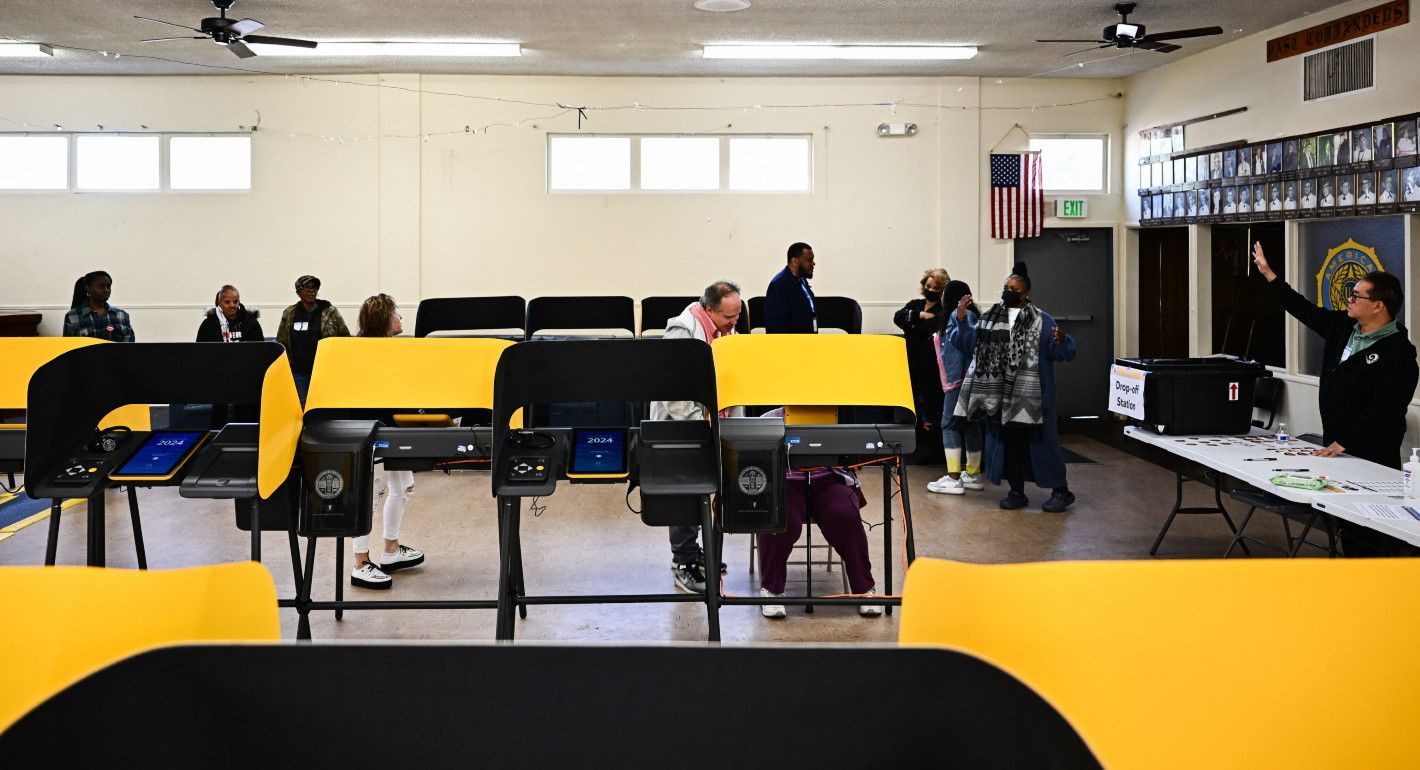
A polling station in Hawthorne, California, in March. (Photo by Patrick T. Fallon/AFP via Getty Images)
The mix of legislative measures and citizens’ initiatives offer a window into the health of direct democracy in the most populous U.S. state.
California is widely expected to live up to its reputation as a blue state in 2024. Republicans have not won a presidential race in the state since 1988, and statewide polling that I have been directing at the Public Policy Institute of California confirms it will likely deliver its fifty-four Electoral College votes to the Democratic presidential ticket. But legislative measures and citizens’ initiatives further down the state ballot—where the choice between a D or an R is replaced by yes or no—is once again the political wildcard this November. Voters will decide an array of policy issues in ten state propositions in the upcoming election. This year’s mix of five legislative measures and five citizens’ initiatives—as well as the reasons why others did not make the final cut—offer a window into the health of direct democracy in the country’s most populous state. How did we get here? And what is at stake this fall?
The California legislature, similar to other states, can place state constitutional amendments, statutes, and bond measures on the state ballot for majority voter approval. After lengthy negotiations involving a plethora of the state’s pressing needs, Governor Gavin Newsom and legislative leaders pared down their wish list to five state propositions: two state bonds and three constitutional amendments.
For the two state bonds, Proposition 2 would provide $10 billion for education facilities, and Proposition 4 would provide $10 billion for climate programs. The need for more state funds in these two areas has been an ongoing issue made more acute by the state budget deficit. Despite the state’s liberal reputation, many Californians are fiscal conservatives. Voters rejected a $15 billion state bond for education facilities in 2020 and narrowly passed a $6.38 billion state bond for homelessness last March.
Proposition 3 (ACA 5) would amend the state constitution’s definition of marriage. It would remove the mention of a ban on same-sex marriages that voters passed in 2008—the controversial Proposition 8, which was later ruled unconstitutional by the courts. Today, most Californians approve of same-sex marriage, in stark contrast to the deep partisan divisions that existed when Proposition 8 passed by a narrow margin sixteen years ago.
Proposition 5 (ACA 1) would amend the state constitution by lowering the threshold from a two-thirds vote to a 55 percent vote to pass local bonds and taxes for affordable housing and public infrastructure. This loosens restrictions that were part of the Proposition 13 property tax limits that voters passed in 1978. Recent polling finds that Proposition 13 and the two-thirds vote for local tax increases are still popular.
Proposition 6 (ACA 8) would amend the state constitution to prohibit slavery in any form—removing the exception of involuntary servitude as punishment for a crime. The issue of prohibiting all forms of slavery in California today surfaced in legislative recommendations from the state’s reparations task force. Many Californians believe that the legacy of slavery affects the position of Black people in American society today.
The frequency with which California voters are asked to weigh in on legislative measures may be on the upswing. But that does not mean there will be rubber-stamp approval. Voters passed a legislative constitutional amendment for abortion rights in 2022. But they rejected a legislative constitutional amendment in 2020 that would have ended the ban on affirmative action programs that voters approved in 1996. Many Californians in both parties show an independent streak when it comes to deciding legislative measures on the state ballot.
Since the state’s direct democracy system was approved by voters in 1911, California voters—similar to those in many other states today—can follow a process run by the California secretary of state to place an initiative or a referendum on the ballot. The large number of signatures required—which changes based on a percentage of turnout in the previous gubernatorial election—is a major financial hurdle. Seven citizens’ initiatives failed to qualify because the proponents did not collect enough signatures from the state’s 22 million voters in the time allowed. Voters are being asked to approve five citizens’ initiatives, including two on the issue of affordability, two related to government funding, and one aimed at increasing the crime sentences that voters approved ten years ago.
Proposition 32 would raise California’s minimum wage to $18 per hour by 2025. This citizens’ initiative would extend and increase the minimum wage hikes that were passed by the governor and legislature in 2016. Most Californians say they favor a policy that would increase the current minimum wage.
Proposition 33 would repeal a state law restricting rent controls on residential property and expand local government authority to regulate rents. Similar citizens’ initiatives were rejected by voters in 2018 and 2020. Still, most Californians favor expanding residential rent controls in the state.
Proposition 34 would require that certain healthcare providers spend 98 percent of their revenues from federal prescription drug discount programs on direct patient care. Media reporting and campaign funding records indicate that Proposition 34 is aimed specifically at political spending by the AIDS Healthcare Foundation, a major proponent of Proposition 33, by opponents of Proposition 33, including the California Apartment Association.
Proposition 35 would make permanent the managed care organization (MCO) tax on managed health insurance plans that expires in 2026, and it would require that the MCO tax only be spent on certain Medi-Cal programs. The initiative’s proponents also want to prohibit the state from using the MCO tax to replace other existing Medi-Cal funding.
Proposition 36 would allow felony charges and increase sentences for certain theft and drug crimes. This would affect Proposition 47, approved overwhelmingly by voters in 2014, which reclassified some felonies as misdemeanors. Local government officials have called for tougher sentencing in response to retail property thefts. The governor and legislature were not able to reach closure on a legislative measure to amend Proposition 47.
Notably, the governor and legislature played an unprecedented role in which initiatives and referendum are not on the state ballot this year. They successfully filed a rare lawsuit at the California Supreme Court that removed an initiative constitutional amendment. Their negotiations with proponents led to the withdrawal of a record four initiative amendments and one referendum. And a new state law made it possible for a proponent to withdraw a referendum and pivot to the courts. This direct engagement by the governor, legislature, and courts in initiatives and referendums has profound implications for the future of direct democracy.
How will California’s voters make choices on the state propositions this fall? The State Voter Information Guide will be their go-to source, but many voters also want other sources. Most Californians favor having televised debates and town hall meetings with proponents and opponents, as well as a citizens’ initiative review commission that holds public hearings and publishes their ballot recommendations.
Direct democracy also has national implications. California is one of twenty-six states (as well as Washington, DC) that have initiatives and referendums; most state legislatures can ask voters to make policy changes. Several states will have abortion rights on the ballot in the wake of the U.S. Supreme Court’s landmark decision in Dobbs v. Jackson Women’s Health Organization. Voters’ experiences with their state’s direct democracy will impact the public’s views of how well American democracy is working in this presidential election year.

Nonresident Scholar, Carnegie California
Mark Baldassare is a nonresident scholar at Carnegie California. He is an authority on elections, voter behavior, and political and fiscal reform.
Recent Work


Ian Klaus, Mark Baldassare, Rachel George, …
Mark Baldassare, Ian Klaus
Carnegie does not take institutional positions on public policy issues; the views represented herein are those of the author(s) and do not necessarily reflect the views of Carnegie, its staff, or its trustees.

Washington needs to recognize that influence in the Western Hemisphere comes from presence, delivery, and reliability. It also must recognize that while the United States remains the key external actor, it no longer operates in a permissive environment and cannot presume deference from regional players who have other options, namely China.
Juan S. Gonzalez

Minsk clearly expected the dialogue with Washington to yield more results, in particular the lifting of EU sanctions and permission to export potash.

Artyom Shraibman

As the U.S. stumbles in its war with Iran, we are likely to see an acceleration of its disengagement from the region.

Michael Young

Why governance of rapidly evolving technology will be distributed and complex.


Stewart Patrick, Scott Singer

It should address the shortcomings of previous crisis communication efforts and adapt to the demands of frontier AI.

Lucy Luo