

Feature
The Disaster Dollar Database is a tool that tracks the major sources of federal funding for disaster recovery in the United States.
{
  "authors": [
    "Sarah Labowitz"
  ],
  "type": "commentary",
  "centerAffiliationAll": "dc",
  "centers": [
    "Carnegie Endowment for International Peace"
  ],
  "collections": [
    "Climate Mobility",
    "Climate Disasters and Adaptation"
  ],
  "englishNewsletterAll": "ctw",
  "nonEnglishNewsletterAll": "",
  "primaryCenter": "Carnegie Endowment for International Peace",
  "programAffiliation": "SCP",
  "programs": [
    "Sustainability, Climate, and Geopolitics"
  ],
  "projects": [],
  "regions": [
    "United States"
  ],
  "topics": [
    "Domestic Politics",
    "Climate Change"
  ]
}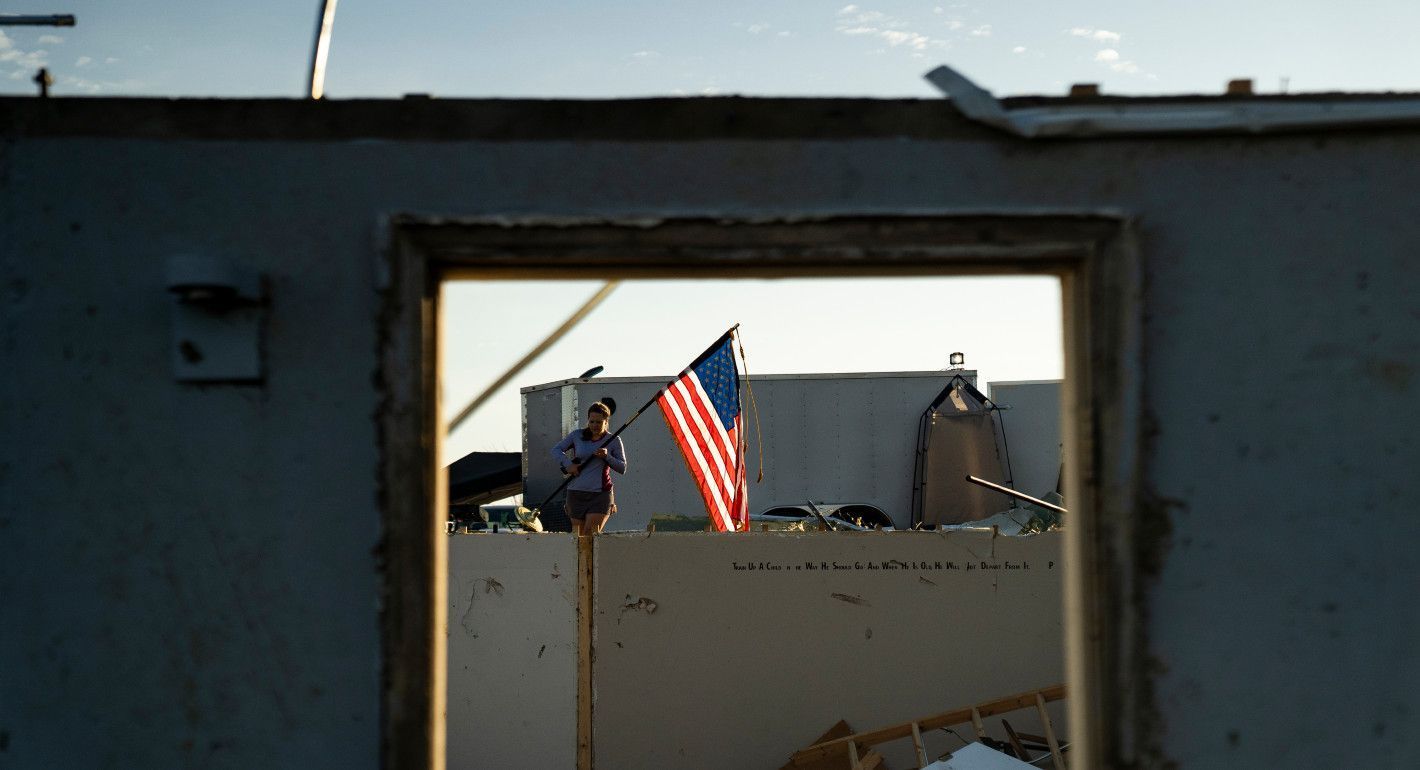
A woman sorts through debris on May 18, 2025, in Kentucky after a tornado hit the area. (Photo by Michael Swensen/Getty Images)
Our goal is to create practical tools for people living through disasters and rebuilding their communities in more resilient ways.
In the context of a very grim picture for hurricane season 2025, we’ve updated the Disaster Dollar Database with a new interface and fresh data, for disasters through May 2025.
Going forward, we aim to update the DDD twice a year—in June and December, the beginning and end of hurricane season. We’ll also update it if Congress makes an emergency appropriation for disaster recovery through the Department of Housing and Urban Development’s Community Development Block Grant Program for Disaster Recovery (CDBG-DR).
To make improvements to the interface, we consulted with disaster survivors, advocates, and researchers about how they’re using the data. They told us that they’re screenshotting the data, so we made a fact-sheet generator to give users more control over the information that’s relevant to them. We also heard that people are using the data to compare recovery funding for similar kinds of disasters—for example, comparing the LA wildfires in January to previous fires, in order to understand how many people applied for assistance or how much funding individuals typically received. In the new interface, you now can select disasters by type.
When we launched the database, one of the tools we were especially excited about was the index of HUD grantees. In the spreadsheet version of the data, you can find the state, local, tribal, or territory government that received funding from HUD for disaster recovery, along with the specific disaster webpage. People weren’t finding this data, so we’ve made it more visible in the fact-sheet generator.
One line of inquiry we’re following is a possible rise in AI-generated fake FEMA applications that may be pushing the numbers of valid FEMA applications artificially high for recent disasters. We’re evaluating the evidence and looking for alternative metrics in the OpenFEMA dataset that give us insight into how many people are seeking assistance. In the December update, we’ll report back on what we’ve found.
If you’re finding this data useful or have ideas for how to improve it, we’d love to hear from you. Email us at climate@ceip.org. In an unpredictable policy and funding environment for disaster recovery, our goal is to create practical tools for people living through disasters and rebuilding their communities in more resilient ways.
The Disaster Dollar Database is a tool that tracks the major sources of federal funding for disaster recovery in the United States.
Senior Fellow, Sustainability, Climate, and Geopolitics Program
Sarah Labowitz is a senior fellow in the Sustainability, Climate, and Geopolitics Program whose work lies at the intersection of climate, national security, and democracy.
Recent Work

Sarah Labowitz, Katie Mears

Sarah Labowitz, Debbra Goh
Carnegie does not take institutional positions on public policy issues; the views represented herein are those of the author(s) and do not necessarily reflect the views of Carnegie, its staff, or its trustees.

Trump has promised Belarus a massive potash deal. But Minsk is seeking something greater: restored Western transit and greater room for maneuver from Russia.

Balázs Jarábik

The real test may come after the leaders leave the room.



Sheena Chestnut Greitens, Oriana Skylar Mastro, Yukon Huang, …

The new U.S.–Denmark–Greenland agreement will help Washington exert political, economic, and financial dominance under the guise of security. Yet, it acknowledged Copenhagen’s and Nuuk’s sovereignty on the island.

Marc Pierini

The nuclear relationship between China and the United States is increasingly shaped by widening perception gaps rather than deliberate strategic design.

Tong Zhao
Washington needs to recognize that influence in the Western Hemisphere comes from presence, delivery, and reliability. It also must recognize that while the United States remains the key external actor, it no longer operates in a permissive environment and cannot presume deference from regional players who have other options, namely China.
Juan S. Gonzalez