


• Research
  • Emissary
  • About
  • Experts
Carnegie Global logoCarnegie lettermark logo
DemocracyIran
  • Donate
{
  "authors": [
    "Richard Sokolsky",
    "Aaron David Miller"
  ],
  "type": "legacyinthemedia",
  "centerAffiliationAll": "",
  "centers": [
    "Carnegie Endowment for International Peace"
  ],
  "collections": [],
  "englishNewsletterAll": "",
  "nonEnglishNewsletterAll": "",
  "primaryCenter": "Carnegie Endowment for International Peace",
  "programAffiliation": "",
  "programs": [],
  "projects": [],
  "regions": [
    "North America",
    "United States",
    "East Asia",
    "North Korea"
  ],
  "topics": [
    "Foreign Policy",
    "Nuclear Policy",
    "Arms Control"
  ]
}

Source: Getty

In The Media

On North Korea, Is Trump Flunking Crisis Management 101?

Trump has correctly put the North Korea crisis at the top of the international agenda, but on almost every other aspect of Crisis Management 101, he is failing the course—and the consequences could be deadly.

Link Copied
By Richard Sokolsky and Aaron David Miller
Published on Sep 28, 2017

Source: USA Today

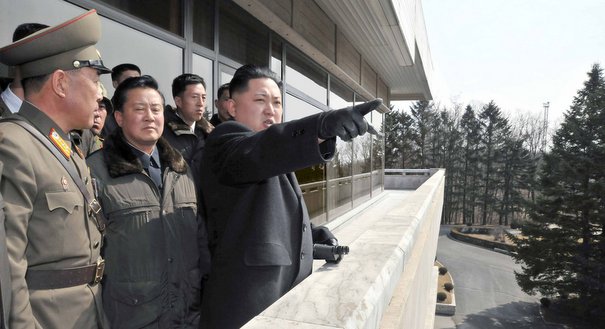
We give President Trump high marks for putting the North Korea nuclear challenge at the top of the international agenda, and injecting urgency into coping with a serious threat that has defied the efforts of three previous administrations. Let’s call it “strategic impatience,” the opposite of the Obama administration’s policy of strategic patience. But on almost every other aspect of Crisis Management 101, Trump is failing the course — and the consequences could be deadly.

Denuclearization is an unrealistic goal

Trump said this week that his goal is “complete denuclearization” of North Korea. Maybe this is the well-known Trump tactic of staking out an extreme position that he will eventually abandon. But if it is his real objective, we might as well plan on a military option.

For decades the Kim family has defined getting nuclear weapons as crucial to its survival — to deter U.S. efforts at regime change and to preserve its independence toward China. Pyongyang also probably harbors the goal of using nuclear weapons to coerce South Korea to end its alliance with the United States and expel U.S. forces from South Korea — and possibly even to force South Korea to achieve unification of the peninsula on North Korean terms...

Read Full Text

This article was originaly published in USA Today.

About the Authors

Richard Sokolsky

Nonresident Senior Fellow, Russia and Eurasia Program

Richard Sokolsky is a nonresident senior fellow in Carnegie’s Russia and Eurasia Program. His work focuses on U.S. policy toward Russia in the wake of the Ukraine crisis.

Aaron David Miller

Senior Fellow, American Statecraft Program

Aaron David Miller is a senior fellow at the Carnegie Endowment for International Peace, focusing on U.S. foreign policy.

Authors

Richard Sokolsky
Nonresident Senior Fellow, Russia and Eurasia Program
Richard Sokolsky
Aaron David Miller
Senior Fellow, American Statecraft Program
Aaron David Miller
Foreign PolicyNuclear PolicyArms ControlNorth AmericaUnited StatesEast AsiaNorth Korea

Carnegie does not take institutional positions on public policy issues; the views represented herein are those of the author(s) and do not necessarily reflect the views of Carnegie, its staff, or its trustees.

More Work from Carnegie Endowment for International Peace

  • Commentary
    Carnegie Politika
    What Does Nuclear Proliferation in East Asia Mean for Russia?

    Troubled by the growing salience of nuclear debates in East Asia, Moscow has responded in its usual way: with condemnation and threats. But by exacerbating insecurity, Russia is forcing South Korea and Japan to consider radical security options.

      James D.J. Brown

  • Vietnam's Top Leader To Lam meets with young representatives from China and Vietnam participating in the "Red Study Tours" at the Great Hall of the People on April 15, 2026 in Beijing, China. T
    Commentary
    Why Vietnam Is Swinging in China’s Direction

    Hanoi and Beijing have long treated each other as distant cousins rather than comrades in arms. That might be changing as both sides draw closer to hedge against uncertainty and America’s erratic behavior.

      • Nguyen-khac-giang

      Nguyễn Khắc Giang

  • Smoke rising over a  bridge
    Commentary
    Emissary
    The Iran War Is a Stress Test for Gulf States

    The conflict is exposing the flaws and fissures of their domestic governance and social cohesion.

      Frederic Wehrey, Charles H. Johnson

  • Commentary
    Strategic Europe
    Taking the Pulse: Is the EU Ready for Rapprochement With the UK?

    Closer EU-UK ties could help address urgent European concerns. But is the EU ready for rapprochement with the United Kingdom?

      • Rym Momtaz

      Rym Momtaz, ed.

  • Commentary
    Diwan
    A Military Balance Sheet in the U.S. and Israeli War With Iran

    In an interview, Jim Lamson discusses the ongoing regional conflict and sees an unclear picture when it comes to winners and losers. 

      Michael Young

Get more news and analysis from
Carnegie Endowment for International Peace
Carnegie global logo, stacked
1779 Massachusetts Avenue NWWashington, DC, 20036-2103Phone: 202 483 7600
  • Research
  • Emissary
  • About
  • Experts
  • Donate
  • Programs
  • Events
  • Blogs
  • Podcasts
  • Contact
  • Annual Reports
  • Careers
  • Privacy
  • For Media
  • Government Resources
Get more news and analysis from
Carnegie Endowment for International Peace
© 2026 Carnegie Endowment for International Peace. All rights reserved.