

Paper
George Perkovich
{
  "authors": [
    "George Perkovich"
  ],
  "type": "legacyinthemedia",
  "centerAffiliationAll": "dc",
  "centers": [
    "Carnegie Endowment for International Peace"
  ],
  "collections": [
    "U.S. Nuclear Policy"
  ],
  "englishNewsletterAll": "ctw",
  "nonEnglishNewsletterAll": "",
  "primaryCenter": "Carnegie Endowment for International Peace",
  "programAffiliation": "NPP",
  "programs": [
    "Nuclear Policy"
  ],
  "projects": [],
  "regions": [
    "North America",
    "United States"
  ],
  "topics": [
    "Security",
    "Foreign Policy",
    "Nuclear Policy"
  ]
}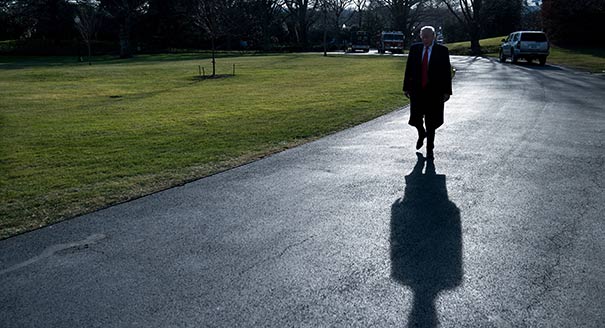
Source: Getty
Widening the role of nuclear weapons and appearing to blur the distinction between nuclear war and fundamentally less catastrophic threats is neither necessary nor helpful to making America great again.
Source: Politico
The front page of Tuesday’s New York Times contained an alarming headline: “Pentagon Suggests Countering Devastating Cyberattacks With Nuclear Arms.” The article, by David Sanger and William Broad, reported on a leaked draft of the Trump administration’s Nuclear Posture Review, which determines what the role of nuclear weapons should be. This draft departs from previous posture reviews by broadening the range of attacks that could trigger a massive U.S. retaliation, including with nuclear weapons.
Sanger and Broad acknowledge that the draft, which was first published by the Huffington Post, “does not explicitly say that a crippling cyberattack against the United States would be among the extreme circumstances” that would motivate the administration to initiate nuclear war. But, citing former and current officials, Sanger and Broad report that the proposed nuclear doctrine posits this contingency if, in the words of the leaked document, an adversary conducted “non-nuclear strategic attacks … on U.S., allied, or partner civilian population or infrastructure.” In plain English, the Trump team seems to be threatening to nuke anyone who conducts a massively disruptive cyberattack on the power grid or water system of the U.S. or one of its friends.
For three reasons, the Trump administration would be wise to reconsider and more carefully calibrate the circumstances under which it would initiate nuclear war.
The first reason has to do with the fact that nuclear war would be much more devastating to the United States than would any conceivable cyberattack. Russia and China appear to be the most likely adversaries that in the near term might be able to use cyberweapons to disable significant segments of the U.S. electricity system. Indeed, Russian attackers already did so to Ukraine, in a December 2015 operation that shut down power for approximately 230,000 Ukrainians for up to six hours. That attack, Wired magazine reported last June, may have been a dress rehearsal for a future assault on the U.S. power grid.
Now imagine it was much worse, and all of Ukraine was without electricity for weeks. If Ukraine possessed nuclear weapons, would any sane person in Washington have recommended that Ukrainian leaders retaliate by nuking Russia, and thereby inviting Russian nuclear attacks on Ukraine? The cure would have been much worse than the disease.
The same strategic logic applies to the United States. A cyberattack on U.S. civilian infrastructure could be enormously disruptive and costly. Depending on the scale and durability of outages of electricity, piped water, etc., the effect could be like what Puerto Rico is experiencing due to Hurricane Maria (though without the collapsed roadways and buildings). But, if a U.S. president initiated nuclear war in response to a massive cyberattack, Russia and China would be expected to retaliate with nuclear weapons. This could leave the mainland U.S. in the condition of Puerto Rico minus all the people, buildings and wildlife. Russia and China would suffer gravely in the process, but the U.S. would lose much more than it would gain by moving from cyberwar to nuclear war.
Here’s the second reason it’s crazy to retaliate with nuclear weapons: The United States’ conventional and cyber capabilities combined are greater than its adversaries’. Thus, the United States for decades has wanted to keep conflicts from going nuclear, where it would be harder if not impossible to “win.” The U.S. continues to develop and deploy its own cyber capabilities to disrupt adversaries’ civilian and dual-use infrastructure—energy, water, finance, etc. This helps deter adversaries from initiating cyberwarfare on a large scale, and, if deterrence fails, to enable countervailing cyberattacks and perhaps conventional warfare.
However, if the U.S. justifies the first use of nuclear weapons in response to possible cyberattacks, it will invite others to lower the threshold for using nuclear weapons. This is exactly the opposite of long-standing U.S. interests. A state with superior conventional and cyber capabilities should raise the nuclear threshold, not lower it.
The third reason has to do with international law and morality. I know—such considerations may seem quaint in today’s Washington. Yet, the authors of the draft Nuclear Posture Review themselves highlight the importance of reducing the number of lives lost to war, and the advances civilization has made in doing so from 1600 to 1900, and since 1945. They attribute the post-1945 trend to the development of nuclear weapons. A parallel development has been in International Humanitarian Law, or the Law of Armed Conflict, which U.S. military officers take very seriously.
These laws require that military operations be strictly necessary, that their harm be proportionate to the objective, and that they not cause unnecessary suffering. While an enemy’s massive cyberattack on U.S. civilian infrastructure would likely violate such law, it is difficult to imagine how the initiation of nuclear war in response would be necessary, proportionate, or would not cause unnecessary suffering (from radiation poisoning and subsequent birth defects, among other things). If the posture review’s authors think otherwise, the stakes are high enough that they should make this case in detail. Otherwise, they are needlessly opening the United States to yet more international condemnation that benefits only our adversaries and harms our allies and friends.
The core threats of nuclear war and massive aggression that the United States has retained nuclear weapons to deter since 1945 have not gone away. Like its predecessors, the Trump administration naturally seeks to counter evolving threats, primarily from Russia, China and North Korea. But widening the role of nuclear weapons and appearing to blur the distinction between nuclear war and fundamentally less catastrophic threats is neither necessary nor helpful to making America great again.

Japan Chair for a World Without Nuclear Weapons, Senior Fellow
George Perkovich is the Japan Chair for a World Without Nuclear Weapons and a senior fellow in the Carnegie Endowment for International Peace’s Nuclear Policy Program. He works primarily on nuclear deterrence, nonproliferation, and disarmament issues, and is leading a study on nuclear signaling in the 21st century.
Recent Work
George Perkovich
George Perkovich
Carnegie does not take institutional positions on public policy issues; the views represented herein are those of the author(s) and do not necessarily reflect the views of Carnegie, its staff, or its trustees.
Troubled by the growing salience of nuclear debates in East Asia, Moscow has responded in its usual way: with condemnation and threats. But by exacerbating insecurity, Russia is forcing South Korea and Japan to consider radical security options.

James D.J. Brown

Hanoi and Beijing have long treated each other as distant cousins rather than comrades in arms. That might be changing as both sides draw closer to hedge against uncertainty and America’s erratic behavior.

Nguyễn Khắc Giang

The conflict is exposing the flaws and fissures of their domestic governance and social cohesion.

Frederic Wehrey, Charles H. Johnson
Closer EU-UK ties could help address urgent European concerns. But is the EU ready for rapprochement with the United Kingdom?

Rym Momtaz, ed.
In an interview, Jim Lamson discusses the ongoing regional conflict and sees an unclear picture when it comes to winners and losers.

Michael Young