

Paper
Ashley J. Tellis
{
  "authors": [
    "Ashley J. Tellis"
  ],
  "type": "other",
  "centerAffiliationAll": "dc",
  "centers": [
    "Carnegie Endowment for International Peace"
  ],
  "collections": [],
  "englishNewsletterAll": "ctw",
  "nonEnglishNewsletterAll": "",
  "primaryCenter": "Carnegie Endowment for International Peace",
  "programAffiliation": "SAP",
  "programs": [
    "South Asia"
  ],
  "projects": [],
  "regions": [
    "South Asia",
    "East Asia",
    "China",
    "Southeast Asia"
  ],
  "topics": [
    "Economy",
    "Trade",
    "Security",
    "Military",
    "Foreign Policy",
    "Global Governance"
  ]
}
Source: Getty
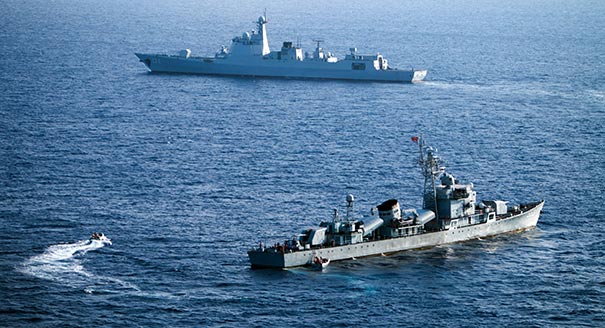
China’s actions in the South China Sea will likely have adverse consequences for the global maritime order. Such actions require a sustained and intentional response on the part of the United States.
Source: Hudson Institute
Speaking at the Hudson Institute, Carnegie’s Ashley J. Tellis addressed the strategic and diplomatic implications of Chinese actions in the South China Sea. Arguing that China’s intention to enforce its ambiguous but expansive claims poses unmistakable danger to the existing international order, Tellis sketched out some of the possible long-term consequences, as well as possible U.S. responses.
Beyond the potential risk to freedom of navigation in the region and economic disadvantages for neighboring countries with conflicting claims in the South China Sea, China’s actions strengthen the shift toward progressively greater “national enclosure” of open international waterways, Tellis warned. He added that, if left unchecked, Chinese militarization would disturb the local military balances and force the United States to commit more resources to the region in order to fulfill its obligations to its local friends and allies.
Tellis called for a coordinated campaign to increase pressure on China through multilateral institutions and other international maritime functional organizations. Sanctions could be applied to specific, Chinese state-owned enterprises engaged in illegal construction in the region, he added. He argued that a regime of routine freedom of navigation operations should be maintained, and a coalition of like-minded nations in Southeast Asia should be assisted to develop their surveillance capacities as well as their naval and air power deterrents.
Former Senior Fellow
Ashley J. Tellis was a senior fellow at the Carnegie Endowment for International Peace.
Recent Work
Ashley J. Tellis
Ashley J. Tellis
Carnegie does not take institutional positions on public policy issues; the views represented herein are those of the author(s) and do not necessarily reflect the views of Carnegie, its staff, or its trustees.
Geoengineering is becoming a geopolitical question as much as a climate one. The way states and the private sector pursue these technologies, assess risks, and drive research increasingly appears focused on gaining a strategic edge. In a field where governance in lagging behind, Europe should keep track of the geopolitical implications if it is to develop effective regulatory frameworks.

Olivia Lazard, ed.

The global hydrocarbon order is changing. Economic diversification and developing productive economies have become essential for Middle Eastern and North African states, requiring them to address social and political challenges and rethink domestic, regional, and global settlements.


Nur Arafeh, Ishac Diwan, Hamza Meddeb, …

The new Serbian leadership may have promised to keep on cooperating with Russia, but soon they will have to make a choice between fighting corruption and sealing lucrative deals with Moscow. The two are mutually exclusive, even if the new leaders in Belgrade haven’t yet realized it.

Maksim Samorukov

The six GCC members’ unity would be a valued—if not essential—asset for negotiating an end to the simmering regional conflict.

Sam Worby, Andrew Leber

Resetting relations with the EU is a central plank of the UK’s current foreign policy. Is Andy Burnham being bold enough or is he falling into the same trap as his predecessors, misreading the power dynamic?

Rym Momtaz, ed.