

Commentary
Ulrich Kühn
{
  "authors": [
    "Ulrich Kühn"
  ],
  "type": "legacyinthemedia",
  "centerAffiliationAll": "dc",
  "centers": [
    "Carnegie Endowment for International Peace"
  ],
  "collections": [
    "U.S. Nuclear Policy"
  ],
  "englishNewsletterAll": "ctw",
  "nonEnglishNewsletterAll": "",
  "primaryCenter": "Carnegie Endowment for International Peace",
  "programAffiliation": "NPP",
  "programs": [
    "Nuclear Policy"
  ],
  "projects": [],
  "regions": [
    "North America",
    "United States",
    "Russia",
    "Eastern Europe",
    "Western Europe"
  ],
  "topics": [
    "Nuclear Policy"
  ]
}
Source: Getty
After Trump's withdrawal from the INF Treaty, Europeans should cooperate with East Asia to prevent a new arms race
Source: International Politics and Society
The end of the INF Treaty, which US President Trump announced on 2 February 2019, is extremely problematic for Europe. Once again, the continent is on the threshold of a debate about rearmament. To prevent the redeployment of American medium-range missiles, it’s worth taking a look at the Far East – because rearmament also threatens America’s allies in Asia. And they have little reason to want new American missiles.
In order to understand this new development, we should first take a closer look at Washington’s interests and motives. Both in Europe and in Asia, the current American administration faces an aggressive struggle against major revanchist powers. In both cases, according to the latest US strategy documents, the US is in danger of being left behind militarily.
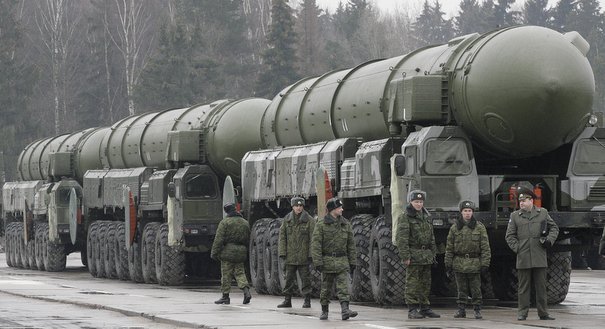
From an American point of view, the threat level in Europe has changed significantly since the Russian invasion of Crimea: Russia is ignoring international rules and will not hesitate to use direct force. In case of doubt – as many American security experts fear – Russia could also seek an open conflict with NATO, as Moscow has significantly more nuclear weapons in Europe than the US does. The fact that Russia is now also producing banned INF missiles with ranges of between 500 and 5,500 km, and thus threatening America’s allies, only serves to support those who ascribe sinister motives to the Kremlin and call for America to provide deterrents.
As for Asia, America’s military planners are warning of China’s growing rocket arsenal, 90 per cent of which violates the INF Treaty. China is not a party to the INF and in recent years has invested heavily in land-based missiles for purposes of the so-called anti-access/area denial (A2/AD) strategy. According to American fears, Beijing could use these weapons to keep the superior US maritime presence away from the disputed island areas of the South China Sea. The freedom of movement of American and other ships in East Asian waters would be increasingly called into question.
America’s response to these various challenges in Europe and East Asia is to exit the INF Treaty. Before a renewed debate about rearmament and another missile race become a European reality, new American INF missiles would first have to be developed and built. This would take an estimated two to three years; a research programme for this purpose was already initiated at the Pentagon in 2018. Only then the delicate question of deployment would follow.
While most of Europe’s NATO partners – most notably Germany – have no desire for new American medium-range weapons in Europe, several Eastern European countries see things completely differently. The recent Polish push for the US to build a so-called ‘Fort Trump’ shows that Warsaw is prepared to act outside the NATO consensus. But if certain allies vehemently reject redeployment and others push ahead for it, then that would be fatal for NATO – and a feast for Putin.
Even in East Asia an arms race poses a threat. Initially, land-based American missiles would significantly expand Washington’s military scope for action vis-à-vis China. But even in the East Asian region, America’s allies are anything but eager for these weapons. Under no circumstances would South Korea allow their cautious thaw in bilateral relations with the North be botched by the placement of new missiles. Australia and the Philippines would isolate themselves in the region in the event of deployment. Even Japan, considered by many in Washington to be the most willing supporter against the People’s Republic, has warned against a possible arms race and has called upon the White House not to abandon the INF treaty. For them, deployment brings no euphoria.
These countries have good reason to be sceptical. For even if Japan, perhaps along with other countries in the region, agreed to deployment, that would be primarily to their own disadvantage, as China would inevitably be compelled to extend any military conflict with the US to the territories of those nations. In addition, in a crisis scenario, it would be highly difficult for US military to reliably distinguish between nuclear and non-nuclear Chinese targets. New INF weapons in East Asia would only aggravate this problem. This is because they increase the risk of vertical escalation: in case of doubt, in a potential conflict China would be forced to use its nuclear weapons early, the rationale being that it’s better to cross the nuclear threshold while it’s still possible. Any Chinese nuclear strikes would then in all likelihood be primarily against those allies hosting US INF missiles.
The development of new American INF weapons ultimately depends the on question of their deployment. If (almost) all of Washington’s allies reject it, Congress would probably not approve any funding. So there’s an incentive to forge a broad, trans-regional coalition of those opposed to deployment. But such an approach entails risks. Individual countries such as Poland, the United Kingdom or Japan could break away. Washington could exert military and economic pressure. In addition, America's allies would turn against their protector instead of repudiating Russian and Chinese misconduct.
This is particularly important, as it will be necessary to be tougher instead of more lenient, on Russia especially. Public appeals to Moscow to revert to the treaty will not be enough. Even a new arms control regime possibly involving third states, as rightly demanded by the German Foreign Minister Heiko Maas, is difficult to imagine without pressure on Moscow. The problem is that the strongest form of leverage – the deployment of new US missiles – (still) runs counter to their own interests. So again, the only remaining means are economic sanctions. But even in this case, success would be anything but certain. For example, EU sanctions have not yet helped the Minsk process to a breakthrough. So do we need stronger threats, including from Germany, for instance with regard to the Nord Stream 2 Pipeline?
If the coming months bring no surprising diplomatic breakthroughs, the Europeans will need to prepare for turbulent years. In addition to their own intra-European solidarity, they should also strive for the closest possible relations with the equally affected allies in East Asia in order to prevent a worst-case scenario – new rearmament.
This article was originally published in International Politics and Society.

Nonresident Scholar, Nuclear Policy Program
Ulrich Kühn is a nonresident scholar at the Carnegie Endowment for International Peace, and the head of the arms control and emerging technologies program at the Institute for Peace Research and Security Policy at the University of Hamburg.
Recent Work
Ulrich Kühn
Ulrich Kühn
Carnegie does not take institutional positions on public policy issues; the views represented herein are those of the author(s) and do not necessarily reflect the views of Carnegie, its staff, or its trustees.
Policy discussion is ignoring that the Palestinian national project is hollowed out and apartheid is a present danger.

Nathan J. Brown
Nuclear recycling has emerged as a salient, cross-cutting issue, one that is heavily dependent on broader choices among reactor designs, fuel availability, economic resources, technological options, and political choices. States and nuclear industries seeking to advance recycling must devote sustained consideration now to the interplay of all these factors.
Etienne Pochon
The issue is not that the president only has selective information at his disposal, but that the decision-making process consists of one person with an unshakeable vision of how the world works.

Tatiana Stanovaya
Hungary under Viktor Orbán deployed right-wing populism as a foreign policy strategy, embedding the country in a web of illiberal transnational networks whose legacy will endure even after his April 2026 electoral defeat.
Zsuzsanna Végh

A much-discussed disagreement over internet restrictions in Russia was never an existential threat for Putin: It was about elite groups protecting their interests.

Alexandra Prokopenko