

Commentary
Balázs Jarábik
{
  "authors": [
    "Balázs Jarábik"
  ],
  "type": "legacyinthemedia",
  "centerAffiliationAll": "",
  "centers": [
    "Carnegie Endowment for International Peace",
    "Carnegie Europe"
  ],
  "collections": [
    "Europe’s Eastern Neighborhood"
  ],
  "englishNewsletterAll": "",
  "nonEnglishNewsletterAll": "",
  "primaryCenter": "Carnegie Endowment for International Peace",
  "programAffiliation": "",
  "programs": [],
  "projects": [],
  "regions": [
    "Eastern Europe",
    "Ukraine",
    "Europe"
  ],
  "topics": []
}
Source: Getty
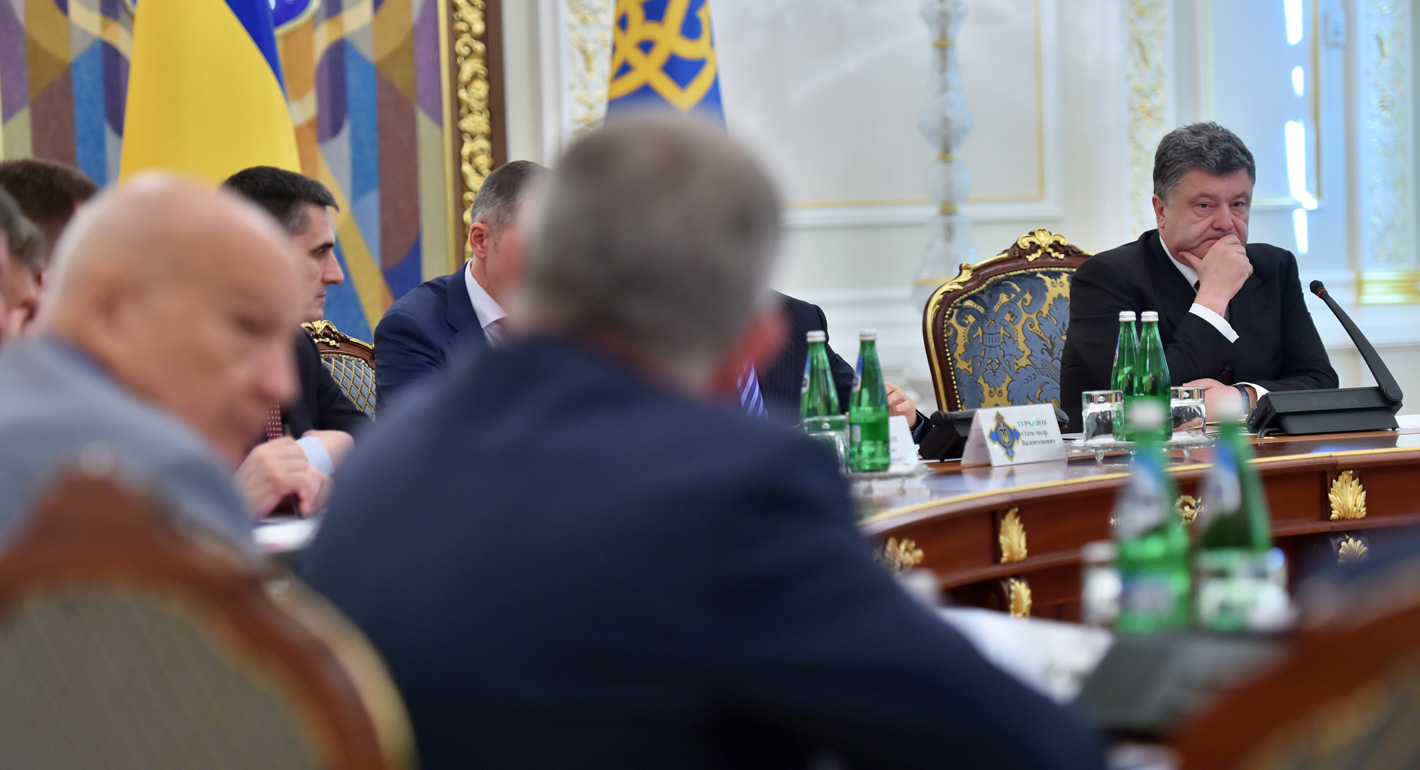
The current Ukrainian President Petro Poroshenko seems to have enough campaign cards up his sleeve to win the upcoming Ukrainian election, despite the damage caused by a fresh corruption case in the defense sector.
Source: Euractiv
In Ukraine’s upcoming presidential election, the candidate disliked by most could actually win.
Just three months ago—and for the first time in the country’s history since becoming independent in 1991—current President Petro Poroshenko imposed martial law in Ukraine. Although the law followed an attack by Russian forces on Ukrainian ships in the Kerch Strait, few believed that its initially proposed sixty-day duration was incidental. The move raised concern in international circles that it may be used to postpone presidential elections scheduled for March 31.Less than a month to go before the vote, Poroshenko is back in the race. The president seems to have enough campaign cards up his sleeve to win the vote, despite damage caused by a fresh corruption case in the defense sector.
The return of Poroshenko is not a reflection of how Ukraine has changed since Maidan. Rather, it is an illustration of how the country’s geopolitical orientation shifted dramatically. No doubt, Ukrainian society has made a firm choice toward the West, and this election won’t change this.
Political satirist Volodymyr Zelenskiy is the current frontrunner but he seems reached his ceiling in the polls. The comedian offers a positive way of collecting protest votes and an unorthodox way of public engagement as many voters feel that reforms “failed” ordinary Ukrainians.
The disillusionment is understandable. One just has to look at Poroshenko’s track record to understand why. Out of his original “four D” program for a new Ukraine—deregulation, debureaucratization, deoligarchization, decentralization—only the latter has been successful. The president has pragmatically switched to a “three P” plan: patriotism, pressure, and populism.
His “Army, Language, Faith” motto portrays him as a “savior” of Ukraine from Russia. The president’s theatrical reaction to the Kerch Strait incident reminded Ukrainians the importance of having a strong commander-in-chief. Poroshenko’s comeback started with his pushing unification of the Ukrainian Orthodox Church. And a new language law will further polarize the country by putting an official end to Ukraine’s bilingualism—but will help the current present mobilize his base.
Another advantage for Poroshenko is that the number of undecided voters has risen in the latest polls to 25 percent—as high as Zelenskiy’s support, whose own base is weak. Zelenskiy spends most of his time campaigning in the regions, avoiding the capital where he could be confronted with policy issues that he is simply not ready to address.
Meanwhile, the “either Poroshenko or Putin” message is polarizing, but it seems to be working. Turning toward the West is the only real achievement of post-Maidan politics the majority can rally behind. Because no candidate can credibly address major citizen concerns—like improving the economy, resolving the war in the Donbas, and tackling corruption—being seen as the only serious political alternative matters.
Poroshenko is reinforcing this message, dominating the campaign with massive spending, presence in the regions, and most media channels with his agenda—pushing everyone else into a defensive position. Tymoshenko is being branded a “populist;” Zelenskiy an “unexperienced clown.” And Poroshenko is the only statesman and commander-in-chief.
To boost his image, and tarnish his opponents, the presidential administration is employing trolls, bots, and experts. Political opponents also claim that pressure is applied through the country’s special services (SBU) and the General Prosecutors Office (GPO), institutions directly under the president’s control.
Nor is Poroshenko is afraid of using populist tactics. Not coincidently, the government brought forward the monetization of gas subsidies before the elections. In addition, Kyiv decided to pay a one-off benefit of $90 to 1.9 million pensioners having a minimum pension of $61. The rest of the country’s 8 million pensioners will also see pension hikes before the vote. All this has been made possible out of the $500 million from duty payments on illegally imported cars from the EU. Classic vote buying is also believed to be massive— though not just in Poroshenko’s camp.
No wonder that his original, whopping 77 percent refusal rate has decreased. His supporters are the most committed of the country’s voters. His campaign reinforces urbanites’ fear of chaos with the fiery Tymoshenko or the novice Zelenskiy. No wonder that 24 percent of Ukrainians actually think that the president will win.
Finally, Ukraine’s dependence on the West also helps the incumbent because the West seems supporting him. The U.S. State Department just launched a website to counter Russian aggression in Ukraine. European Council President Donald Tusk reaffirmed Ukraine’s Euro-Atlantic integration ambition in a passionate speech in the Ukrainian Parliament on the occasion of the constitutional changes enacted by President Poroshenko. Supporting the status quo has become the Western policy by default, born out of inertia and fear of change.
Ukraine’s electoral campaign should serve as a wake-up call for the West to realize the need of changing the economic policy. Macroeconomic stabilization has been painful and has not been brought investments. The trade deficit doubled in 2018; in goods it reached a whopping $10 billion. Ukraine is now ranked as Europe`s poorest country. An estimated 4 million Ukrainians working abroad are currently providing more external sources for the economy than the IMF.
Poroshenko himself says that poverty is his post-election priority. Yet the obvious risk — underlined by his track record in office— is that even if he wins, “continuity” will mostly mean the same old policies.

Political analyst, former Slovak diplomat, and consultant specializing in Eastern Europe
Recent Work
Balázs Jarábik
Balázs Jarábik
Carnegie does not take institutional positions on public policy issues; the views represented herein are those of the author(s) and do not necessarily reflect the views of Carnegie, its staff, or its trustees.

Europe is facing rising populism internally as well as external pressures from Russia, China, Turkey, and the United States.

Dimitar Bechev

A notable degree of participative democracy has firmly arrived in Europe. But to have more far-reaching impact, democratic deliberation needs to move into a radically new phase.

Richard Youngs

Much has been said of the changes Brussels is trying to make to the EU enlargement process. Here’s why gradual integration might—or might not—be the answer.
Dimitar Bechev

Despite a new textbook, an influx of Russian teachers and managers, and an end to the teaching of Ukrainian, the Kremlin is unlikely to have “reprogrammed” locals.

Konstantin Skorkin

The European Commissioner for Trade is headed to China. But after President Xi’s bridge-building visit to Washington, can a more isolated EU overcome Beijing’s stranglehold on critical raw materials? Who will blink first?

Rym Momtaz, ed.