

Commentary
If the Russian-speaking community in Latvia cannot articulate their interests without being seen as disloyal, they could end up embracing a pro-Kremlin agenda.
Sergejs Potapkins
{
  "authors": [
    "Dimitri Avaliani"
  ],
  "type": "commentary",
  "centerAffiliationAll": "",
  "centers": [
    "Carnegie Endowment for International Peace",
    "Carnegie Russia Eurasia Center"
  ],
  "collections": [],
  "englishNewsletterAll": "",
  "nonEnglishNewsletterAll": "",
  "primaryCenter": "Carnegie Russia Eurasia Center",
  "programAffiliation": "",
  "programs": [],
  "projects": [],
  "regions": [
    "Caucasus",
    "Georgia"
  ],
  "topics": [
    "Political Reform"
  ]
}
Source: Getty
The recent events have both damaged the Georgian government’s domestic legitimacy and spelled an end to its thaw with Russia.
The government of Georgia formed by businessman Bidzina Ivanishvili has fallen into a double trap that it set itself many years ago.
The political crisis that erupted suddenly in Georgia on June 20 destroyed two big ideas that had sustained the authority of the Georgian Dream coalition: that it was mild and tolerant toward the public, and that it had delivered a successful normalization of relations with Moscow. The violent suppression of an opposition protest, followed by Russia’s canceling of commercial flights to Georgia on alleged grounds of national security, makes it hard for Georgian Dream to stay in power next year.
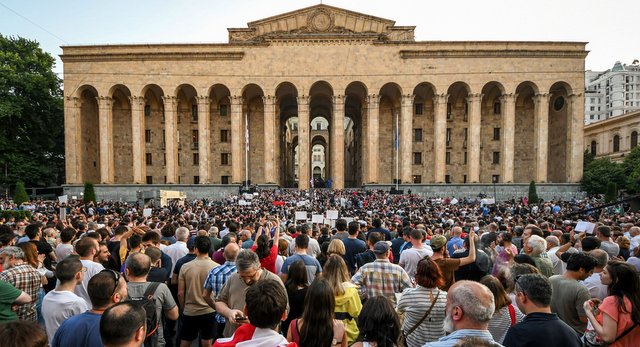
Around 200 people were injured on June 20 by the police dispersing a crowd that came out to protest the chairing of a session inside the Georgian parliament by Russian parliamentarian Mikhail Gavrilov.
The issue of relations with Russia was the trigger for the crisis, but the underlying causes lie in deep domestic discontents.
The governing regime had presented itself as relatively “vegetarian” in contrast to that of Mikheil Saakashvili, which governed Georgia from 2004 to 2012. The brutality with which the police suppressed the demonstration on June 20–21, firing rubber bullets at fleeing civilians, matched anything that Saakashvili’s security forces had done.
Georgia dates its path to modern independence from April 9, 1989, the day on which Soviet troops violently dispersed a demonstration on Rustaveli Avenue, and twenty-one peaceful protesters were killed. Since then, any police action that even faintly echoes those events causes a neuralgic reaction in Georgia. Saakashvili’s popularity drained away after he authorized crackdowns in November 2007 and May 2011.
No one can say for sure why the government took this suicidal step. Judging by the statements of Prime Minister Mamuka Bakhtadze and other officials, they believed that the protest was entirely organized by Saakashvili’s opposition United National Movement (UNM). They were proved wrong on this when yet more people turned out to protest on the following evening.
Since Ivanishvili’s Georgian Dream party took power in 2012, it has pursued a two-track policy of continuing Georgia’s trajectory toward the EU and NATO, and improving relations with Moscow. Transport communications were restored to Russia; Russian tourists flooded back to Georgia; and imports of Georgian agricultural products and wine resumed. Russia eased its visa regime for Georgians, but did not lift it altogether. The new government softened its language on Russia, and Ivanishvili has personally refused to criticize Putin.
Yet this resumption of people-to-people contacts was not accompanied by a political thaw. Diplomatic relations remained suspended over Russia’s recognition of Abkhazia and South Ossetia as independent states. At the same time, Russian cultural and political figures sought to recover Moscow’s political standing in Georgia. Gavrilov’s ill-fated appearance in Tbilisi was part of this attempted campaign of influence.
However, instead, Gavrilov almost instantly ignited passions about Russia, and by extension about Georgian Dream’s Russia policy. It comes as no surprise that the majority of the protesters on Rustaveli Avenue were otherwise generally apolitical young people. Few of these young people speak Russian, have been to Russia, or come into contact with Russians. For most of them, the only association they have with Russia is that of an occupier.
Negative feelings toward Russia coincide with falling ratings for the government. According to the latest survey by the National Democratic Institute from April of this year, 46 percent of Georgians believe that their country is going in the wrong direction.
Ivanishvili’s personal negative rating has risen to 39 percent. Georgian Dream has used all resources at its disposal to win the recent presidential and municipal elections. The party has strengthened its control over local authorities and the judiciary. Economic growth has slowed down and crime has been on the increase. This has produced a steam-kettle effect in which discontent with the government has built up.
Cases of nepotism and corruption scandals have been on the increase. In 2018, the mayor of the western city of Zugdidi, a member of the ruling party, was arrested for taking bribes. In April of this year, several senior officials in Batumi were detained for receiving kickbacks. Journalists found that the former general prosecutor owned a large amount of expensive property, but no one gave them a proper explanation.
All of these issues come back to one major flaw in the system: the fact that members of the government and parliament still report back to a man who currently holds no formal office, the behind-the-scenes godfather and creator of Georgian Dream, Bidzina Ivanishvili. The continuing personal dominance of Ivanishvili means that the resignation of parliamentary speaker Irakli Kobakhidze was not enough to quell the protests.
What was chiefly a crisis about domestic politics became an international one thanks to President Vladimir Putin, who canceled Russian commercial flights to Georgia, citing security grounds—even though not a single Russian citizen was hurt during the protests. Russian officials are now threatening to reimpose a commercial ban on Georgian wine. This is reminiscent of the actions Moscow took in 2006, when it reacted angrily to the public detention of GRU officers in Tbilisi and imposed a trade and travel embargo on Georgia.
The latest actions by Moscow will hurt the Georgian economy, in the short term at least. Putin will have known for sure that he was only adding to Georgian Dream’s problems and undermining a government that had sought friendlier relations with Russia. Why the Kremlin acted in this way is a mystery understood only in Moscow. What is now certain is that the chances of Ivanishvili and his party keeping power in next year’s parliamentary elections look much slimmer than they did one week ago.
Dimitri Avaliani
Carnegie does not take institutional positions on public policy issues; the views represented herein are those of the author(s) and do not necessarily reflect the views of Carnegie, its staff, or its trustees.

If the Russian-speaking community in Latvia cannot articulate their interests without being seen as disloyal, they could end up embracing a pro-Kremlin agenda.

Sergejs Potapkins

Russia’s ruling party would have benefited from Putin appearing as its distant patron, but as an active frontman imposing his views on the public, he has done nothing but harm both the party’s election campaign and the ruling system overall.

Andrey Pertsev

In the tenth year of his presidency, President Mirziyoyev’s system is becoming even more personalized than that of his predecessor Karimov.

Galiya Ibragimova

The greater threat to Zelensky comes not from Fedorov alone, but from the convergence between the former defense minister’s political campaign and the anti-corruption investigations moving ever closer to the presidential administration.

Balázs Jarábik

With his public call for new elections in Ukraine, ex-defense minister Mykhailo Fedorov has opened Pandora’s box.

Konstantin Skorkin