

Commentary
Andrew Miller
{
  "authors": [
    "Andrew Miller"
  ],
  "type": "commentary",
  "centerAffiliationAll": "dc",
  "centers": [
    "Carnegie Endowment for International Peace",
    "Malcolm H. Kerr Carnegie Middle East Center"
  ],
  "collections": [],
  "englishNewsletterAll": "menaTransitions",
  "nonEnglishNewsletterAll": "",
  "primaryCenter": "Carnegie Endowment for International Peace",
  "programAffiliation": "MEP",
  "programs": [
    "Middle East"
  ],
  "projects": [],
  "regions": [
    "North America",
    "United States",
    "Middle East",
    "Iran"
  ],
  "topics": [
    "Political Reform",
    "Security",
    "Foreign Policy"
  ]
}
Source: Getty
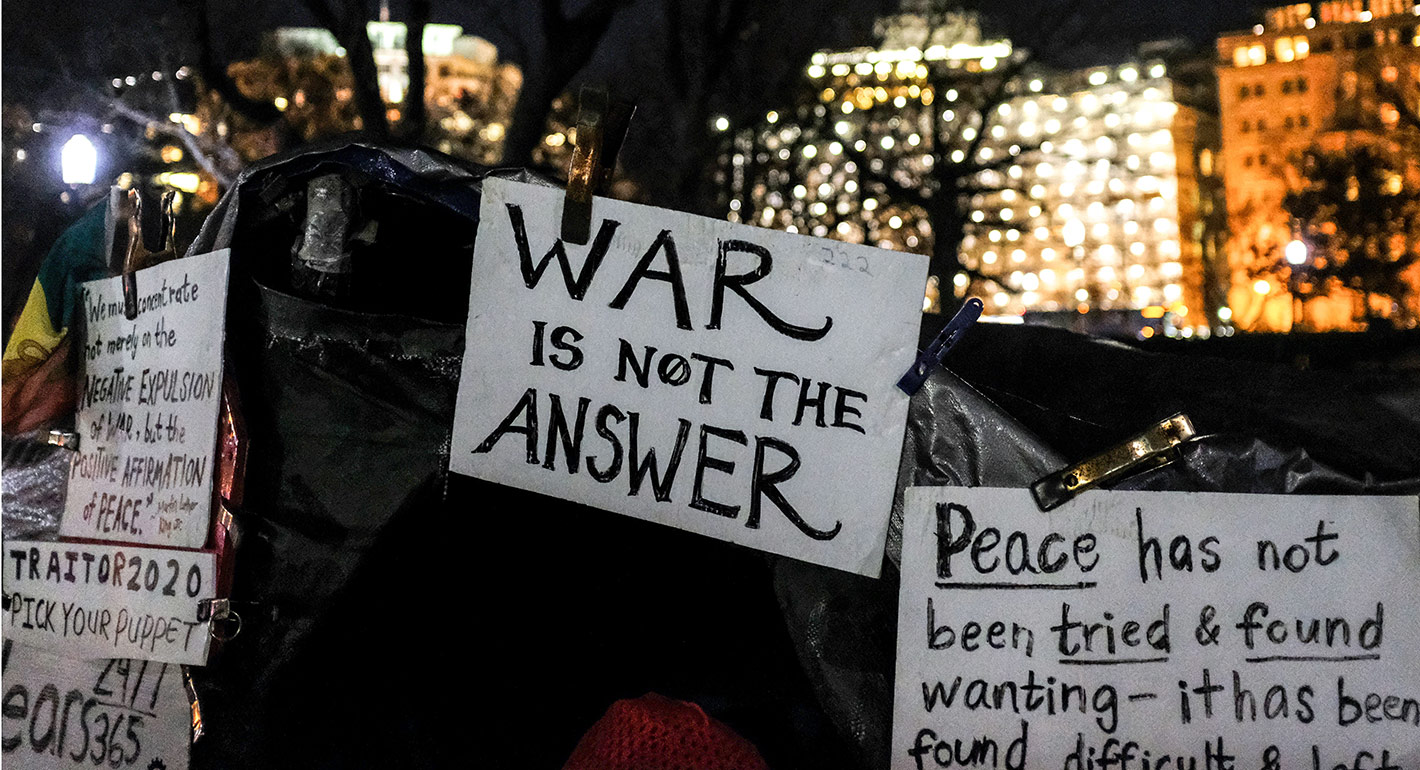
The escalating conflict between the United States and Iran seems to be cooling off. But any relief may be short-lived.
Many Americans are breathing a collective sigh of relief as the immediate risk of a conventional war between the United States and Iran appears to be receding. Iran’s January 7 missile salvo against two Iraqi installations housing U.S. soldiers in response to the January 3 assassination of Iranian major general Qassem Soleimani of the Islamic Revolutionary Guard Corps, which may have been designed to avoid American casualties, may satisfy the Iranian leadership’s short-term need to save face without provoking additional action by U.S. President Donald Trump. Iranian Foreign Minister Javad Zarif’s statement that Iran had “concluded proportionate measures” in retaliation for Soleimani’s death was met by an uncharacteristically nonchalant tweet from Trump declaring that “all is well.” Trump’s January 8 national address seemed to confirm that the United States was not contemplating a military response to Iran’s attack, creating hope that both sides want to de-escalate a dangerous standoff.
Unfortunately, it is not at all clear that Iran’s missile barrage represents the totality of the country’s response to the killing of one of its most important leaders. At the very least, Iran will intensify efforts to oust the United States from Iraq and neighboring Syria, as Supreme Leader Ali Khamenei asserted in a January 8 speech. While the wisdom of a long-term U.S. presence in these countries is debatable, American forces continue to play an important role in preventing the reemergence of the self-proclaimed Islamic State in Iraq and Syria. And even those advocating for the withdrawal of U.S. forces should acknowledge that it is better to do so in an orderly and well-thought-out manner, not under political or military duress.
Worse, it remains a distinct possibility that Iran will not be satisfied until it avenges Soleimani’s death by killing Americans. Iran’s fabricated account of American deaths in the missile attack circulated via state media may help the regime to save face at home, but it does not provide any deterrence vis-à-vis the United States. Iran could calculate that, if it does not impose a direct cost on the United States for the assassination, it will be open season on Iranian leaders. Short of launching another conventional attack on U.S. forces, Iran could resort to asymmetric warfare, directing its proxies to conduct terrorist attacks against U.S. soldiers, diplomats, or civilians.
Even if these scenarios do not come to pass, however, the Trump administration’s “maximum pressure” campaign already severely undermined U.S. interests. The Joint Comprehensive Plan of Action (JCPOA), or “Iran deal,” which foreclosed Iran’s paths to a nuclear weapon for years, may have been fatally damaged as Iran sheds more of its commitments in response to U.S. violations. Iran’s malign regional behavior, which admittedly continued while the JCPOA was in full force, has only escalated.
The U.S. military has been forced to suspend counter–Islamic State operations in Iraq to focus on protecting its troops. U.S.-European relations have been badly bruised, with European leaders muttering about going their own way. Regional energy supplies look increasingly vulnerable, causing a rise in global oil prices to the detriment of the American consumer. And, of course, civilians in the region, especially the Iraqis, continue to suffer in circumstances largely not of their own making.
Americans are nevertheless right to be relieved at the apparent de-escalation between the United States and Iran. Almost regardless of what happens next, it remains the best possible outcome. But that underscores just how disastrous U.S. foreign policy has become under Trump. He has created an environment in which it is impossible to advance U.S. interests. All the United States can do is minimize and mitigate losses.
The only way to break out of this action-reaction cycle is for Trump to abandon his ill-conceived policy and try to do what he loves most: make deals. It may prove impossible to return to the JCPOA, but two things are clear about Trump’s pressure campaign. One, it will not produce a better nuclear deal with Iran. Two, it does not make it any easier to deal with other aspects of Iranian behavior. The Soleimani assassination was no victory for Trump, and “maximum pressure” has been an abysmal failure. Unless Trump changes course, our fleeting relief will soon be eclipsed by the next crisis.
Former Nonresident Scholar, Middle East Program
Andrew Miller was a nonresident scholar in Carnegie’s Middle East Program.
Recent Work
Andrew Miller

Michele Dunne, Andrew Miller
Carnegie does not take institutional positions on public policy issues; the views represented herein are those of the author(s) and do not necessarily reflect the views of Carnegie, its staff, or its trustees.

Ensuring that cities’ perspectives shape international discussions at this year’s forums is not just equitable; it is likely to produce better outcomes.


Liliana Gamboa, Marissa Jordan
Anger over online restrictions has led to a surge in support for the New People party, which has replaced the Communists as Russia’s second most popular political party.

Andrey Pertsev
Debate is heating up on how Turkey could be integrated into a common European defense framework. Commercial and industrial deals offer a better chance at alignment than sweeping political efforts.

Marc Pierini

The India–EU Free Trade Agreement (FTA) is shaping up to be one of the most consequential trade negotiations, both economically and strategically. But, what’s in the agreement, what’s missing, and what will determine its success in the years ahead

Vrinda Sahai, Nicolas Köhler-Suzuki
As the monarchy appears to question its grandest projects, the state could do with more critical debate than rote cheerleading.

Andrew Leber