• Research
  • Emissary
  • About
  • Experts
Carnegie Global logoCarnegie lettermark logo
DemocracyIran
  • Donate
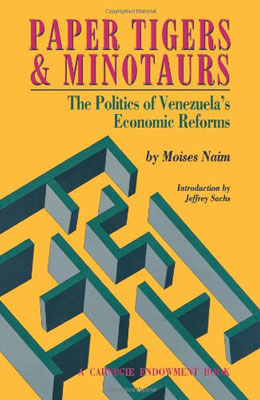
Paper Tigers and Minotaurs: The Politics of Venezuela's Economic Reforms
Book

Paper Tigers and Minotaurs: The Politics of Venezuela's Economic Reforms

Weakened public institutions, military reform, and public opinion in the face of rapid change have opened the door for corruption, inequitable distribution of burdens, and political instability in South America. Countries in the region are facing painful and sometimes dangerous reform.

Link Copied
By Moisés Naím
Published on Jan 1, 1993

Additional Links

Paperback - $5.95

Source: Washington

Based on Moisés Naím's experiences as Minister of Industry in rapidly changing Venezuela and as Executive Director at the World Bank, this book raises questions and explores problems crucial to political and economic reform. Dr. Naím grapples with entrenched interests bent on derailing reform, the corrosive effects of corruption, the inequitable distribution of burdens, political instability brought on by weakened public institutions, military reform, and public opinion in the face of rapid change. After the revolutionary political and economic changes of the 1980s and early 1990s, the countries of South America—and many other countries all over the world—are facing painful and sometimes dangerous reform. Dr. Naím's book tackles the subject of managing that reform.

Advance Praise

“This book is a timely and relevant contribution for rethinking both the content and the process of future reform attempts.”
—Miriam Kornblith, Universidad Central de Venezuela

“The story is well-told and the lessons valuable for those interested in under-standing, as well as making, economic policy."
—Robert Grosse, University of Miami

About the Author

Moisés Naím

Distinguished Fellow

Moisés Naím is a distinguished fellow at the Carnegie Endowment for International Peace, a best-selling author, and an internationally syndicated columnist.

    Recent Work

  • Research
    The World Reacts to Biden’s First 100 Days
      • +10

      Rosa Balfour, Frances Z. Brown, Yasmine Farouk, …
  • Commentary
    View From Latin America

      Moisés Naím

Moisés Naím
Distinguished Fellow
Moisés Naím
North AmericaSouth AmericaTrade

Carnegie does not take institutional positions on public policy issues; the views represented herein are those of the author(s) and do not necessarily reflect the views of Carnegie, its staff, or its trustees.

More Work from Carnegie Endowment for International Peace

  • Photo of garment workers sewing jeans in Kenya.
    Article
    The Strategic Stakes of AGOA Reform and Renewal

    Strengthening U.S.-Africa trade and advancing U.S. interests aren’t conflicting goals.

      • Tyler Beckelman
      • Kholofelo Kugler

      Tyler Beckelman, Kholofelo Kugler

  • Chinese President Xi Jinping interacts with U.S. President Donald Trump during a state banquet at the Great Hall of the People on May 14, 2026 in Beijing, China.
    Commentary
    Post U.S.-China Summit: Managed Instability

    The U.S.-China Summit produced a welcome commitment to build a constructive, strategically stable relationship. However, the United States has a full agenda, including the USMCA review beginning this week, that will likely target Chinese practices of concern. If China views these efforts as inconsistent with the agreements reached in Beijing, it may slow or halt progress in response. 

      • Barbara Weisel

      Barbara Weisel

  • Commentary
    Carnegie Politika
    Russian Market Sours for Belarusian State Companies

    Minsk’s faith in the future of its larger neighbor’s economy is fading as Belarusian firms in Russia see record losses.    

      Olga Loiko

  • Commentary
    Carnegie Politika
    Did Putin Return From China Empty-Handed?

    With no key agreement signed on the Power of Siberia 2 gas pipeline, there is a risk that the window of opportunity for Russia will close if Chinese power generation becomes so green that new gas sources are no longer of any interest to Beijing.

      • Alexander Gabuev

      Alexander Gabuev

  • Article
    Continental Asia and the Rise of Portfolio Politics

    “Central Asia” as an analytical category is itself part of the problem. The term is a Soviet administrative inheritance, drawn along lines that served the convenience of Moscow. The Central Asian states the Soviets named no longer see themselves through this category alone and are not aligning across political blocs but are instead building external partnerships sector by sector, assigning different partners to different functions.

      Jennifer B. Murtazashvili

Get more news and analysis from
Carnegie Endowment for International Peace
Carnegie global logo, stacked
1779 Massachusetts Avenue NWWashington, DC, 20036-2103Phone: 202 483 7600
  • Research
  • Emissary
  • About
  • Experts
  • Donate
  • Programs
  • Events
  • Blogs
  • Podcasts
  • Contact
  • Annual Reports
  • Careers
  • Privacy
  • For Media
  • Government Resources
Get more news and analysis from
Carnegie Endowment for International Peace
© 2026 Carnegie Endowment for International Peace. All rights reserved.