• Research
  • Emissary
  • About
  • Experts
Carnegie Global logoCarnegie lettermark logo
DemocracyIran
  • Donate
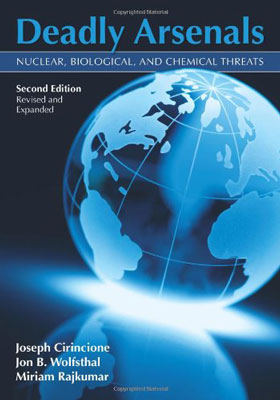
Deadly Arsenals: Nuclear, Biological, and Chemical Threats, <i>Second Edition, Revised and Expanded</i>
Book

Deadly Arsenals: Nuclear, Biological, and Chemical Threats, <i>Second Edition, Revised and Expanded</i>

The revised and expanded edition ofDeadly Arsenals provides the most up-to-date and comprehensive assessment available on global proliferation dangers, with a critical assessment of international enforcement efforts.

Link Copied
By Joseph Cirincione, Jon Wolfsthal, Miriam Rajkumar
Published on Jul 10, 2005

Additional Links

Table of ContentsChapter OnePaperback - $29.95iTunes - $15.99Nook - $12.64Kindle - $22.99
Program mobile hero image

Program

Nuclear Policy

The Nuclear Policy Program aims to reduce the risk of nuclear war. Our experts diagnose acute risks stemming from technical and geopolitical developments, generate pragmatic solutions, and use our global network to advance risk-reduction policies. Our work covers deterrence, disarmament, arms control, nonproliferation, and nuclear energy.

Learn More

Source: Washington

Deadly Arsenals provides the most up-to-date and comprehensive assessment available on global proliferation dangers, with a critical assessment of international enforcement efforts. An invaluable resource for academics, policy makers, students, and the media, this atlas includes strategic and historical analysis; maps, charts, and graphs of the spread of nuclear, chemical, and biological weapons and missile delivery systems; descriptions of the weapons and regimes—and policies to control them; and data on countries that have, want, or have given up these deadly weapons. A CHOICE outstanding academic title from one of the premier non-proliferation research teams.

The new edition addresses the recent, dramatic developments in Iran, Iraq, Libya, North Korea, and the nuclear black market, analyzing strategic and policy implications.

On July 12, 2005, the authors of this new study presented their findings and then chaired a discussion and debate with experts from the audience. Click here to go to the LIVE AT CARNEGIE site, featuring archived audio and a slideshow presentation with new maps and charts from the book.

About the Authors

Joseph Cirincione previously served as a senior associate and director for Non-Proliferation at the Carnegie Endowment for International Peace, and is coauthor of the major Carnegie report, Universal Compliance: A Strategy for Nuclear Security and editor of Repairing the Regime: Preventing the Spread of Weapons of Mass Destruction (Routledge, 2000).

Jon B. Wolfsthal is former associate and deputy director for non-proliferation at the Carnegie Endowment. He is coauthor of Universal Compliance and coeditor of Nuclear Status Report: Nuclear Weapons, Fissile Material, and Export Controls in the Former Soviet Union (Carnegie/Monterey, 2001).

Miriam Rajkumar is former project associate for nonproliferation at the Carnegie Endowment.

Advance Praise

"[A] comprehensive and useful guide to nuclear and CBW proliferation issues, and an essential companion to the SIPRI Yearbook.”
—Pierre-Emmanuel Dupont, Caucasian Review of International Affairs

About the Authors

Joseph Cirincione

Former Senior Associate, Director for NonProliferation

Jon Wolfsthal

Former Nonresident Scholar, Nuclear Policy Program

Jon Wolfsthal was a nonresident scholar with the Nuclear Policy Program.

Miriam Rajkumar

Former Associate, Non-Proliferation Project

Authors

Joseph Cirincione
Former Senior Associate, Director for NonProliferation
Joseph Cirincione
Jon Wolfsthal
Former Nonresident Scholar, Nuclear Policy Program
Jon Wolfsthal
Miriam Rajkumar
Former Associate, Non-Proliferation Project
Miriam Rajkumar
United StatesNuclear Policy

Carnegie does not take institutional positions on public policy issues; the views represented herein are those of the author(s) and do not necessarily reflect the views of Carnegie, its staff, or its trustees.

More Work from Carnegie Endowment for International Peace

  • Commentary
    Diwan
    Firepower Against Willpower

    In an interview, Naysan Rafati assesses the first week that followed the U.S. and Israeli attack on Iran.

      Michael Young

  • A missile tail embedded in the ground in an open field with green ground cover and a blue sky.
    Commentary
    Emissary
    Turkey Has Two Key Interests in the Iran Conflict

    But to achieve either, it needs to retain Washington’s ear.

      Alper Coşkun

  • Commentary
    Diwan
    What Is Israel’s Plan in Lebanon?

    At heart, to impose unconditional surrender on Hezbollah and uproot the party among its coreligionists.

      Yezid Sayigh

  • people watching smoke rising at sunrise from rooftops
    Commentary
    Emissary
    Bombing Campaigns Do Not Bring About Democracy. Nor Does Regime Change Without a Plan.

    Just look at Iraq in 1991.

      Marwan Muasher

  • Satellite of a damaged oil refinery
    Commentary
    Emissary
    Iran Is Pushing Its Neighbors Toward the United States

    Tehran’s attacks are reshaping the security situation in the Middle East—and forcing the region’s clock to tick backward once again.

      Amr Hamzawy

Get more news and analysis from
Carnegie Endowment for International Peace
Carnegie global logo, stacked
1779 Massachusetts Avenue NWWashington, DC, 20036-2103Phone: 202 483 7600Fax: 202 483 1840
  • Research
  • Emissary
  • About
  • Experts
  • Donate
  • Programs
  • Events
  • Blogs
  • Podcasts
  • Contact
  • Annual Reports
  • Careers
  • Privacy
  • For Media
  • Government Resources
Get more news and analysis from
Carnegie Endowment for International Peace
© 2026 Carnegie Endowment for International Peace. All rights reserved.