

Commentary
AI capabilities are moving fast. Most institutions—including governments—can’t keep up.
Anton Leicht, Scott Singer
Source: Getty
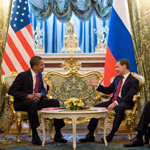
Opponents of the START follow-on agreement are employing scare tactics to impede Senate ratification of the treaty at the long-term risk of imperiling national security.
Senators Kyl, McCain, and Lieberman are troubled by Russia’s alleged intransigence over missile defenses at a time when many observers believe the START follow on (a.k.a. New START) negotiations to be all but finished. In a recent letter to National Security Advisor James L. Jones obtained by Josh Rogin at Foreign Policy’s The Cable, these Senators expressed their concern that the Obama administration will be so eager to conclude this modest nuclear arms reduction agreement that they will trade U.S. freedom of action on missile defenses for Russian buy-in. Senator Kyl expressed a similar view on the Senate floor in November of last year when he suggested that “we have entered an endgame where the Russians may feel that the U.S. wants the START follow-on agreement more than they do.” Perhaps. But there is no reason to believe the administration will prioritize “deadline diplomacy” over concluding a treaty in the national interest.
Twice already the administration has ignored self-imposed deadlines to get this treaty right. First, talks continued past the December 5 expiration date of the original treaty, at which point the U.S. and Russia agreed to abide by the terms of the first START agreement as if it were still in force. Then, the administration missed President Obama’s deadline to conclude a treaty by year’s end as pledged in his April 2009 speech in Prague. This is not the behavior of an Administration willing to sacrifice the quality of the agreement for expediency’s sake.
Additionally, it is curious that in their letter Senators Kyl, McCain, and Lieberman would not insist on including a withdrawal clause in a START follow-on treaty. Such clauses hedge against an uncertain future in which the fundamental assumptions of an international agreement may change. By rejecting a withdrawal clause in the new treaty, Senators Kyl, McCain, and Lieberman advocate hamstringing the ability of a future President or Congress to make critical national security decisions.
The inclusion of withdrawal clauses is not only customary in international treaties in general, but in arms control agreements with Russia in particular. Both the 1991 Strategic Arms Reduction Treaty (START I) and the 1993 START II, signed by President George H.W. Bush include provisions for withdrawal (Article XVII, Item 3; Article VI, Item 4). The 2002 Strategic Offensive Reductions Treaty (SORT), signed by President George W. Bush also includes a withdrawal provision (in Article IV, Item 3). And most notably, the United States invoked the withdrawal clause of the Anti-Ballistic Missile Treaty (Article XV, Item 2) when it backed out of the treaty on December 13, 2001, citing fundamental changes to its national security priorities. Excluding a similar provision would not only fly in the face of international precedent, but would also unnecessarily limit U.S. sovereignty.
Moreover, neither a withdrawal provision nor a unilateral Russian declaration provides Moscow with additional leverage over U.S. missile defense decisions. In no way would such a clause limit the capability or the capacity of the U.S. to pursue missile defenses. Russian threats to back out of the START follow on treaty might influence U.S. calculations, but so do any number of international developments. The Senators are oversimplifying missile defense policy. The reality is that the future of U.S. missile defense deployments will be determined by more factors than just a bilateral arms control agreement with the Russians. For instance, and as was appropriate, the Obama administration’s September 2009 decision to revamp missile defense in Europe was driven by an updated assessment of the threat posed by Iranian missiles.
Finally, it is naive to presume, as recommended in the Senators’ letter, that the United States can prevent Russia from making unilateral declarations about withdrawal. It is both bizarre, inequitable, and counterproductive for the United States to insist on withdrawal clauses, exercise them contrary to international public opinion, and then to denounce Russia for seeking similar treaty provisions.
When the START follow-on treaty is completed and the ratification process begins, the Senate will have to decide between two alternative visions of international security. If they reject the treaty, they risk a world in which Russian missile developments go unmonitored and Russian nuclear posture goes unchecked. Or, they can ratify a treaty that does not in any way restrict the United States’ ability to field missile defenses while providing for reasonable and mutually verifiable reductions in the world’s two largest nuclear arsenals. Surely, the latter is the better choice.
Kimberly Misher and Brian Radzinsky are, respectively, research assistant and junior fellow in the Nuclear Policy Program at the Carnegie Endowment for International Peace.
Kimberly Misher
Former Program Manager, Nuclear Policy Program
Brian Radzinsky
Former Project Coordinator, Nuclear Policy Program
Carnegie does not take institutional positions on public policy issues; the views represented herein are those of the author(s) and do not necessarily reflect the views of Carnegie, its staff, or its trustees.
AI capabilities are moving fast. Most institutions—including governments—can’t keep up.


Anton Leicht, Scott Singer

The Bureau of Industry and Security needs to adjust its focus and practices to maintain its position as the U.S. government’s primary champion of international technological competition.

Geoffrey Irving

European Commission President Ursula von der Leyen is about to give her annual address on the state of the EU. Here’s what she won’t—but should—say.

Rym Momtaz

Depleted financial reserves and a shrinking tax base mean it is no longer possible to simultaneously deliver high defense spending, price stability, and economic growth.

Alexandra Prokopenko
Understanding the climatic pain points is necessary for policymakers hoping to minimize the war’s negative environmental consequences.



Alejandro Martin Rodriguez, Joy Arkeh, Sarah Yerkes