• Research
  • Emissary
  • About
  • Experts
Carnegie Global logoCarnegie lettermark logo
DemocracyIran
  • Donate
War in Saada: From Local Insurrection to National Challenge

Source: Getty

Paper

War in Saada: From Local Insurrection to National Challenge

The Yemeni government is mired in an unwinnable and sporadic civil conflict in the northern governorate of Saada that has weakened the central government, accelerated the economic crisis, and threatens global stability by emboldening al-Qaeda.

Link Copied
By Christopher Boucek
Published on May 5, 2010

Additional Links

Full Text
Program mobile hero image

Program

Middle East

The Middle East Program in Washington combines in-depth regional knowledge with incisive comparative analysis to provide deeply informed recommendations. With expertise in the Gulf, North Africa, Iran, and Israel/Palestine, we examine crosscutting themes of political, economic, and social change in both English and Arabic.

Learn More

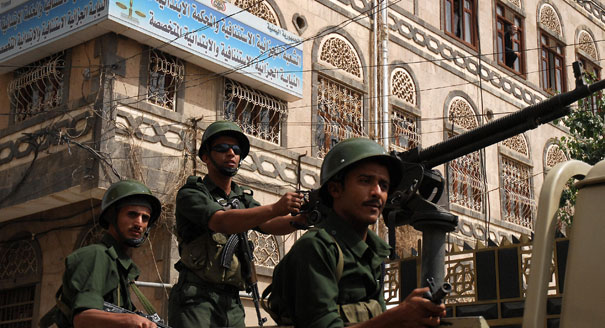
The Yemeni government has been mired in an unwinnable and sporadic civil conflict in the northern governorate of Saada since 2004. This war has weakened the central government, accelerated the economic crisis, and threatened global stability by emboldening al-Qaeda, concludes a paper by Christopher Boucek.

Key conclusions about the conflict in Saada:

  • Fighting likely to continue. The current cease-fire agreed to in February 2010 is likely to fail as the central government shows little interest in addressing the core grievances of the rebelling Houthis.
     
  • Priorities are misguided. The Southern secessionist movement is Yemen’s more serious security threat, but the regime is more involved in Saada for two key reasons: the government believes the war is winnable, and uses the military operations in the North to send a message to agitators in the South.
     
  • Costs are escalating. In the six years the war evolved from a local insurrection into a national challenge, devastating the economy and consuming crucial resources.
     
  • Burdens disproportionately felt by noncombatants. The six rounds of fighting came with high humanitarian costs. Hostilities displaced over 250,000 people, killed hundreds or thousands (the exact number of casualties is unknown), and destroyed significant civilian infrastructure.
     
  • Conflict expands beyond borders. When Saudi Arabia’s military entered the conflict in November 2009 following Houthi incursions, conditions went from bad to worse. But there is no evidence that the conflict in Saada is a proxy war between Saudi Arabia and Iran as commonly asserted.

“The government’s uncompromising position in Saada has exacerbated local grievances and rapidly accelerated Yemen’s economic crisis,” writes Boucek. “Without a serious international effort at mediation, further fighting is inevitable—and poses a serious threat to Yemeni stability.”

 

About the Author

Christopher Boucek

Former Associate, Middle East Program

Boucek was an associate in the Carnegie Middle East Program where his research focused on security challenges in the Arabian Peninsula and Northern Africa.

    Recent Work

  • Q&A
    Yemen After Saleh’s Return and Awlaki’s Exit

      Christopher Boucek

  • Q&A
    Rivals—Iran vs. Saudi Arabia

      Christopher Boucek, Karim Sadjadpour

Christopher Boucek
Former Associate, Middle East Program
Christopher Boucek
Middle EastYemenGulfPolitical ReformSecurityForeign Policy

Carnegie does not take institutional positions on public policy issues; the views represented herein are those of the author(s) and do not necessarily reflect the views of Carnegie, its staff, or its trustees.
More Work from Carnegie Endowment for International Peace

  • Map of Hormuz shipping traffic on a smartphone screen
    Commentary
    Emissary
    “It’s Not Like Turning a Switch On and Off”

    Why the Iran ceasefire isn’t a quick fix to the Strait of Hormuz energy crisis.

      Helima Croft, Aaron David Miller

  • Commentary
    Diwan
    The United States and Iran Have Agreed to a Two-Week Ceasefire

    Spot analysis from Carnegie scholars on events relating to the Middle East and North Africa.

      Michael Young

  • Commentary
    China’s Energy Security Doesn’t Run Through Hormuz but Through the Electrification of Everything

    Across Asia, China is better positioned to withstand energy shocks from the fallout of the Iran war. Its abundant coal capacity can ensure stability in the near term. Yet at the same time, the country’s energy transition away from coal will make it even less vulnerable during the next shock.


      • Damien Ma

      Damien Ma

  • Delegates watch as U.S. President Donald Trump speaks onstage at the World Economic Forum (WEF) on January 21, 2026 in Davos, Switzerland.
    Article
    Unstrategic Ambiguity: Trump’s Erratic Approach Leaves Europe Guessing

    The behaviors, public statements, and policies of Donald Trump’s administration have perverted America’s strategic posture toward Europe.

      Dan Baer, Erik Brown

  • Commentary
    Strategic Europe
    On NATO, Trump Should Embrace France Instead of Bashing It

    Donald Trump’s repudiation of NATO goes against the Make America Great Again vision of a U.S.-centered foreign policy. If the goal is to preserve the alliance by boosting Europe’s commitments, leaning into France’s vision is the most America First way forward.

      • Rym Momtaz

      Rym Momtaz

Get more news and analysis from
Carnegie Endowment for International Peace
Carnegie global logo, stacked
1779 Massachusetts Avenue NWWashington, DC, 20036-2103Phone: 202 483 7600Fax: 202 483 1840
  • Research
  • Emissary
  • About
  • Experts
  • Donate
  • Programs
  • Events
  • Blogs
  • Podcasts
  • Contact
  • Annual Reports
  • Careers
  • Privacy
  • For Media
  • Government Resources
Get more news and analysis from
Carnegie Endowment for International Peace
© 2026 Carnegie Endowment for International Peace. All rights reserved.