

Q&A
- +1
Sheena Chestnut Greitens, Oriana Skylar Mastro, Yukon Huang, …
Source: Getty
By relying on low-interest loans to catalyze economic growth, China’s growth model resembles that of a huge development bank. While this approach has been successful so far, it remains to be seen whether it can be sustained.
No country seems to generate such disparate and heated views on its economy as China.
The optimists see China as an irrepressible force. They point to its near double-digit growth rate, which has persisted for three decades; the 500 million people it has lifted out of poverty; and its rise to become the world’s second-largest economy.
The pessimists, on the other hand, see China as a house of cards, built on a repressed financial system that exacerbates global trade imbalances and encourages wasteful public expenditures. They believe it faces imminent collapse, including the implosion of an inflated real estate bubble.
Which characterization is closer to the truth? Neither. But there is a way of interpreting Chinese development that sheds some light on its economic approach. That model is the one adopted by multilateral development institutions, including the World Bank and the Asian Development Bank.
The multilateral development banks aim to accelerate growth in developing countries, motivated by the conviction that the immense income disparities between high-income and emerging market countries are untenable. With per-capita incomes in OECD countries some 100 times those of the poorest 1 billion people, not only do economic and trade tensions exist, but political frictions also emanate from civil strife, environmental degradation, and cross-border migration driven by despair as much as opportunity.
Developing sustainable solutions to these problems will require that developing countries grow more rapidly and in ways that preserve the global commons, from forests to fisheries and the atmosphere.
Moreover, the action of development banks to encourage growth in emerging countries is justified by market imperfections that are at the heart of underdevelopment. These include scarcity of information on potential investment returns and risks, as well as weak financial and fiscal institutions that are unable to secure and allocate resources with due regard to social considerations. The development banks seek to correct this by capturing some of the positive externalities inherent in the development process—benefits that markets, left to their own devices, fail to include.
The development banks’ strategy for catalyzing growth in developing countries is to subsidize loans to them, which in turn lowers the cost to their ultimate beneficiaries—typically, local authorities, households, and firms.
The development banks’ strategy for catalyzing growth in developing countries is to subsidize loans to them, which in turn lowers the cost to their ultimate beneficiaries—typically, local authorities, households, and firms. Such assistance enables developing countries—whose fragile fiscal and banking systems exclude them from access to commercially priced lending, or make it prohibitively expensive—to secure resources for investments such as infrastructure and social programs, which have high social returns but whose risk-adjusted return is perceived to be unacceptably low by markets.
The implicit or explicit subsidy to the loans comes from budget transfers or guarantees from advanced countries. Institutions like the World Bank and the Asian Development Bank can borrow in international capital markets on favorable terms because repayment of their loans is guaranteed—first, by the recipient governments and, second, by the banks’ shareholding governments. Thus, despite skepticism of the viability of loans to regimes as diverse as Sudan, Myanmar, Zimbabwe, and Afghanistan, the loan-loss history of development banks has been remarkably reassuring and the financial soundness of the development banks has rarely been questioned. Development banks have also been at the forefront of encouraging outward-oriented growth strategies, based on integration into global markets.
China’s growth model resembles that of a huge development bank: it relies on low-interest loans to catalyze growth and makes those low rates possible by reducing the incentives to consume and providing sovereign guarantees.
By keeping interest rates relatively low, China can tap household savings to subsidize lending. This represents a transfer from current consumption of households in favor of investment. But if these investments generate sufficiently high returns, the economy grows faster than it would have otherwise, enabling China to maximize household consumption over time.
In reality, personal consumption has been increasing at an impressive rate of 8–9 percent annually for two decades. Thus, because its subsidized investment has been so successful and may not have occurred otherwise, China’s model has arguably led to sustainably higher, not lower, consumption levels—contrary to the common perception.
This approach is not new. Decades ago, the “Asian Miracle” paradigm underscored the success of the industrializing East Asian tigers in shaping incentives to support a high-savings-cum-investment, export-led strategy. The Commission on Growth and Development, which assessed the experiences of a select group of successful developing countries (including China), also noted the importance of high investment and outward-oriented strategies in accelerating growth.
The model used by the development banks and China generates important weaknesses and risks. Because lending is subsidized and the benefits are hard to evaluate, the potential for waste is significant.
For China, this means that curbing current consumption in favor of higher investment is sustainable only if it results in growth acceleration. Moreover, the government cannot rely indefinitely on state-owned banks to subsidize investment; investments have to generate adequate returns.
Currently, as is typical of centrally planned economies in transition, China’s fiscal system is inadequate to meet the country’s needs, given the dominant role the central government plays in public expenditures. So the government instead relies on state-owned banks to channel additional resources to local authorities and specialized agencies for infrastructure and social programs.
Over time, however, the country’s fiscal and financial systems must develop, so that its “directed” lending—loans driven by policy and not commercial objectives—can be done through budgetary channels rather than banks. This would require increasing the share of public revenues that flows into the fiscal system from the current 20 percent of GDP to closer to 30 percent, as well as getting commercial banks out of lending for projects that would normally be funded by the budget. This would improve transparency and reduce risks. It would also mean undertaking a major fiscal reform to transform non-performing loans—which are actually quasi-fiscal deficits—into line items in the budget.
Recent claims about waste and corruption suggest that China’s leaders need to pay more attention to the quality, and less to the quantity, of public expenditures.
Because China’s major banks are state-owned, however, the soundness of China’s financial system depends on the creditworthiness of the state (much like the viability of the multilateral development banks rests on the solidity of their sovereign guarantees). However, the country’s high savings rate, which exceeds 50 percent of GDP, and three trillion dollars in foreign exchange reserves imply that a significant surge in non-performing loans would likely lead to a controlled scaling back of lending rather than a full-blown financial collapse.
The key question, therefore, is whether the quality of government-sponsored investment and expenditures continues to justify the transfers from ordinary consumers and for how long.
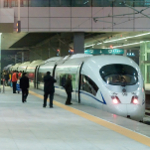
China’s pattern of above-normal productivity increases, surging FDI inflows motivated by double-digit returns on investment, and consistently high GDP growth has until lately suggested that investments and expenditures have been efficient in the aggregate. But recent claims about waste and corruption—as exemplified by China’s high-speed rail program and other stimulus-supported initiatives—suggest that leaders need to pay more attention to the quality, and less to the quantity, of public expenditures.
The World Bank, for example, has also experienced periods when excessive lending to countries with poor economic policies did not generate sustained growth and only contributed to debt-servicing problems later. Its response was to tighten lending standards, a policy China should consider since much of its recent lending has gone to local authorities for expenditures that have been difficult to monitor or evaluate.
And, just as the World Bank and other development banks face scrutiny on the broader impact of their lending activities, including poverty and governance implications, China needs to consider the sustainability of its growth process, including its effect on the environment and internal equity, which senior leaders have recognized as key challenges facing the country.
Yukon Huang is a senior associate in the Carnegie Asia Program. He formerly served as the World Bank's country director for China.

Senior Fellow, Asia Program
Huang is a senior fellow in the Carnegie Asia Program where his research focuses on China’s economy and its regional and global impact.
Recent Work


Sheena Chestnut Greitens, Oriana Skylar Mastro, Yukon Huang, …


Yukon Huang, Isaac B. Kardon, Matt Sheehan
Carnegie does not take institutional positions on public policy issues; the views represented herein are those of the author(s) and do not necessarily reflect the views of Carnegie, its staff, or its trustees.

With its public finances in shambles, the far right polling at 35 percent ahead of the 2027 presidential election, and a growing protest movement, is France’s crisis a threat to the EU’s geopolitical awakening?

Rym Momtaz, ed.

Russian strikes are weakening the economy sustaining Ukraine’s war effort. Closing the growing funding gap will require more European support and politically contentious reforms in Kyiv.

Balázs Jarábik

While the EU and European governments are embracing the much-lauded middle-power moment, this entails three difficult conundrums.

Richard Youngs

Europe is facing rising populism internally as well as external pressures from Russia, China, Turkey, and the United States.

Dimitar Bechev

Economic recovery has brought Sri Lanka a modicum of stability, but domestic strains and great-power rivalry could test how long it lasts.

Avinash Paliwal