

Article
Marina Ottaway, Omar Hossino
Source: Getty
The fact that Morsi’s victory was allowed to stand marks a major change in Egypt, but it is only one step in a process of transformation that will take time, be punctuated by many acrimonious battles, and in the end may not lead to democracy
The announcement that the Muslim Brotherhood’s candidate, Mohamed Morsi, won Egypt’s presidential election is the first piece of good news for the transition in two weeks. After dissolving the parliament and assuming legislative functions, amending the constitutional declaration it had issued in March 2011 in order to increase its own power and protect the military from civilian oversight, and de facto asserting its control over the writing of the new constitution, the Supreme Council of the Armed Forces (SCAF) did not dare to go the last step and also declare Ahmed Shafiq, its preferred candidate and a representative of the old regime, the winner.
It was a close call. It took the presidential election commission a week after the run-off vote to pronounce a winner, with the time spent not on recounting votes and examining complaints, but deciding whether the SCAF dared to claim that Morsi lost.
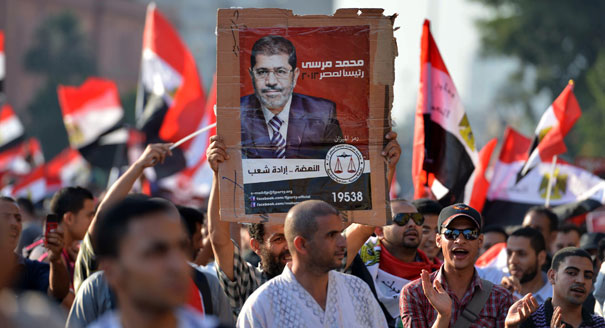
Morsi’s victory does not mean that democracy has triumphed in Egypt. This is just one episode in a battle for change that will unfold for years and will undeniably continue to be difficult.The scenes of jubilation in Tahrir Square cannot obscure the fact that only one in four potential voters cast their ballots for the Muslim Brotherhood’s candidate. True, about 50 percent of eligible voters failed to go to the polls at all, but Shafiq was not far behind Morsi in the number of votes he received. While Islamists and the so-called revolutionary youth are celebrating, many other Egyptians are worried about the future. Among them are Copts and many women.
And many of the secular parties that controlled about 30 percent of the seats in the now dissolved parliament are already crying foul, accusing the Muslim Brotherhood of engaging in shady deals with the military and competing unfairly with the true democratic forces in the country—namely themselves.
Egypt has dodged the possibility of a complete restoration of the old regime, which would have been the case had Shafiq been declared the winner. But the old regime is still very much alive and will fight new battles with the Muslim Brotherhood and other groups that want political change to continue.
Two battles will certainly be fought in the next few months, and a third one is also a distinct possibility. The first is the battle over the new constitution. With the recently issued amendments to the constitutional declaration, the SCAF has demonstrated that it will seek to control the process by giving itself and the courts veto power over any article that they disapprove of. In fact, it is likely that the SCAF will even appoint a new constituent assembly. The Muslim Brotherhood has already denounced the constitutional declaration, but the SCAF is unlikely to give in on that point after conceding Morsi’s triumph.
The second battle is the election of the new parliament that should take place soon after the constitution is adopted, probably sometime in the fall. Opponents of the Muslim Brotherhood are already predicting that Islamists will not win as many seats as they did earlier this year, because many Egyptians no longer trust them. This may be true, but it is impossible to verify at this point. What is clear, however, is that the secular parties that claimed that their past performance in the elections was poor because they did not have adequate time to organize do not appear to be making the massive effort to build their parties that they need in order to be successful the next time around.
A third battle may also loom over the country in the next few months—a new presidential election. SCAF representatives have already hinted that a fresh presidential election will have to be held after the constitution is enacted. While this possibility was never discussed earlier, it would be easy to write the requirement for new presidential elections into the new charter, thus making the Morsi presidency a short-lived one.
The outcome of these battles will depend largely on the decisions taken by the SCAF and more broadly the institutions and personalities of the old regime and by the Muslim Brotherhood’s reactions. The old regime still controls the institutions and it has shown recently that it is determined to use its control, particularly over the courts, to curb the Muslim Brotherhood. The Islamists can mobilize the street and the large crowds we have seen celebrating could easily turn into angry mobs.
An important test of things to come is the outcome of two highly political legal suits currently pending in front of the administrative court—one seeking to ban the Muslim Brotherhood and one seeking to ban its Freedom and Justice Party. Both cases will be adjudicated in September and the decisions could dramatically affect the parliamentary elections and the stability of the country.
Another test is the Muslim Brotherhood’s willingness and ability to form alliances. Islamists have demonstrated that they enjoy both popular support and effective organization. What they have not shown so far is much interest in working effectively with other political forces seeking change. Morsi is now saying that he intends to reach out to other political parties and independents and form a broad cabinet, but this remains to be seen.
The fact that Morsi’s victory was allowed to stand marks a major change in Egypt. Morsi is the first president that came to power on the basis of a popular vote rather than by rising through the ranks of the military. But it is only one step in a process of transformation that will take time, be punctuated by many acrimonious battles, and in the end may not lead to democracy. Egyptians are right to celebrate, but they have more fights ahead.

Former Senior Associate, Middle East Program
Before joining the Endowment, Ottaway carried out research in Africa and in the Middle East for many years and taught at the University of Addis Ababa, the University of Zambia, the American University in Cairo, and the University of the Witwatersrand in South Africa.
Recent Work
Marina Ottaway, Omar Hossino
Marina Ottaway
Carnegie does not take institutional positions on public policy issues; the views represented herein are those of the author(s) and do not necessarily reflect the views of Carnegie, its staff, or its trustees.
European reactions to the war in Iran have lost sight of wider political dynamics. The EU must position itself for the next phase of the crisis without giving up on its principles.

Richard Youngs
If the succession process can be carried out as Khamenei intended, it will likely bring a hardliner into power.

Eric Lob

Just look at Iraq in 1991.

Marwan Muasher
Tehran’s attacks are reshaping the security situation in the Middle East—and forcing the region’s clock to tick backward once again.

Amr Hamzawy

Only collective security can protect fragile economic models.

Andrew Leber