

Commentary
Olga Shumylo-Tapiola
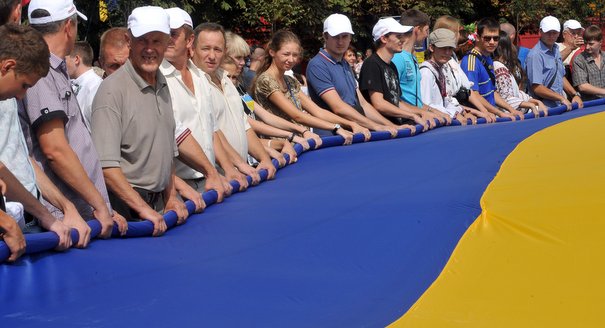
Source: Getty
Ukraine is believed to be one step from joining the Eurasian Customs Union, and Ukrainians may be the only ones who can help stop this eastward slide.
Ukraine is believed to be one step from joining the Eurasian Customs Union, with President Viktor Yanukovych reportedly planning to go to Moscow and sign agreements there on December 18. According to prominent members of Ukrainian civil society, the European Union is the only thing that can help stop this eastward slide.
All Brussels has to do, it is said, is sign the Association Agreement that would tie Ukraine to the European Union and all discussion about Kyiv’s orientation would come to a halt. When a group of Ukrainian experts sent a letter to EU leaders urging them to sign the agreement, that is what they implicitly meant. The Association Agreement has become a tool in a geopolitical fight between Brussels and Moscow, and Brussels will be assigned the role of the guilty party if Ukraine joins the Customs Union.
Kyiv has received invitations to all Moscow-led integration initiatives, including this one, but has managed to stay at arm’s length from most of them. And its suggestion of a 3+1 framework for cooperation that would have entailed free trade between the Customs Union and Ukraine was rejected by Moscow. This time, some Ukrainian experts suggest, the situation is different.There are many reasons to worry that Ukraine may indeed be moving eastward. The Ukrainian economy is not doing well, and it may need the money that would come from external players—and with the IMF freezing a stand-by loan for Ukraine, Russia is the only provider in town. Ukraine’s oligarchs need cheaper gas, and Russia promised a discount in return for Kyiv’s membership in the Customs Union. And Yanukovych and his aides seem to be testing the waters by talking about closer ties with Moscow. Last week, the Communist Party of Ukraine suggested holding a referendum on joining the Customs Union.
The necessary legal framework for this is in place after a new referendum law was signed in November. A referendum must be held if at least 3 million signatures are gathered in support of holding one. With the help of this law, the administration could easily falsify the signatures and potentially the voting results as well.
The EU can do little to help in this situation. It is not and should not be in the business of regime change or course reorientation. Brussels steps in with support when there is a need to build something. The Association Agreement is important because its implementation may help Ukraine finally break free of its Soviet past. But that transformation can happen only is there is focus on Ukraine and not on geopolitics.
In this spirit, only the Ukrainians themselves can help their own country. Long gone is the Ukraine in which local elites relied on external forces to protect them from their neighbors. In 2004, in independent Ukraine, the people’s massive protests during the Orange Revolution stopped former president Leonid Kuchma from pushing through Yanukovych, who was then prime minister, as president in falsified elections and discouraged the Kremlin from interfering in Kyiv’s domestic affairs in 2004. They should not try to put their responsibilities onto the EU’s shoulders now.
So what can Ukrainian citizens do to stop their country from joining the Customs Union?
Ukrainians must begin by viewing their situation less emotionally.
Yanukovych definitely intends to use the referendum law to bypass parliament on internal and foreign policy decisions. Yet, the law’s existence is not a sign of impending Customs Union membership. Yanukovych is likelier to use the law to grab more power and ensure his (or his protégé’s) reelection in 2015 rather than lose political and economic power by using the law to bring Ukraine into the Customs Union.
The oligarchs may push for cheaper gas rather than modernizing their factories and reducing their dependency on Russia. Yet, while they may get better access to Russian markets after many trade barriers between Ukraine and the Customs Union members are eliminated, they will lose in all other markets. Kyiv will have to adopt the Customs Union’s common external tariff, which is twice and sometimes three times higher than that of Ukraine. They will also not be immune from trade wars that still exist within the Customs Union. This will outweigh all possible benefits from cheaper gas.
An agreement on joining the Customs Union and the adoption of all other relevant documents needs to be ratified by parliament. The members of Yanukovych’s Party of Regions are unlikely to ecstatically vote for such a deal, let alone the opposition, which has more seats in parliament and is well equipped for the fight.
Even if the parliament would ratify Ukraine’s membership in the Customs Union, there would be two further barriers ahead. The first is the Ukrainian constitution, which prohibits surrendering sovereignty to a supranational body. But of course, the president may use the referendum law to change the constitution.
If he does so, Ukraine may be prevented from integrating into the Customs Union with the help of the WTO. Membership in the Customs Union will require the revision of Ukraine’s WTO commitments on customs tariffs. Kyiv’s recent attempt to raise the tariff ceiling for 371 goods was strongly opposed by all WTO members. Raising all tariffs may lead to long fights and demands from WTO members for compensation for their reduced access to the Ukrainian market.
Despite all of these barriers, the president may still wish to take Ukraine on a journey to the Customs Union. To prevent that, Ukrainians must take action. They should focus on Ukraine and make European integration a domestic issue, not a foreign policy tool.
Ukrainians can hit the administration with its own weapon: the referendum law. They should collect 3 million signatures to launch a referendum on whether Ukraine should meet the EU’s conditions and sign the Association Agreement. With over 50 percent of the population supporting European integration, gathering the necessary signatures should not be a problem. And it is doubtful the administration would try to rig this one.
To avoid future abuses, Ukrainians should use the referendum law to fix the deficiencies of the law itself. They should initiate a referendum on adding public oversight to the law and reducing the possibility of result manipulation. But Ukrainians must go further. They have to put issues that really trouble them—from corruption, to excessive presidential authority, to the tax code—up for referendum as well.
Ukrainians will also have to start a massive information campaign. The media proved to be the best fighter for freedoms this year by pushing the administration to abandon the libel law that would have imprisoned or heavily fined journalists found guilty of defamation. This potential should be used to highlight the benefits of closer integration with the EU. A picture of a farmer in Belarus contrasted with one in the EU, or a table with financial benefits from trade with the EU versus losses that Kazakhstan experienced after it raised tariffs because of Customs Union membership, will beat every nostalgic thought an ordinary Ukrainian might have about uniting with Russia.
The opposition in parliament must do its best to block any document that would reverse Ukraine’s European course, be that the ratification of the Customs Union membership or any other law that would deviate from the EU or Council of Europe’s norms.
Last but not least, Ukrainians can use the EU to fight their own administration. They can build alliances with Brussels based on mutual interests by, for instance, condemning the increase of customs tariffs by the Ukrainian administration—both today’s suggested increases and larger changes if Kyiv joins the Customs Union—that will be bad for both the Ukrainian economy and the EU. By defending their country’s interests and showing some empathy by addressing the EU’s concerns, Ukrainians can get much further than they imagine.

Former Nonresident Associate, Carnegie Europe
Shumylo-Tapiola is a nonresident associate at Carnegie Europe in Brussels, where her research focuses on Eastern Europe and Eurasia.
Recent Work
Olga Shumylo-Tapiola
Olga Shumylo-Tapiola
Carnegie does not take institutional positions on public policy issues; the views represented herein are those of the author(s) and do not necessarily reflect the views of Carnegie, its staff, or its trustees.

For every ruble allocated to social policy, health, and education in 2027, double that amount is earmarked for the army, the police, and the security services.

Alexandra Prokopenko

The acknowledgment has sparked fears of a new arms race with China and Russia.

Chris O’Meara
Smaller powers cannot go it alone, but Canadian history shows that integration with the United States will not always be benign.
Paul Samson

The European Commissioner for Trade is headed to China. But after President Xi’s bridge-building visit to Washington, can a more isolated EU overcome Beijing’s stranglehold on critical raw materials? Who will blink first?

Rym Momtaz, ed.

The summit may be remembered as a fatal blunder, when Washington, Beijing, and the AI industry collectively chose ceremony over action.

Jeffrey Prescott