


• Research
  • Emissary
  • About
  • Experts
Carnegie Global logoCarnegie lettermark logo
DemocracyIran
  • Donate
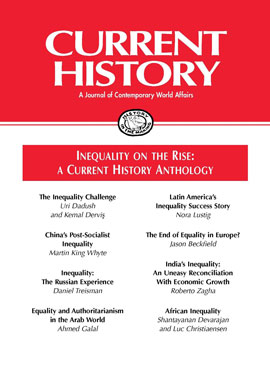
Inequality on the Rise: A Current History Anthology
Book

Inequality on the Rise: A Current History Anthology

Rising inequality and unfair disparities in incomes and opportunities is stirring controversy in both developing and advanced countries and could undermine the legitimacy of governments across the globe.

Link Copied
By Uri Dadush, Kemal Dervis, Martin King Whyte, Daniel Treisman, Ahmed Galal, Nora Lustig, Jason Beckfield, Roberto Zagha, Luc Christiaensen, Shantayanan Devarajan
Published on Jun 11, 2013

Source: Current History

Inequality is stirring controversy in developing and advanced economies. Perceptions of unfair disparities in incomes and opportunities can undermine the legitimacy of both authoritarian and democratic governments. Yet the problem is more complex than many on the right or left care to admit. Once it reaches certain levels, income inequality impedes economic growth; at other times it seems an unavoidable trade-off in the pursuit of growth. Finding the proper balance is more than a question of economic theory; it’s a moral and political dilemma.

The eight essays collected in this e-book appeared in Current History from 2012 to 2013 in a monthly series on inequality around the world. Together they form a useful guide to the topic that benefits from Current History’s region-by-region approach. Contributors include Uri Dadush and Kemal Derviş, who provide a global overview; Martin King Whyte on China; Daniel Treisman on Russia; Ahmed Galal on the Middle East; Nora Lustig on Latin America; Jason Beckfield on Europe; Roberto Zagha on India; and Luc Christiaensen and Shantayanan Devarajan on Africa. As their essays show, each of the world’s regions has struggled with the economics and politics of income distribution. Yet, as Dadush and Derviş note, “There is no secret to the recipes that governments can use to mitigate inequality.” The key ingredient may be political will.

About the Authors

Uri Dadush

Former Senior Associate, International Economics Program

Dadush was a senior associate at the Carnegie Endowment for International Peace. He focuses on trends in the global economy and is currently tracking developments in the eurozone crisis.

Kemal Dervis

Martin King Whyte

Harvard University

Daniel Treisman

Ahmed Galal

Egyptian Center for Economic Studies

Nora Lustig

Center for Global Development

Jason Beckfield

Harvard University

Roberto Zagha

Luc Christiaensen

World Bank

Shantayanan Devarajan

World Bank

Authors

Uri Dadush
Former Senior Associate, International Economics Program
Uri Dadush
Kemal Dervis
Martin King Whyte
Harvard University
Daniel Treisman
Ahmed Galal
Egyptian Center for Economic Studies
Nora Lustig
Center for Global Development
Jason Beckfield
Harvard University
Roberto Zagha
Luc Christiaensen
World Bank
Shantayanan Devarajan
World Bank
North AmericaPolitical ReformEconomyTrade

Carnegie does not take institutional positions on public policy issues; the views represented herein are those of the author(s) and do not necessarily reflect the views of Carnegie, its staff, or its trustees.

More Work from Carnegie Endowment for International Peace

  • Xi walking into a room with people standing and applauding around him
    Commentary
    Emissary
    The Xi Doctrine Zeros in on “High-Quality Development” for China’s Economic Future

    In the latest Five-Year Plan, the Chinese president cements the shift to an innovation-driven economy over a consumption-driven one.

      • Damien Ma

      Damien Ma

  • Commentary
    Carnegie Politika
    After Ilia II: What Will a New Patriarch Mean for Georgia?

    The front-runner to succeed Ilia II, Metropolitan Shio, is prone to harsh anti-Western rhetoric and frequent criticism of “liberal ideologies” that he claims threaten the Georgian state. This raises fears that under his leadership the Georgian Orthodox Church will lose its unifying role and become an instrument of ultraconservative ideology.

      Bashir Kitachaev

  • A white humanoid robot with a black head and hips stands behind a rope barrier. It stands with its feet apart, knees bent, and elbows raised at its sides.
    Commentary
    Europe Is Falling Behind in General-Purpose Robotics. Here’s What It Can Do to Catch Up.

    The continent needs to improve conditions for production of complete AI robotic systems and preserve its edge in hardware.

      Pavlo Zvenyhorodskyi

  • Worker pushing machinery toward a car frame
    Commentary
    Emissary
    Europe’s New Industrial Policy Can Learn From U.S. Mistakes

    Although the IAA often differs from the IRA, European policymakers can still take note of the U.S. act’s shortcomings.

      Milo McBride

  • Commentary
    Carnegie Politika
    What the Russian Energy Sector Stands to Gain From War in the Middle East

    The future trajectory of the U.S.-Iran war remains uncertain, but its impact on global energy trade flows and ties will be far-reaching. Moscow is likely to become a key beneficiary of these changes; the crisis in the Gulf also strengthens Russia’s hand in its relationships with China and India, where advantages might prove more durable.

      • Sergey Vakulenko

      Sergey Vakulenko

Get more news and analysis from
Carnegie Endowment for International Peace
Carnegie global logo, stacked
1779 Massachusetts Avenue NWWashington, DC, 20036-2103Phone: 202 483 7600Fax: 202 483 1840
  • Research
  • Emissary
  • About
  • Experts
  • Donate
  • Programs
  • Events
  • Blogs
  • Podcasts
  • Contact
  • Annual Reports
  • Careers
  • Privacy
  • For Media
  • Government Resources
Get more news and analysis from
Carnegie Endowment for International Peace
© 2026 Carnegie Endowment for International Peace. All rights reserved.









