

• Research
  • Emissary
  • About
  • Experts
Carnegie Global logoCarnegie lettermark logo
Democracy
  • Donate
Strategic Asia 2014-15: U.S. Alliances and Partnerships at the Center of Global Power
Book

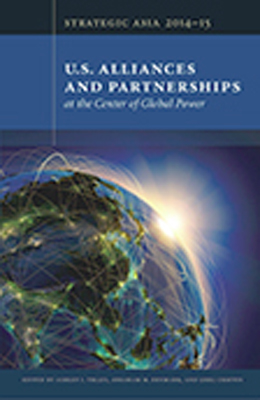
Strategic Asia 2014-15: U.S. Alliances and Partnerships at the Center of Global Power

This book analyzes the structure and impact of U.S. relations with Pacific countries on regional stability, both bilaterally and multilaterally.

Link Copied
By Ashley J. Tellis, Abraham M. Denmark, Greg Chaffin
Published on Dec 1, 2014
Program mobile hero image

Program

South Asia

The South Asia Program informs policy debates relating to the region’s security, economy, and political development. From strategic competition in the Indo-Pacific to India’s internal dynamics and U.S. engagement with the region, the program offers in-depth, rigorous research and analysis on South Asia’s most critical challenges.

Learn More

Source: National Bureau of Asian Research

Co-edited and introduced by Ashley J. Tellis, the 2014-15 Strategic Asia< volume examines the trajectories of U.S. alliance and partner relationships in the Indo-Pacific in light of the region’s shifting strategic landscape. Leading experts provide comprehensive assessments of the current state of the United States' relations with its five treaty allies, as well as with emerging "strategic partners" in Asia, and draw implications for U.S. policy.

Order this book, or read the introduction by Ashley J. Tellis for free.

About the Editors

Ashley J. Tellis is a Senior Associate at the Carnegie Endowment for International Peace and Research Director of the Strategic Asia Program at NBR, served in the U.S. Department of State as senior adviser to the Undersecretary of State of Public Affairs, and previously as senior adviser to the Ambassador at the U.S. Embassy in India. He also served on the National Security Council Staff as special assistant to the President and senior director for Strategic Planning and Southwest Asia. He is the author of India’s Emerging Nuclear Posture (2001) and co-author of Interpreting China’s Grand Strategy: Past, Present, and Future (2000), as well as the co-editor of the ten most recent volumes of Strategic Asia, published by NBR.

Abraham Denmark is Vice President for Political and Security Affairs at the National Bureau of Asian Research.

Greg Chaffin is a Project Manager with the Political and Security Affairs group at the National Bureau of Asian Research.

Authors

Ashley J. Tellis
Former Senior Fellow
Abraham M. Denmark
National Bureau of Asian Research
Greg Chaffin
North AmericaUnited StatesSouth AsiaIndiaEast AsiaSouth KoreaChinaTaiwanJapanSoutheast AsiaNorth KoreaIndonesiaEconomyTradeSecurityMilitaryForeign Policy

Carnegie does not take institutional positions on public policy issues; the views represented herein are those of the author(s) and do not necessarily reflect the views of Carnegie, its staff, or its trustees.

More Work from Carnegie Endowment for International Peace

  • Trump stands in front of a blue screen reading "Board of Peace"
    Paper
    U.S. Peace Mediation in the Middle East: Lessons for the Gaza Peace Plan

    As Gaza peace negotiations take center stage, Washington should use the tools that have proven the most effective over the past decades of Middle East mediation.

      • Sarah Yerkes

      Amr Hamzawy, Sarah Yerkes, Kathryn Selfe

  • Commentary
    Carnegie Politika
    Russia’s Unspoken Condition for Ending the War Is Zelensky’s Resignation

    Insisting on Zelensky’s resignation is not just a personal vendetta, but a clear signal that the Kremlin would like to send to all its neighbors: even if you manage to put up some resistance, you will ultimately pay the price—including on a personal level.

      Vladislav Gorin

  • Commentary
    Carnegie Politika
    For Putin, Increasing Russia’s Nuclear Threat Matters More Than the Triad’s Modernization

    For Putin, upgrading Russia’s nuclear forces was a secondary goal. The main aim was to gain an advantage over the West, including by strengthening the nuclear threat on all fronts. That made growth in missile arsenals and a new arms race inevitable.

      Maxim Starchak

  • Hochel stading behind a dais, with a hand raised
    Commentary
    Emissary
    With the RAISE Act, New York Aligns With California on Frontier AI Laws

    The bills differ in minor but meaningful ways, but their overwhelming convergence is key.

      Alasdair Phillips-Robins, Scott Singer

  • Commentary
    Strategic Europe
    Europolis, Where Europe Ends

    A prophetic Romanian novel about a town at the mouth of the Danube carries a warning: Europe decays when it stops looking outward. In a world of increasing insularity, the EU should heed its warning.

      Thomas de Waal

Get more news and analysis from
Carnegie Endowment for International Peace
Carnegie global logo, stacked
1779 Massachusetts Avenue NWWashington, DC, 20036-2103Phone: 202 483 7600Fax: 202 483 1840
  • Research
  • Emissary
  • About
  • Experts
  • Donate
  • Programs
  • Events
  • Blogs
  • Podcasts
  • Contact
  • Annual Reports
  • Careers
  • Privacy
  • For Media
  • Government Resources
Get more news and analysis from
Carnegie Endowment for International Peace
© 2026 Carnegie Endowment for International Peace. All rights reserved.











