

Arms supplies from Russia to Iran will not only continue, but could grow significantly if Russia gets the opportunity.
Nikita Smagin
This book examines how various countries and regions are coping with the Sino-U.S. competition and implications for U.S. policymakers.
Source: National Bureau of Asian Research
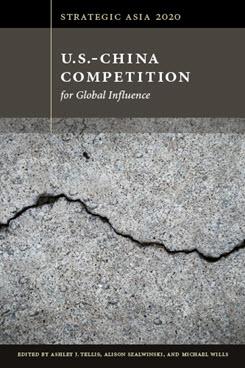
Co-edited and introduced by Ashley J. Tellis, the nineteenth volume in the Strategic Asia series—Strategic Asia 2020: U.S.-China Competition for Global Influence—will be published in January 2020. The new book will offer a forward-looking assessment of how the rivalry between China and the United States is playing out around the globe. Each chapter examines how a country or region (including Japan, South Korea, India, Taiwan, Russia, Oceania, Southeast Asia, Europe, and the Americas) is coping with the consequences of Sino-U.S. competition and draws implications for U.S. policymakers.
Read the introduction by Ashley J. Tellis for free or pre-order this book.
Ashley J. Tellis holds the Tata Chair for Strategic Affairs and is a senior fellow at the Carnegie Endowment for International Peace and Research Director of the Strategic Asia Program at the National Bureau of Asian Research (NBR).
Alison Szalwinski is vice president of research at NBR.
Michael Wills is executive vice president at NBR.
Former Senior Fellow
Ashley J. Tellis was a senior fellow at the Carnegie Endowment for International Peace.
Alison Szalwinski
National Bureau of Asian Research
Alison Szalwinski is assistant director for political and security affairs at NBR.
Michael Wills
National Bureau of Asian Research
Michael Wills is senior vice president for strategy and finance at NBR.
Carnegie does not take institutional positions on public policy issues; the views represented herein are those of the author(s) and do not necessarily reflect the views of Carnegie, its staff, or its trustees.
Arms supplies from Russia to Iran will not only continue, but could grow significantly if Russia gets the opportunity.
Nikita Smagin
On the fourth anniversary of Russia’s full-scale invasion, Carnegie experts discuss the war’s impacts and what might come next.
Eric Ciaramella, Aaron David Miller, Alexandra Prokopenko, …
The use of technology to mobilize Russians to vote—a system tied to the relative material well-being of the electorate, its high dependence on the state, and a far-reaching system of digital control—is breaking down.
Andrey Pertsev
New data from the 2026 Indian American Attitudes Survey show that Democratic support has not fully rebounded from 2020.
Sumitra Badrinathan, Devesh Kapur, Andy Robaina, …
A new draft regulation on “anthropomorphic AI” could impose significant new compliance burdens on the makers of AI companions and chatbots.
Scott Singer, Matt Sheehan











