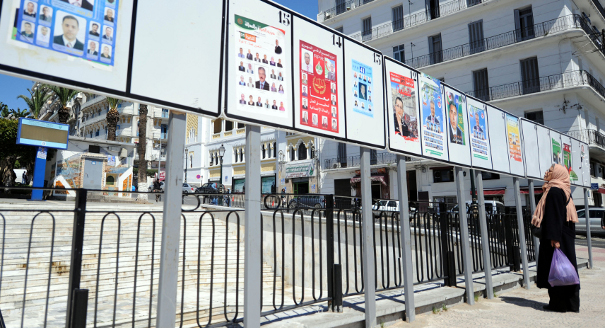
Following a conspicuous absence of large-scale protest movements—in sharp contrast to neighboring Tunisia and even to the smaller February 20th Movement in Morocco—Algeria’s election results point to a triumph of the status quo. While the recent elections in Tunisia, Egypt, and Morocco gave Islamist parties majorities in their respective parliaments, Algeria’s ruling National Liberation Front (FLN) maintains its leading position—and by far greater a margin than most observers predicted: with 221 seats out of 462. The other main government-allied party, the Democratic National Rally (RND), also did well, taking 70 seats. The United States and Europe seem to have taken the relatively poor showing of the Islamists as good news, but they would do well to take the FLN’s most recent consolidation with caution—and question themselves on whether or not they really want to carry on with business as usual in Algeria.
US Secretary of State Hillary Clinton hailed Algeria's elections, welcoming the large number of women elected (almost a third, up from seven percent in the outgoing house) and calling the vote a "welcome step" toward democratic reform. On the EU side, the head of the EU’s observer mission in Algeria Jose Ignacio Salafranca stated that the election “constitutes a first step on the path to reform which should lead to a deepening of democracy and human rights.”
Within Algeria, however, the election results have been extremely contentious. The three-party Islamist bloc known as “The Green Algeria Alliance”—comprised of the Movement of Society for Peace (MSP, or Hamas), the Islamic Renaissance Movement (Ennahda), and the Movement for National Reform (Islah)—accused the government of widespread election fraud. Others, such as the Rally for Culture and Democracy (RCD) and the opposition Socialist Front Forces (FFS) also declared that Thursday's vote "was riddled with irregularities." The Algerian National Front said it would challenge the results in the constitutional court. Among the most contested issues is that of the 43% voter turnout (as counted by the Ministry of the Interior)—a much higher figure that most expected. But as of yet, international observers have not raised any flags, and the European Union’s observer mission (which along with other foreign observers was allowed to monitor Algeria’s elections for the first time) even gave the elections a qualified endorsement. Salafranca listed shortcomings in some technical aspects of the election but added that there were “as many positive points as there were weak points.” A full assessment of the elections’ fairness of will have to await the release of the final reports.
Even so, however fair the elections may prove to be, one thing remains clear: more than half of registered voters boycotted the elections—even by the ministry of interior’s count, and despite President Bouteflika’s calls for a large turnout.
The Islamists’ weak showing—which seems to be the main focus in the international press—doesn’t necessarily indicate that the population is satisfied with the FLN—merely, they might be cautious of the alternatives. The fact that the Green Alliance only won 47 seats (13 less than they did in 2007) shocked many who expected the Islamists to fare better—especially in light of the recent 73-seat expansion of the People’s National Assembly (from 389 to 462). This might be surprising if we consider Algeria through a regional lens, but is less so when we remember Algeria’s recent history; these losses might indicate how heavily memory of the violence following the 1990s victories of Islamists continues to weigh. This history has provided the Algerian regime with even greater leverage than its regional counterparts to exploit anti-Islamist sentiments.
Additionally, these low results force us to consider the obvious, though neglected point that not all Islamist parties are alike and that in Algeria, many of their leaders are neither new to the political scene nor outsiders to power. The MSP—the dominant party in the Islamist bloc—was allied to the ruling FLN party only until shortly before the elections. Indeed, the movement’s last minute decision to run as an “opposition” contender seems somewhat cynical and politically manipulative, rather than a real commitment to oppose the ruling party. This perception, coupled with the only-too-recent relaxed conditions for the creation of new parties, suggests that the election results are not a great measure of voter satisfaction if we carefully examine the alternatives.
It would be wise for the US and Europe to keep these factors in mind when analyzing (and reacting to) the election. Instead, most diplomats have uttered a collective sigh of relief at a “stable” situation in the midst of the upheavals elsewhere. It seems that while dealing with Bouteflika’s authoritarian regime might be complicated, Algeria’s partners prefer to play by familiar rules; continuity ensures that their terms of engagement with the regime and the military are stable: access is provided to valuable natural resources, cooperation is assured on anti-terrorism policies, and joint measures are taken against illegal migration.
Even so, the future of the country remains dangerous and uncertain, especially given the strict restrictions on civil society. Fear of government reprisal has not stopped sporadic demonstrations, and the country is in need of a radical shift to a strict separation of powers. The civilian sphere must be strengthened, and the military must submit to the decisions of an elected civil government. Algeria should be a lesson against old habits; the U.S. and the EU should remember how the Arab Awakening started and throw out the pre-2011 rulebook—even in the countries that remain “stable.”
Barah Mikail is a senior researcher on the Middle East and North Africa at the Fundación para las Relaciones Internacionales y el Diálogo Exterior (FRIDE) in Madrid.