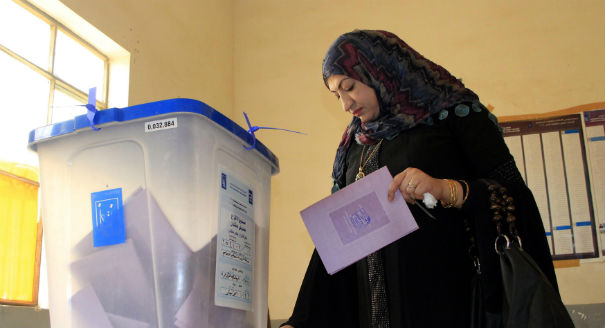
On June 27, 2013, Iraq’s Independent High Electoral Commission (IHEC) announced the final results of the provincial elections held in the two predominantly Sunni Arab provinces of Anbar and Ninawa. Voter turnout in Anbar reached 49.5%, but was significantly lower in Ninawa at 37.5%. The polls in Anbar and Ninawa were pushed from April (when the rest of Iraq’s provinces had their elections) to late June. The Kurdistan Regional Government (Dohuk, Erbil and Sulaimaniya) is expected to have theirs in September 2013. Prime Minister Nouri al-Maliki invoked “security concerns” to justify his decision to delay elections in both provinces—namely increasing insurgent attacks and assassinations of candidates and members of the armed forces. However, his decision was in fact primarily motivated by months of unprecedented anti-government protests carried out by politically marginalized and disenfranchised Sunni Arab populations. These protests first broke out in December 2012 following the unexpected arrest of several guards of former Finance Minister Rafi al-Issawi—an Anbar native linked to Iyad Allawi’s Iraqiyya bloc who has since resigned from government. The unrest then spread across other Sunni Arab provinces including Ninawa, Salahaddin, Diyala, Baghdad, and Tamim.
These provincial election results illustrate the enduring resentment and sociopolitical alienation of Sunni Arab populations over a decade after the fall of Saddam Hussein, and a clear weakening of the political process in the country. Compared to the 2009 elections, fewer Sunni Arab voters went to the ballot box, while political parties scattered among a variety of alliances. Once again, these elections demonstrated the difficulty for Sunni Arabs to organize themselves and define an effective action plan in their lasting confrontation with the Shia dominated central government. This has not only benefited al-Maliki’s State of Law coalition and its partners, but also the Kurdish parties in their regions.
Just as Sunni Arabs were marginalized under the U.S. occupation for their collective association with the former regime, most Sunni Arabs still have not been reintegrated into new institutions and face what they perceive to be discriminatory policies aimed at “de-Sunnifying” Iraq. In particular, they maintain that without the abolition of “de-Ba‘athification,” as well as certain laws and anti-terrorism provisions, political normalization will be impossible. Previously downplayed by the U.S. coalition, these demands have been met with disdain by the Shia-led government. In fact, instead of engaging in a dialogue, al-Maliki has persistently refused to involve the opposition—notably Sunni Arabs—in public debates and decision- making. In response, criticisms of this apparently authoritarian drift have mounted steadily in the last months.
While Sunni Arabs have long preferred to present themselves as the last defenders of Iraqi national unity, their identity has ostensibly “sectarianized” over time. This first became evident during the two military sieges of Fallujah in 2004, and then in 2006 with the rise of religious and ethnic violence, as well as open confrontations between Sunni insurgent groups and Shia militias. In 2010, many Sunnis who embraced the secular nationalistic discourse of the Iraqiyya bloc in the lead up to the parliamentary elections found themselves without a leader and without a voice. As a consequence, they increasingly started to give up on the idea of a peaceful settlement and embraced more radical positions such as separatism—several Sunni Arab provinces claimed the formation of an autonomous region in 2011—and renewed armed struggle. The Syrian crisis and its double dynamic of sectarianization and regionalization has also greatly contributed to the Sunni inward turn to identity politics.
However, the exacerbation of Sunni anger against the central government has not translated into any unified or coherent political leadership. Sunni political factions have continually failed to coordinate their positions to challenge the overwhelming influence of both the Shia and Kurdish camps. Despite common grievances, even the latest protests failed to coalesce into a homogeneous movement as actors remained divided by their conflicting objectives and ideologies.
The first protests of the “Sunni Arab Uprising” emerged in Ramadi in late 2012 and involved opposition figures—including Baghdad politicians, provincial authorities and members of the local establishment. The essential goal of the protests was to denounce the repressive measures enforced by al-Maliki and to accelerate the return of Sunni Arabs to the political scene. Most started as peaceful gatherings seeking to initiate a dialogue with Baghdad through mediation. In response, Sunni figures such as Deputy Prime Minister Saleh al-Mutlak and parliament speaker Osama al-Nujaifi met several times with Anbar political, tribal and religious leaders, in particular cleric Abd al-Malik al-Sa‘adi, the main spiritual guide for the demonstrators.
Attempts at a dialogue with Baghdad mostly failed, causing the fragmentation of the protest movement and the rise of more radical actors within its ranks. Al-Maliki’s unresponsiveness to the protesters’ demands and his unbridled use of repression—including the Hawija crackdown on April 23—further radicalized demonstrators, prompting violence and new calls for regional separation. Many Sunnis have been exposed to the propaganda of extremist elements that are working to exploit their frustrations. The outcome has been a militarization of the protests in many Sunni Arab cities—Falluja, Tikrit and Mosul for instance—and the emboldening of jihadist groups such as al-Qaeda’s Islamic State of Iraq and the “Neo-Ba‘athist” Army of the Men of the Naqshbandi Order (Jaysh Rijal al-Tariqa al-Naqshbandiyya). In the meantime, local tribes, some of which previously participated in the “Awakening” (Sahwa) movement, have been threatening to take up arms, while other political leaders have distanced themselves from the protests and eventually returned to government.
On many levels, the failure of the 2012-2013 protests to give birth to a strong Sunni Arab leadership and their perpetuation of intra-Sunni divides are reflected in the recent election results. These results indeed point to relentless splintering of the Sunni Arab landscape, and a decline in the influence of established forces, including Iraqiyya and the Mutahidun (United) coalition in Ninawa led by incumbent governor Atheel al-Nujaifi. They also clearly illustrate the disenchantment of most Sunni Arab voters who have gradually grown apart from their own leaders, blamed for not having brought any tangible progress, and have now become skeptical about both political participation and mobilization as useful strategies to make their voices heard. This may bring renewed violence in the coming months, particularly as the 2014 legislative elections approach. Already, a number of Sunni Arab forces have stated that self-defense would be justified in the face of Baghdad’s oppression or sectarian attacks. Furthermore, in the wake of Egypt’s second revolutionary round, several protest leaders have called on their followers to take to the streets again and bring down the regime. The coming months will likely elucidate Sunni Arabs’ willingness—or lack thereof—to adapt to Iraq’s new political balances and their capacity to form alliances that limit, or even reverse, their structural state of marginalization.
Myriam Benraad is a Middle East Research Fellow and Iraq Specialist at Sciences Po Paris.