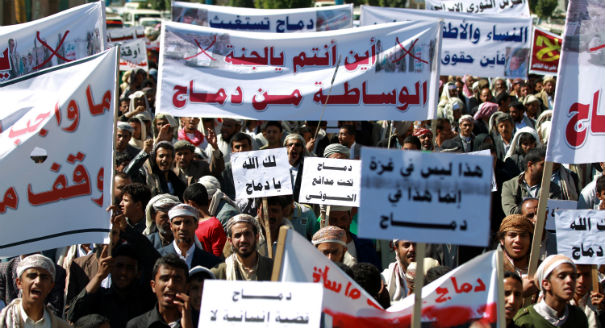
The past month has seen growing violence in Yemen’s northern Province of Saada, particularly around the town of Dammaj. Primarily an expression of the completion between the two main rival tribes, Hashid and Bakil, the conflict is the two tribes’ way of seeking power in the capital, Sanaa. In so doing, the two actors (referred to as the “two wings” of the state in Yemen), whose loyalty and support are paramount to ruling Yemen, look to gain even greater influence in national politics beyond their existing power base in the northern areas of the north.
After six wars between 2004 and 2010 with the government in Sanaa, Sayyid Abdul Malik al-Houthi, leader of the mostly Shi’a Bakil, controlled almost all of the province of Saada, in addition to many neighboring parts traditionally affiliated with the partly Sunni Hashid tribe under the leadership of sheikh Sadeq al-Ahmar (whose late father claimed to be the Hashid’s sheikh of sheikhs). However, despite growing control of the Houthis in the region, even in the heart of the predominately Shi’a Saada, there still is a prominent Salafi presence currently allied with the Hashid tribe. The Salafi presence in Saada is concentrated near Mount Barraqa and Dammaj—where they are largely limited to the Dammaj school, which has thousands of students from Yemen and abroad. Salafis remain a minority within Saada, and the peaceful ones swept up in the conflict gain increasing sympathy from other Yemeni citizens across the country, even abroad, as the underdogs in the conflict. Although the Dammaj school and its surrounding villages only cover about two square kilometers within large, mountainous Saada, they receive much support and sympathy from opponents of al-Houthi, among them the al-Ahmar family, the Sunni Islamist Islah party, and the newly formed Salafi Rashad Union Party—and therefore pose a threat to the dominant Houthi tribe. The Islah party, in particular the head of its Salafi wing Sheikh Abdul Majid al-Zindani, is using the oppressed status of Salafis in Saada to gain popular support for their party, already the largest opposition party in Yemen; and with this comes support for the party's goals in the ongoing National Dialogue Conference on all issues, not just the Saada working group. The Rashad Union Party, though they have little support among Salafis in Dammaj, is also conducting regular media campaigns in Sanaa, seeking to use the violence in Dammaj to show that the National Dialogue is ineffective in providing a secure transition. Because of this support for Dammaj from Hashid and Salafi powers, the Houthis feel their influence in the north is threatened, as well as their ability to influence politics nationally.
For President Abd Rabu Mansour Hadi, continued conflict in Dammaj could be advantageous, as it stands to gain him national relevance and influence if he manages to mediate a peace deal between the two tribes. President Hadi understands that the only thing currently keeping him in power is international support; a prolonged conflict in Saada would give him an opportunity to emerge as the arbiter between those involved in the sectarian-tribal war of Dammaj (his opponents, including al-Houthi, the al-Ahmar family, General Ali Mohsen, and members of the Islah party, among others), and thus be able to take advantage of their weakened positions to exert his own influence on national and regional politics. If Hadi’s efforts to build a compromise among these groups are successful, he may have some chance at remaining politically relevant beyond his interim presidency. This strategy, however, relies on the Saada conflict being too intractable for tribal actors to resolve. Hadi’s personal interests make him disinclined to resolve the tensions too soon, which risk endangering the entire National Dialogue and transition process by allowing the local conflict to sharpen divides at the national stage.
Other parties, especially detractors of Yemen’s revolution, would also stand to gain from the protracted conflict in the north, most significantly former President Ali Abdullah Saleh’s party, the General People's Congress (GPC). By not openly taking sides in the Dammaj war, they can claim the conflict highlights the contradictions and hostilities of the warring parties—al-Houthi, Islah, al-Ahmar, and General Mohsen—who were the main forces behind the 2011 revolution against Saleh. Now, Saleh’s allies are discrediting the revolution by pointing to the worsening security situation, as well as the ongoing violence and partisanship in Yemen. Already, this stance is showing positive results for the semi-secular GPC, which is gaining support among the many Yemenis convinced that the warring parties in Dammaj are using religion and sectarianism for political gain.
Although the Dammaj war is an internal Yemeni conflict and not a regional one, as it is sometimes portrayed, outside players—Saudi Arabia and Iran—stand to gain from the Sunni-Shi’a conflict playing out in Saada. Iran wants to help Houthi Shi’a to expand, primarily in an attempt build up a friendly political-military presence on Saudi border. Likewise, Saudi Arabia is pushing back by seeking to empower the Salafi Wahhabis across Yemen in order to strengthen its own influence in Yemeni politics. Al-Qaeda has also joined the fray as a player in the war against the Houthis, but the local Salafis have denied al-Qaeda’s involvement, perhaps as a way to deny al-Houthi the ability to say that he is fighting a terrorist organization.
The recent assassination of Abdul Kareem Jadban, Member of Parliament and member of the Saada working group in the National Dialogue, inside the capital Sanaa on November 22, 2013 and the assassination attempt on Mohammed al-Emad, editor-in-chief of the pro-Houthi al-Haweyah newspaper only one day earlier indicate that the Dammaj war is spilling over to Sanaa. Houthi-controlled checkpoints have been set up in areas like Joraf, in the northern part of Sanaa, and Houthi supporters in Sanaa’s change square have dug-up ditches and set up barricades near where they have been camped since 2011. This security situation in Sanaa worsened after the assassination of Jadban and after Houthi spokesman Ali al-Bukhaiti asked President Hadi to remove the Minister of the Interior and heads of intelligence—whom he accused of plotting the assassination. Najeeb Ghallab, a professor of politics at Sanaa University, stressed, “unlike the previous six wars with the government, al-Houthi will not succeed, because he is fighting a minority." He added, "this time the sympathy will be for the minority of Salafis of Dammaj, and if the war continues, al-Houthi will be the big loser."
As various national and regional players seek to exploit the conflict for their own advantage and to increase their own influence, they do so at the expense of the National Dialogue Conference and the country’s political transition. With the transition already plagued by numerous seemingly intractable issues, this dilutes Yemen’s remaining hopes for the dialogue’s success.
Nasser Arrabyee is a Yemeni journalist based in Sanaa.