After Yemen’s ten-month National Dialogue, writing a new constitution and holding elections are the most important next steps, yet the recommendations of the dialogue cannot be implemented without additional external support—without upsetting the delicate political balance.
To support Yemen’s transition, the United Nations Security Council (UNSC) adopted in late February resolution 2140, which threatens travel bans and sanctions for any individuals or entities that could spoil the country’s transition, following disputes among competing groups over the UN-supported decision to divide their country into six provinces, four in the north and two in the south, within a federal State. The resolution came after it became clear, at least to Yemenis, that it would be almost impossible for President Abd Rabu Mansour Hadi to stop obstructions that have so far hampered the process (including assassinations, kidnappings, and bombings of gas, oil, and electricity installations).
Al-Qaeda, for instance, recently attacked the country's maximum-security prison, releasing at least 29 terrorists and criminals, after it previously attacked the headquarters of the Ministry of Defense on December 5, killing more than 52 in the compound’s hospital. The two terrorist operations inside the capital show that al-Qaeda now feels safer in Sanaa than anywhere else, where U.S. drones strike easily. Meanwhile, the Islamist-headed interim government and even President Hadi point fingers at former President Ali Abdullah Saleh for supporting spoilers, among them al-Qaeda.
Despite its best intensions, and with the exception of al-Qaeda as a clear spoiler, the UN has not really been able to identify other spoilers and gather enough evidence against them to be able to fully and systematically implement resolution 2140. While the debate over who the spoilers are has been ongoing for the last two years, neither United Nations Special Adviser to Yemen, Jamal Benomar, nor Yemeni experts have been able to determine one single spoiler from any side, despite the repeated kidnappings and attacks. Resolution 2140 is supposed to sanction spoilers by freezing their assets and banning travel, but no group can develop hard evidence that members of the other side are spoilers.
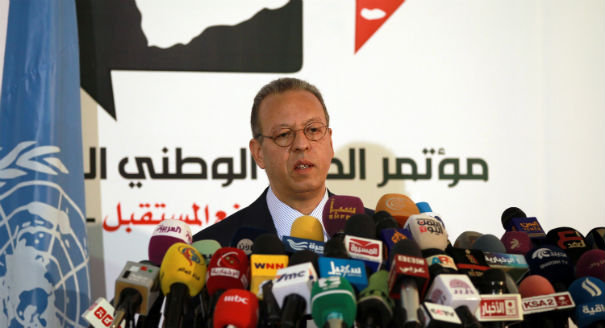
Benomar, who came to mediate between two conflicting sides (allies of the former regime and the revolutionaries who opposed it), has failed to proceed neutrally. In some of his speeches, he differentiates between the two sides as "revolutionaries" and "not revolutionaries" (that is, the former regime), even though the transition deal recognized both of them as equal partners. Saleh’s supporters have therefore accused Benomar of bias in favor of the “revolutionaries,” whom they believe label themselves as such only to secure political advantages. Saleh's party, the General People’s Congress, together with its allies among more than ten small political parties, sent an official complaint to the UNSC about the alleged bias. The publication of that complaint escalated the political wrangling and name calling between the UN mediator and Saleh and his senior aides. Both Hadi and Benomar have been hinting that the spoilers are mainly from Saleh's side. Although all groups have been spoiling the transition process in one way or another to ensure their own political advantages, Saleh’s party has become the easy scapegoat.
Given the difficulty of identifying and holding accountable the spoilers, the UNSC has decided to form a committee from all the 15 members to help identify the spoilers independent of the efforts of Benomar, whom some parties in Yemen describe as “not neutral and not wanted.” Yet even if a completely neutral and strong committee is put together, it might not be able to accomplish as much as Benomar in terms of meeting and working with a cross-section of actors—including President Hadi and the majority of the parties and groups involved in the political process—and identifying spoilers, let alone find enough evidence to implicate them.
Given these challenges, the committee would face three possible scenarios. In the best case, spoilers—even before being identified—would fear serious sanctions and the UN’s authority under Chapter VII of its charter to take military and nonmilitary action to "restore international peace and security." In this case, the fear of repercussions might lead actors to cooperate and prevent obstructions. The second case would involve the committee gathering clear and convincing evidence that identifies these spoilers and that can be submitted to courts to determine their culpability. The spoilers could then be tried either in Yemeni courts or, more likely, outside the country because Yemeni judges might be unwilling or unable to oversee such process. However, this scenario is unlikely, because it requires hard evidence, which has been extremely difficult to obtain. Alternately, the last and worst case would involve the committee designating spoilers based on fabricated reports, politicized information, and media guesses or prejudices. In this case, conflict would abound, and there would be little fear of such consequences as international sanctions.
Another major issue facing UNSCR 2140 is the perception that it meddles in internal political structures, an action some Yemenis fear will marginalize them. The resolution explicitly states its goal of "turning the page from the presidency of Ali Abdullah Saleh," which is understood among Yemenis to mean that President Hadi would assume the presidency of the General People’s Congress (GPC), which to date is still presided over by Saleh with Hadi as its deputy chairman. Forcing Saleh out of the GPC presidency would be difficult given that he signed the initial transition deal, the Gulf Cooperation Council Initiative (GCCI), in November 2011in his capacity as president of Yemen and leader of the GPC. "If the resolutions violate the GCCI in any way and turns into a tool for settling accounts, then Yemen will return to a swamp of wars," said Ahmed Al Sufi, a GPC senior official and Saleh’s secretary.
At the moment however, the resolution has the full support of the interim government. Rajeh Badi, the official spokesman of the interim government of consensus and a senior official in the Islamist Islah party, says that he doesn’t expect anyone to challenge the resolution. "The resolution will stop spoilers, and it will not fail at all. No one would dare to confront the unanimity of the international community by even thinking of obstructing the outcomes of the dialogue," he said. The resolution could help Yemen if wisely implemented—particularly if it allows Yemenis to achieve the basic goals of the national dialogue. But UNSCR 2140 could also stand to hurt the transition if it plays into the political divisions.
Nasser Arrabyee is a Yemeni journalist based in Sanaa.