The Peace and National Partnership Agreement (PNPA) the Yemeni government signed with the Houthi movement on September 21 has the potential to give the transitional process in Yemen a positive bump, given its emphasis on inclusiveness and transparency. At the same time, however, the agreement provides cover for the Houthis’ continued drive for territorial expansion and risks leading to further instability.
The PNPA sought to halt escalation to the conflict that followed the lifting of fuel subsidies by the transitional government in late July 2014. The wide political concessions the Houthis received through the agreement weakened the elites and made space for political change. Among the many reforms, the PNPA stipulates the formation of an inclusive government—with Houthis and members of the southern secessionist Hirak Movement, who had been excluded from the Gulf Cooperation Council (GCC) Initiative and marginalized in the resulting transitional process—and requires the appointment of a Houthi and Hirak representative as presidential advisors. Additionally, the PNPA calls for a series of reforms to improve living conditions through social welfare programs and pay increases for workers in the civil service and security sectors, the reinstatement of fuel subsidies, and the implementation of the outcomes of the National Dialogue Conference.
The Houthis hope the PNPA will establish a new transitional roadmap—one that provides an alternative to the GCC-driven framework laid out in November 2011. Bolstered by their increasing popularity (drawn largely from their non-elite status), their significant victories over the Islah party including driving out General Ali Mohsen, and the widespread frustrations with the performance of the transitional government, they are attempting to give previously alienated local political actors a new stake in the process. PNPA require that President Abd Rabu Mansour Hadi hold “inclusive and transparent consultations with all of the constituencies represented in the National Dialogue Conference” in order to ensure their representation and meaningful engagement in forming a new, “competency-based” government.
As such, the Houthis and leading political parties are currently negotiating the composition of the cabinet. Political infighting and distrust among the parties prolonged the negotiations, risking further instability. The new Prime Minister Khaled Bahah announced on October 25 that out of 34 ministries the ruling General People's Congress (GPC) and the former opposition bloc, the Joint Meeting Parties (JMP) which includes Islah, will receive nine portfolios each. The Houthis and Hirak are to head six ministries each, and another four will be appointed by President Hadi, who belongs to the GPC, but the JMP rejected this distribution. They threatened to boycott the next government if the JMP—along with other parties, such as the Salafi Rashad Union Party—does not receive fair representation. Given this deadlock in negotiations, compounded by the hostilities between the Houthis and the JMP’s Islah, the parties agreed on October 29 that the government should not be formed on the basis of political parties. Although unlikely to satisfy the Houthis, President Hadi and Prime Minister Bahah are instead going to select “competent” ministers and form a technocratic government.
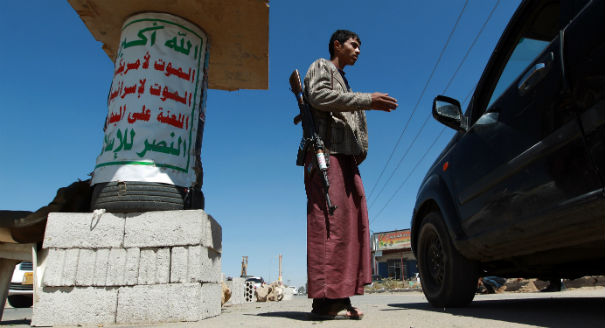
Since signing the PNPA, the group has been selective about its commitment to the agreement. While they claim to push for more inclusion and transparency in the formation of the government, the PNPA gives them cover in their drive for territorial expansion. But this drive jeopardizes any progress the PNPA promises on the political front; and although the Houthis signed the PNPA’s Annex, which addresses the security situation and stipulates the removal of armed groups, Houthi militias remain in the capital. They are likely to remain for as long as they continue to distrust the elites driving the political process. In the meantime, they have taken up security functions and established checkpoints in the city, hoping to be seen as a legitimate provider of security, rather than a militia subject to the conditions of the PNPA Annex. Rather than resolving an armed conflict between the Houthis and the state, the PNPA used the language of peaceful political change to legitimize the violent takeover of Sanaa.
In addition to keeping their militias and armed forces in Sanaa, the movement has continued unabated with its expansion south of the capital. Formerly restricted to the northern governorate of Saada, the Houthis are now in control of the entire northwest of the country. They also reached the port city of Hodeida, located by the Red Sea, on October 14. At the moment, the movement is moving further south toward Bab al-Mandab, one of three crucial straits along the oil shipment routes between the Middle East and the West. In central Yemen, the Houthis are running into al-Qaeda in the Arabian Peninsula (AQAP), one of their main opponents, and the tribes supporting it. Since mid-October, there has been heavy fighting in Ibb and Bayda, where the Yemeni army has frequently fought against AQAP over the past two years. These violent confrontations in central Yemen, however, may push tribes unaligned with AQAP and disenfranchised supporters of Islah into al-Qaeda’s arms
The Houthis are poised to play a dominant role in Yemen’s transitional process. Although genuine political cooperation between the Houthis and Islah is doubtful, a technocratic government might be able to reconcile the political groups and implement the PNPA. It is, however, more likely that political infighting will continue, while the de facto distribution of power is determined by the fighting on the ground. Given the Houthis’ strength, and their involvement with the Yemeni army against AQAP, the Houthis will have the upper hand in this conflict. Their territorial expansion and their selective commitment to the PNPA show that they are determined to shape the transition on their own terms. In both the short and long term, however, this strategy will not lead to political or social stability in Yemen.
Mareike Transfeld is a fellow at the German Institute for International and Security Affairs (SWP) in Berlin.
The text of the PNPA is available in English and Arabic.