

Commentary
Raed El-Hamed
{
  "authors": [
    "Raed El-Hamed"
  ],
  "type": "commentary",
  "blog": "Sada",
  "centerAffiliationAll": "",
  "centers": [
    "Carnegie Endowment for International Peace"
  ],
  "collections": [],
  "englishNewsletterAll": "",
  "nonEnglishNewsletterAll": "",
  "primaryCenter": "Carnegie Endowment for International Peace",
  "programAffiliation": "",
  "programs": [],
  "projects": [],
  "regions": [
    "Middle East",
    "Iraq",
    "Levant"
  ],
  "topics": [
    "Security",
    "Military"
  ]
}
Source: Getty
If Iraqi parties cannot agree on a unified vision for the National Guard, options will remain limited for the U.S.-led coalition against the Islamic State.
If Iraqi parties cannot agree on a unified vision for the National Guard, options will remain limited for the U.S.-led coalition against the Islamic State.
The United States is pressing the Iraqi parliament to ratify the creation of a National Guard Force in all Iraqi provinces, which would involve Sunni tribes in the international effort to confront the Islamic State. The goal is to get Sunni tribesmen in west and northwest Iraq to agree to work under the leadership of the National Guard as part of a unifying framework to merge the predominately Shia Popular Mobilization Forces—which include fighters from the Badr Organization, Asa’ib Ahl al-Haq, and other militias, along with new volunteer fighters answering Ali al-Sistani’s fatwa last June to pursue defensive jihad—with members of Sunni tribes that are still fighting the Islamic State.
The Popular Mobilization Forces have committed serious violations against Sunnis in areas where it has regained control, leading to a backlash against them. Locals are now more likely to accept the Islamic State as a replacement for government forces and the Popular Mobilization. For these reasons, and despite the suffering caused by the Islamic State’s control of many Sunny tribal regions, the Iraqi and U.S. governments face significant challenges in recruiting Sunni tribesmen to join the proposed guard.
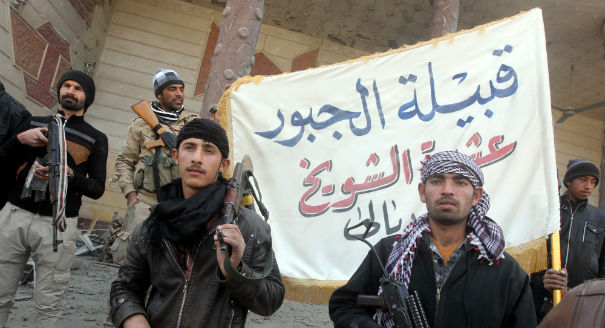
There is already notable security and intelligence cooperation between the Islamic State and residents of these cities—with thousands of locals still joining the group—limiting the National Guard’s ability to recruit these forces. This is largely because the Islamic State was successful in defeating Iraqi security forces and taking control of cities, which further attracted fighters from former resistance factions and tribal rebels who became convinced of the group’s military superiority. The Islamic State’s harsh deterrent tactics against those who fight it—last October, they massacred thousands from Albu Nimr tribe in Anbar’s city of Hit—have made many Sunni tribes more reticent, while others like al-Jubour tribe in Salahuddin and the al-Ubaid tribe in Kirkuk continue to express readiness to fight the Islamic State.
Moreover, Sunni tribes still remember the effects of the United States’ short-lived support of the Sahwa (Awakening) forces after its withdrawal from Iraq. Former Prime Minister Nouri al-Maliki failed to integrate these fighters into the army and security services, stopped paying their salaries, and had some of their senior leaders arrested. The Islamic State was easily able to target senior leaders of the Sahwa councils after the government stopped paying their salaries—and the salaries of those protecting them—and many Sahwa members had previously left their hometowns for safer cities or emigrated abroad. This raises fears of a repeat situation with the government of Prime Minister Haider al-Abadi after they finish their mission. Furthermore, the government’s inability to differentiate between Islamic State fighters and local residents, and its policy of indiscriminate air and ground shelling, make it difficult to appeal to Sunni tribal fighters.
To address these challenges, the United States has expressed its willingness to send American advisers to Anbar to train and consult with Iraqi forces, the peshmerga, and fighters from Sunni tribes—on the condition that the central government supports the process to arm Sunni tribes. The United States realizes that more airstrikes will merely weaken the Islamic State and limit its progress, but not defeat it. Washington seeks to have Iraqi forces and the Kurdish peshmerga train more than 10 brigades, including 20–30,000 fighters, tasked with recovering Mosul in the first stage. The United States is also reaching out to tribal leaders from the Sunni community, whom they deem capable of defeating the Islamic State if provided sufficient support and arms. The failure to assist these tribes could further alienate them, particularly as the Iraqi security forces—seen as dominated by Shia militias—are distrusted in Anbar and other Sunni provinces where they have committed violent acts after regaining control from the Islamic State.
Even if the United States agrees to arm Sunni tribes—either through the central government or in coordination with Arab states that have strong ties with Sunni tribal leaders—other issues remain, such as the lack of a unified Sunni tribal representation, which would facilitate the process of working with fighters. Washington is aware of the depth of the rift within the Sunni community—divided between supporters of the Islamic State, those fighting it, and neutral parties—and will remain reluctant to arm Sunni tribes quickly.
But if the United States manages to cooperate and coordinate with Sunni tribes, Washington would gain greater access to on-the-ground information needed for targeted combat operations, particularly as it is reluctant to send a large ground force. This would also curb the Islamic State’s efforts to recruit more young tribesmen as it seeks to compensate for its losses caused by the international coalition’s airstrikes.
For its part, the Iraqi government under Prime Minister Abadi has slowly been taking important steps toward fulfilling his commitment, struck during the formation of the government, to a political agreement with Sunni forces. The council of ministers has ratified the creation of the National Guard at the beginning of March 2015, and parliament conducted an initial reading aimed at resolving initial disputes. Further readings will be required to narrow the disagreements. According to the Iraqi Forces Alliance, a Sunni-majority parliamentary bloc, the National Guard will mobilize as many residents of the Sunni provinces as possible and keep them away from the Islamic State by absorbing officers from the former Iraqi army.
But the fragile process also faces opposition from influential Shia groups that believe this project undermines the Popular Mobilization Forces. In addition, Sunni and Shia political groups are in dispute over the National Guard’s potential leadership. Shia parties believe that Prime Minister Abadi should lead the forces, while Sunni parties want the National Guard subject to the authority of the provincial councils. If the military balance tips in favor of the Islamic State, however, the need to empower Sunni regions as much possible against the group would force concessions. Among other things, this may include denying the Popular Mobilization Forces a role in recovering cities and entering Sunni areas.
The central government adopts the view that the establishment of a National Guard is crucial to combatting the Islamic State. The failure to agree on a unified vision and to ratify the National Guard will significantly hinder these efforts. In such a scenario, the United States will find itself faced with the option of arming Sunni tribes through neighboring Arab states or relying more heavily on the less-inclusive regular forces and the Kurdish peshmerga. But without real contribution from Sunni tribes, these forces are far less equipped to battle the Islamic State.
Raed El-Hamed is an Iraqi researcher and regular contributor to Sada.
This article was translated from Arabic.
Raed El-Hamed is an Iraqi journalist and member of the Iraqi Journalists Union.
Recent Work
Raed El-Hamed
Raed El-Hamed
Carnegie does not take institutional positions on public policy issues; the views represented herein are those of the author(s) and do not necessarily reflect the views of Carnegie, its staff, or its trustees.
Can economic ties help contain conflict between Egypt and Israel, or do they simply postpone confrontation? Drawing on the German-Russian experience, the article examines how the gas deal creates mutual dependence, keeps channels of cooperation open, and raises the cost of conflict, without necessarily delivering lasting peace.

Nourhan Hefzy

Is the Gulf moving beyond the dollar? This article examines how China is expanding the renminbi's role across Gulf markets, what that means for regional finance, and why the future of global currencies is more complex than the de-dollarization debate suggests.

Andrew Bonney
Syria's transition promised a fresh start. But are old habits of power making a comeback? This analysis looks at the warning signs and what it will take to build a more accountable state.

Sima Beitinjaneh
Syria’s worsening drought is no longer a seasonal crisis. This report explains what climate change is doing to rainfall, groundwater, and food security, and what solutions experts say are still possible.
Milia Esper
From anime heroes to online gaming communities, Morocco’s Gen Z is building a new protest culture. What does this digital imagination reveal about youth politics, and how should institutions respond?
Abdelilah Farah