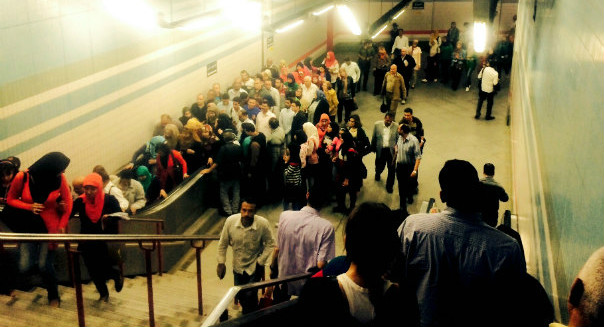
Crowds exit a train on the Cairo Metro’s new Line 3 at Al-Ataba station near Downtown Cairo. The station connects the metro’s Line 2 with Line 3. First opened in February 2012, Line 3 connects busy Al-Ataba Square and Abbassiya—home to the ministry of defense, Ain Shams University, and Saint Mark’s Coptic Orthodox Cathedral—with the upscale district of Heliopolis. On May 7, 2014, then interim President Adly Mansour inaugurated the second phase of the line in a grand media event, built with 940 million Euros in loans from the French Development Agency and the European Investment Bank. Construction is underway to eventually bring the line to the airport. Photo by Angela Boskovitch
Passengers board a train on Line 1 of the Cairo Metro, which connects El Marg in the north with the industrial city of Helwan to the south runs and over 35 stations. Line 1, sometimes called the French line because it was built with French loans, hasn’t been altered significantly since opening on September 27, 1987. Then-president Anwar Sadat first initiated the Metro’s construction in July 1981, the first subway system in the Middle East and Africa. Tickets are EGP 1.00 (USD 0.13), regardless of the distance of the trip. Photo by Angela Boskovitch
“I see so many people every day but I get to know a lot of them over time because they travel the same routes,” said Ahmed, a Metro employee since 2005, adding, “We’re helping make Cairo work.” As Greater Cairo’s population soars, metro ridership is going up as well, with Cairo Metro statistics projecting a 2014/2015 annual ridership of 1.6-1.7 billion. Fares remain fixed at EGP 1, and the government has denied rumors of a ticket price hike to pay for the costs of constructing the new metro Line 3, which currently consumes about one-third of the entire transport budget for Egypt. Photo by Angela Boskovitch
Students Fatima (left) and Marwa (right) use the metro’s new Line 3 to reach their classes at the Faculty of Engineering, Ain Shams University near the Abdou Pash Square station. Despite covering less than 10 percent of Cairo, the metro enjoys a prized reputation among Cairenes for its reliability, although complaints of overcrowding are common. Photo by Angela Boskovitch
“Only for women”—one of two cars reserved on every train exclusively for female passengers since 1989 to ensure women’s unbothered travel, while all other train cars are officially mixed between men and women. In practice, most women ride in the women’s car. Overcrowding on the platforms and inadequate lighting outside train stations make many women feel unsafe, they say, as others speak of unwanted groping when exiting crowded stations. According to a 2014 study by the independent initiative HarassMap, public transportation is the second most common place for sexual harassment. Photo by Angela Boskovitch
Women ride together in a women’s only car aboard the Cairo Metro during the rush hour commute. Although the cars are supposed to be exclusively for women, male vendors often board trying to sell their wares to the women aboard. In October 2013, the Ministry of Interior dispatched female police officers around busy metro stations and in the women’s cars. Photo by Angela Boskovitch
Passengers gather on a platform at Al Shohadaa (the martyrs) station near Ramses Square—location of Ramses Railway Station—one of only two transfer points between the Cairo Metro’s Line 1 and 2. The station was renamed “Al Shohadaa” from “Mubarak” after the 2011 revolution. The only other transfer point between Line 1 and 2, Sadat Station under Tahrir Square, was closed on August 14, 2013 after the violent breakup of the pro-Morsi sit-ins. With reports of overcrowding and harassment at Al Shohadaa, the government has said it plans to reopen the central Sadat Station for transfers only sometime in May 2015. Photo by Angela Boskovitch
A new train departs for Heliopolis on the Cairo Metro’s recently launched Line 3 from the pristine Al-Ataba station near downtown, the only transfer point between Line 2 and Line 3. Construction continues on Line 3, which is eventually planned to reach the airport. On April 26, 2015, an empty train coming out of maintenance on the new Line 3 derailed and crashed into the wall, injuring the driver, due to “technical problems.” The accident–covered widely in Egyptian media–has alarmed many Cairenes amid an increase in train accidents from 52 in 2013 to 100 in 2014, according to Egypt’s Central Agency for Mobilization and Statistics. Photo by Angela Boskovitch
A passenger walks along a platform of the Cairo Metro’s new Line 3, where screens advise of oncoming trains that arrive every few minutes. Photo by Angela Boskovitch
Fourteen-passenger microbuses wait for passengers outside the Shubra El-Kheima Metro Station. Microbuses cover each and every meter of Cairo as the most important means of mass transportation, according to architect and urban designer Ahmed Zaazaa. They operate in the semiformal private sector. Their fares vary with distance traveled and went up when the Egyptian government cut fuel subsidies in mid-2014. Photo by Angela Boskovitch
A train on Cairo Metro’s Line 2 departs from Shubra El-Kheima Station after the busy rush hour commute. Around 3.5 million passengers travel on the Cairo Metro’s three lines each day, according to Egypt’s State Information Service. In comparison, the London Underground has some four million daily passengers across eleven subway lines. The greatest passenger complaint is overcrowding, especially during the heat of summer. Photo by Angela Boskovitch
Two full-length single-decker Cairo Transportation Authority (CTA) buses travel along the Corniche. Urban designers say the slow-moving public buses, intended to support the metro, remain a very limited option, as they lack proper support like designated bus lanes. Photo by Angela Boskovitch
As Downtown Cairo and Tahrir Square have undergone a facelift, with buildings being sandblasted and repainted, the city’s most important Metro Station, Sadat, has been closed since the violent breakup of the Muslim Brotherhood sit-ins in August 14, 2013. Media reports say Sadat Station is to reopen sometime in May for transfers only, leaving its doors to the street closed. Photo by Angela Boskovitch
Mobility is a constant challenge for Cairo’s residents. With a metropolitan population of nearly 22 million and a vast urban area, many Cairenes must combine various forms of transportation—including the Metro, public buses, and semi-private microbuses—to navigate a complex transit system that disproportionately burdens people with lower incomes. Exacerbating all of this is the lack of democratic mechanisms for ordinary residents to press the government to improve services in this rapidly expanding megacity that is projected to top 40 million people by 2050.
Mohamed knows the challenges of public transit all too well. For ten years, this 44-year-old ticketing agent traveled 22 kilometers five days a week for an hour and a half from his downtown home to the Cairo International Airport where he worked. “I used to take a bus and two trains to reach the airport,” he said, waiting for a bus at an unmarked station along his old commute route. Public buses do not have dedicated lanes, and when roads become bottlenecked their arrival is not guaranteed. “Sometimes the bus didn’t come for a half an hour, so to get to work on time I’d take a taxi to a nearby hotel and catch a shuttle bus from there to the airport, but then it was more expensive,” Mohamed added. On an average workday, he spent around EGP 15 of his EGP 1,000 monthly salary to get to and from work, or about 30 percent of his income.
Mohamed’s ordeals are commonplace in Cairo, where residents struggle to find affordable and reliable public transportation. “The metro doesn’t even cover ten percent of Cairo,” explained Ahmed Zaazaa, an urban designer, architect, and cofounder of the MADD Platform, an independent initiative that works on urban development issues. That makes the most important means of mass transportation the microbuses, which cover each and every meter of the city. “When they’ve stopped working because of a strike, for example, the city also stops working,” Zaazaa explained.
The fourteen-passenger microbuses operate in a semiformal private sector, with the government regulating only the routes traveled. Passengers’ fares depend on the length of their journey, and their cost rose after the government of President Abdel Fattah El-Sisi enacted a fuel price hike in 2014. Unlike public buses, whose prices remained flat after the hike, microbus drivers passed off higher fuel costs onto passengers. Lower-middle income groups tend to take the microbuses, prizing their speed and reliability, while the very poor ride the slower public minibuses (between 2 and 2.50 EGP per trip) or full-size single-decker buses (1 to 2 per trip) operated by the Cairo Transport Authority (CTA). Ticket prices are even higher on newer bus lines and air-conditioned minibuses with Wi-Fi access, which middle-income earners prefer. In a kind of transport hierarchy, the lowest-cost bus travels along the city’s oldest routes.
Because microbus drivers work on commission, they often drive at breakneck speeds and weave in and out of traffic in an effort to maximize passenger numbers—violating any number of traffic safety ordinances along the way. Accidents are common, and road safety has long been a pressing concern. According to the World Health Organization (WHO), about 12,000 Egyptians die each year due to road traffic accidents, making traffic-related deaths a leading cause of death. Even more sobering, at a May 5, 2015 conference organized by the Ministry of Transportation, the NADA Foundation for Safer Egyptian Roads reported that road accidents are the leading cause of death among those aged 15 to 19 and the second leading cause of death among children between 5 and 14 years old.
This transportation chaos is compounded because the public does not always know the microbus routes or stations. Drivers use hand signals to tell passengers their destinations at crowded, noisy pickup points; riders use similar gestures to let drivers know when they need to hop out. But in order to improve services, Zaazaa is working on a project to map microbus routes and stations. “We want to increase the capacities of the microbuses and understand their problems to eliminate bottlenecks at the stations,” he said.
The burden of mobility is greater still for women, who struggle not only to find affordable, reliable ways to move around, but safe ones too. According to a June 2014 study conducted by HarassMap, the first independent initiative to use crowdsourced data to map sexual harassment in Egypt, public transportation is the second most common place for sexual harassment. In answer to the harassment of women on public transit, since 1989 the government has reserved two marked cars on every metro train for women. However, during peak travel times this is hardly adequate, and many women end up riding in mixed cars. “When something happens in one of these cars, fellow passengers often tell the woman she should’ve been riding in the women’s car, because there’s this misperception,” explained Monica Ibrahim, communications manager at HarassMap.
For female passengers changing between the metro’s two main lines at Al-Shohadaa—the only transfer point in the city after Tahrir Square’s Sadat station closed in August 2013—the overcrowded conditions can be particularly dangerous. Back in October 2013, amid growing reports of sexual harassment, Egypt’s Interior Ministry dispatched female police officers around busy stations. “I often see the women police officers at Al-Shohadaa,” said Nermeen, a 28-year-old marketing consultant, from the packed women’s car she said she always rides during her rush hour commute. Despite more police presence, she says she still doesn’t quite feel at ease: “The microbus I take has become really expensive. And then I take a tuk-tuk to and from the metro, as I really don’t feel safe on the streets in my neighborhood because I’m Christian and almost all the women around are covered.”
First opened in 1987, the Cairo Metro is still one of only two subway systems in Africa, traversing 61 stations along three lines. At least 3.5 million people ride the metro each day, and annual ridership is steadily increasing, according to the metro’s statistics. The Cairo Metro has recently added stations to a new third line opened in February 2012, linking two of the city’s busiest squares near downtown with the upscale Heliopolis district, but it sees comparatively fewer passengers. Construction is underway for this line—which runs along shining new stations with digitized monitors—to eventually reach the airport.
In the 1980s, the metro was envisioned to reduce the ever-growing traffic on Cairo’s streets amid rising birth rates and urban migration, and the government considers it a crowning achievement. But critics say it is both slow and expensive to expand. “The secondary transport system that is supposed to support the metro is organic and mostly informal and semi-formal private sector [services] like tuk-tuks and microbuses,” said Yahia Shawkat, a built environment researcher with the Right to Housing initiative.
Many agree that the real issue behind Cairo’s transit woes is the lack of a comprehensive public transport framework in which polices and investments are made. The most up-to-date comprehensive study on urban transport was done by the Cairo Regional Area Transportation Study (CREATS) in 2001-2004, but its recommendation to establish a transport authority to coordinate and oversee all transport needs for the region has not been implemented, explained Shawkat. Instead, transport solutions come piecemeal, and there are growing reports of poorly maintained public transport vehicles and frequent enough train accidents—numbering 100 train accidents in 2014. Metro drivers even recently went on strike over what they said were unsafe train and tunnel conditions, after an empty train on the new third line derailed and crashed into the wall, injuring the driver.
In Egypt, where the president appoints all 27 governors, residents have little democratic say in the affairs that govern their day-to-day lives. The central government determines and implements urban projects, leaving qualified urban planners, designers, and architects unable to make decisions independently with mayors or city councils. Rather than finding holistic solutions for the city’s myriad challenges—like transportation—the Sisi government, making matters worse, is instead pursuing mega-projects for satellite cities. The latest plan, unveiled at the March 2015 Egyptian Economic Development Conference in Sharm el-Sheikh, is for a $300 billion new capital city. “We need normal solutions for our problems, not these big projects,” said Zaazaa, whose MADD Platform works in Cairo’s informal settlements with residents on participatory urban designs. “This new capital will leave the problems of the old one, which is rapidly expanding in a very haphazard way, and where there’s no comprehensive strategy to cover the city’s needs with services like public transportation. People are struggling every day just to move from one point to another.”
Angela Boskovitch is a Cairo-based writer, researcher, and cultural producer.