Aleppo’s old city, a UNESCO World Heritage site. By some estimates, attacks by regime forces have
... Show More >
destroyed 40 percent of the eastern part of the city’s infrastructure. Photo by Mohammed Shaalan, February 14, 2015.
< Show less
A bombed-out road in Aleppo. Photo by Mohammed Shaalan, February 13, 2015.
An Aleppo school. As a result of the Syrian civil war, the public education system has all but collapsed. Enrollment
... Show More >
in Syria has fallen to an average of 50 percent, compared to the pre-war years when virtually all Syrian children were enrolled in primary schools. Photo by Mohammed Shaalan, February 13, 2015.
< Show less
Children play in the rubble of Aleppo’s destroyed buildings. Photo by Mohammed Shaalan, February 13, 2015.
Aleppo’s destroyed buildings. Photo by Mohammed Shaalan, February 13, 2015.
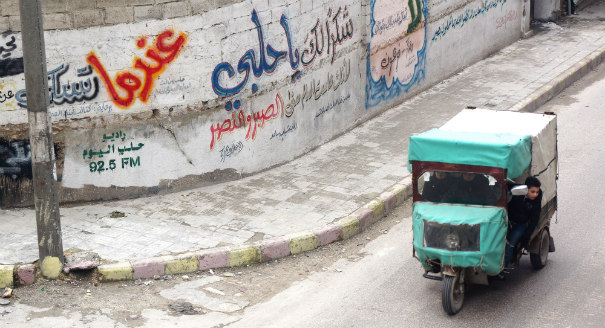
Graffiti on the wall says, “Thank you, Halabi [the Arabic word for the city of Aleppo],” followed by, “Patience and
... Show More >
Victory.” Photo by Mohammed Shaalan, February 13, 2015.
< Show less
Graffiti on the ruins states, “The barrels of death sent us to heaven.” The inscription above reads, “Your barrels have
... Show More >
killed the fear in us, you donkey.” Photo by Mohammed Shaalan, February 14, 2015.
< Show less
Colored ropes warn residents that snipers are nearby and signal their position. In opposition-held areas, there
... Show More >
is extensive use of such makeshift methods to protect civilians from regime forces, which have made extensive use of snipers in their battle for the city. Photo by Mohammed Shaalan, February 14, 2015.
< Show less
A curtain hung across the road serves as a makeshift barricade to warn residents from entering an area known
... Show More >
to have snipers. Photo by Mohammed Shaalan, February 14, 2015.
< Show less
To overcome food shortages, and due to the shifting nature of the front line, civilians in opposition-held
areas
... Show More >
have resorted to the use of urban farms, which double as petting zoos for children. Photo by Mohammed Shaalan, February 14, 2015.
< Show less
Azaz is an important supply route from Turkey for the opposition and a strategic target of the Assad regime
... Show More >
forces and the Islamic State. Photo by Mohammed Shaalan, February 11, 2015.
< Show less
Azaz, a suburb of Aleppo, is currently under the control of Jabhat al-Nusra, with a small Free Syrian Army
... Show More >
presence. Photo by Mohammed Shaalan, February 11, 2015.
< Show less
Azaz Souk. Photo by Mohammed Shaalan, February 11, 2015.
Azaz Souk. Photo by Mohammed Shaalan, February 11, 2015.
A souk in Aleppo. Photo by Mohammed Shaalan, February 14, 2015.
An underground cultural center in Aleppo, established by a citizen journalist as a meeting point for other local
... Show More >
citizen journalists to take part in the propaganda war against the regime. The cartoon on the left reads, “The trip of death to stay alive” from Syria to Turkey/Jordan/Lebanon/Egypt to Europe. Photo by Mohammed Shaalan, February 14, 2015.
< Show less
An underground cultural center in Aleppo. The opposition of the people of Aleppo is not limited to the use of arms,
... Show More >
but also includes nonviolent resistance. Photo by Mohammed Shaalan, February 14, 2015.
< Show less
Three young members of the Free Syrian Army fighting along the Sifat frontline. They were killed in action soon
... Show More >
after this picture was taken. Photo by Mohammed Shaalan, February 12, 2015.
< Show less
Free Syrian Army (FSA) fighters break for tea along the Sifat frontline. The FSA holds the eastern side of this
... Show More >
frontline, and FSA fighters on the ground report the presence of Iranian troops supporting the regime on the other side. Photo by Mohammed Shaalan, February 12, 2015.
< Show less
Fighting along the Sifat frontline. The struggle for the city has raged since mid-July 2012. The eastern side of the city,
... Show More >
currently under opposition control, lost the majority of its inhabitants; only about 40,000 out of an estimated one million residents remain. Photo by Mohammed Shaalan, February 12, 2015.
< Show less
The Syrian civil war has claimed the lives of over 320,000 people, with some of the fiercest fighting occurring in
... Show More >
Aleppo. The tombstones are for those killed during the war. Photo by Mohammed Shaalan, February 15, 2015.
< Show less
The city of Aleppo has been the site of some of the fiercest urban fighting of the brutal Syrian civil war, which has claimed more than 320,000 lives. Syria’s largest city has been divided between Bashar al-Assad’s forces in the comparatively wealthier central and western neighborhoods and the Syrian rebels, including various Islamist factions such as Jabhat al-Nusra, in the eastern parts. Despite the city’s strategic location—it lies only 50 kilometers (30 miles) from the Turkish border and serves as the rebel forces’ main supply route in the north—and its role as a commercial hub, it is particularly important to the conflict because the loss of the city would deal a fatal blow to the Assad regime’s claim that it still represents all Syrians. This would entrench the demarcation line that has already emerged between the interior areas and regime-controlled areas around Damascus and the Mediterranean coast, where the Alawite minority is concentrated.
Because of the city’s importance, Aleppo’s civilian population has been subjected to severe and sometimes indiscriminate violence from both sides of the conflict since mid-July 2012. This includes the regime’s infamous use of barrel bombs, which have claimed thousands of lives. The Violations Documentation Center, a Syria-based monitoring group, estimates that 3,124 civilians in the Aleppo governorate were killed by barrel bombs between January 2014 and March 2015. As early as January 2014, the REACH Initiative, a UN-affiliated group focusing on humanitarian action, estimated that up to 550,000 people from the eastern side of the city were displaced—due to the random bombardment of opposition-held areas by regime forces and the lack of basic services in the city, including repeated electricity shutdowns. There are some estimates that of the one million inhabitants of the eastern part of the city, only 40,000 remain.
In response to this violence, many residents fled, but others opted to pick up arms and join one of the opposition groups. Three such teenage boys joined the Free Syrian Army (FSA) at the end of 2013, almost a year and a half after the start of hostilities within the city. One of them decided to join the fight after losing family members in the war against the regime, and the families of the other two were forced to leave the city due to the horrid living conditions, while the boys opted to stay and carry on the fight against the regime. The boys claimed to have opposed the regime before the start of the revolt, though passively, like most of the Syrian population. These stories are not uncommon in Aleppo, as many find themselves unwittingly drawn into the conflict that has engulfed the city.
Meanwhile, civilians who haven’t fled have come up with their own ways of coping with living in a conflict zone. For instance, the regime uses snipers—initially used to suppress peaceful protests at the beginning of the revolt—as an execution squad to indiscriminately target those living in rebel-held areas. The Syrian Observatory of Human rights has stated that as of October 2014, the causalities from sniper fire in Syria reached 5,307 civilians. Aleppo residents have created a complex system of signals to mark the location of possible snipers with colored ropes. Based on this, civilians know not to cross a particular rope lest they become a target for the snipers. Locals have also created large, makeshift barricades that provide a semblance of shelter for bystanders.
As the military conflict dragged on, other forms of nonviolent resistance appeared in the city. The most striking example is the Union of Media Professionals, which aims to develop the skills of freelance citizen journalists in Aleppo and report events on the ground to international news agencies, as well as local newspaper Aleppo Today. For example, they offer film-editing courses to develop the necessary skills to create battlefield footage that can be sold to the various news agencies. These freelance journalists form an integral part of the propaganda war against the regime, for which they are deliberately targeted (the Syrian Network for Human Rights claims that 384 journalists and media activists were killed in Syria from the beginning of the conflict to the end of 2014).
Aleppo is also confronting the country’s collapsed public education system. Enrollment in Syria has fallen to an average of 50 percent, compared to the pre-war years when virtually all Syrian children were enrolled in primary schools. UNICEF estimates that 2.2 million children in Syria are not enrolled in schools and that only 30 percent of the 400,000 Syrian children who have fled to Lebanon are receiving proper education. In response, Aleppo’s rebel-held areas developed a network of underground schools, which when open use the same government textbooks and syllabus of the pre-war years, with very few redactions. These schools also sometimes staff a person responsible for the care of traumatized children. According to Anas, a child care provider in one of the schools, part of this care includes running a number of petting zoos, where the children are encouraged to play with domesticated animals to distract them from the ongoing conflict.
The struggle for Aleppo is still ongoing, with front line shifting constantly between the regime and the opposition. Unlike in other areas, and with the exception of the Islamic State, the opposition groups in Aleppo seem to have a working relationship, more so since increased Russian and Iranian involvement allowed the regime to launch a major offensive in Aleppo province. This minimizes infighting between different rebel groups and allows them to consolidate their forces against the regime and the Islamic State, leaving more room for civilian initiatives. However, Russian airstrikes have started to weaken the opposition, who form the majority of targets. This has the effect of allowing the Islamic State to regain territory in Aleppo province that it lost earlier to other rebel groups. As the war drags on, so does the destruction of the city of Aleppo. The loss of infrastructure—roughly 40 percent of eastern Aleppo is damaged or destroyed—is compounded by the loss of the people, especially youth, who were forced to leave the city and the travails of those stuck in a struggle for survival between snipers, barrel bombs, and the Islamic State.
Maged Mandour is a political analyst and writes the “Chronicles of the Arab Revolt” column for Open Democracy. Follow him on Twitter @MagedMandour.