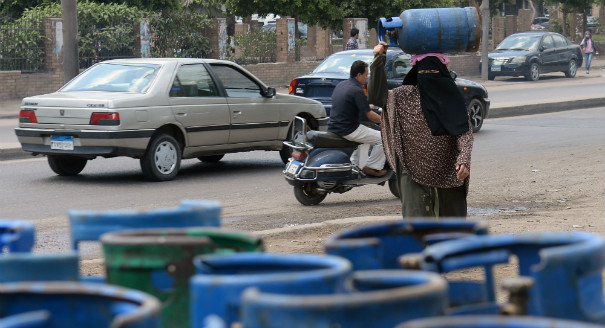
One of the most pressing crises facing the Egyptian economy has been the severe shortage of natural gas. The crisis itself—which involves supply cuts to factories and frequent electrical outages—has received copious coverage in the domestic and international press and has tested the patience of the Egyptian people and the business community. However, during the first week of November, officials at the Egyptian Natural Gas Holding Company (EGAS) announced that Egyptian heavy industry was now being supplied with all of its needed natural gas and other fuels. Officials from a number of companies and trade organizations confirmed this on December 2. There has also been an absence of reports of power cuts in major residential areas. Unfortunately for Egypt, this may simply be the result of a lull in demand due to moderate weather and slower production from heavy industry, not a permanent end to the shortages.
Natural gas is one of the most important inputs in Egypt’s power generation infrastructure. According to the International Energy Agency, in 2013 natural gas accounted for 51.5 percent of the total primary energy supplied in Egypt and produced 76.8 percent of the electricity generated. This reliance on natural gas was never a problem when Egypt was producing a surplus. According to the 2015 BP Statistical Review of World Energy, domestic production of natural gas peaked at 6.06 billion cubic feet (bcf) of gas per day in 2009, when consumption averaged only 4.11 bcf per day. However, by 2014, domestic gas production had fallen by 22.3 percent to 4.71 bcf per day.
Conversely, Egypt’s rapidly growing population, with a voracious appetite for consumer electronics and air conditioning, pushed consumption to a peak of 5.09 bcf per day in 2012 (although it dipped in 2013 and 2014, this was due to supply limitations). This coincided with a slowdown in natural gas production and the halting of new exploration contracts from the government following the popular uprisings in 2011 and 2013. The result of this was the elimination of Egypt’s natural gas surplus and the forfeiture of its status as a net energy exporter.
While supply cuts to power plants and factories have been common for several years, increasing residential demand and the government’s hesitancy to trigger popular discontent has led authorities to put heavy industry in the crosshairs of most of their natural gas supply cuts—rather than the power plants that provide electricity for Egypt’s residential neighborhoods. By the end of May 2015, media reports indicated that EGAS had stopped pumping natural gas to 60 percent of Egypt’s heavy consumption factories, and gas production stood at 4.35 bcf per day. Not only did this hurt the domestic economy, production cutbacks also reduce Egypt’s ability to export, exacerbating the foreign exchange shortage that has also been plaguing the economy. By the end of November 2015, production had fallen to 4.15 bcf per day.
Natural gas supply prospects going forward appear somewhat grim for the business community as well—the supply–demand deficit is estimated at 0.7 bcf per day presently and is expected to rise to 1.77 bcf per day in the 2017-18 fiscal year, and natural production from actively producing fields is declining by 1.2 bcf per day each year. However, three important developments from 2015 have the potential to turn Egypt’s natural gas supply situation around.
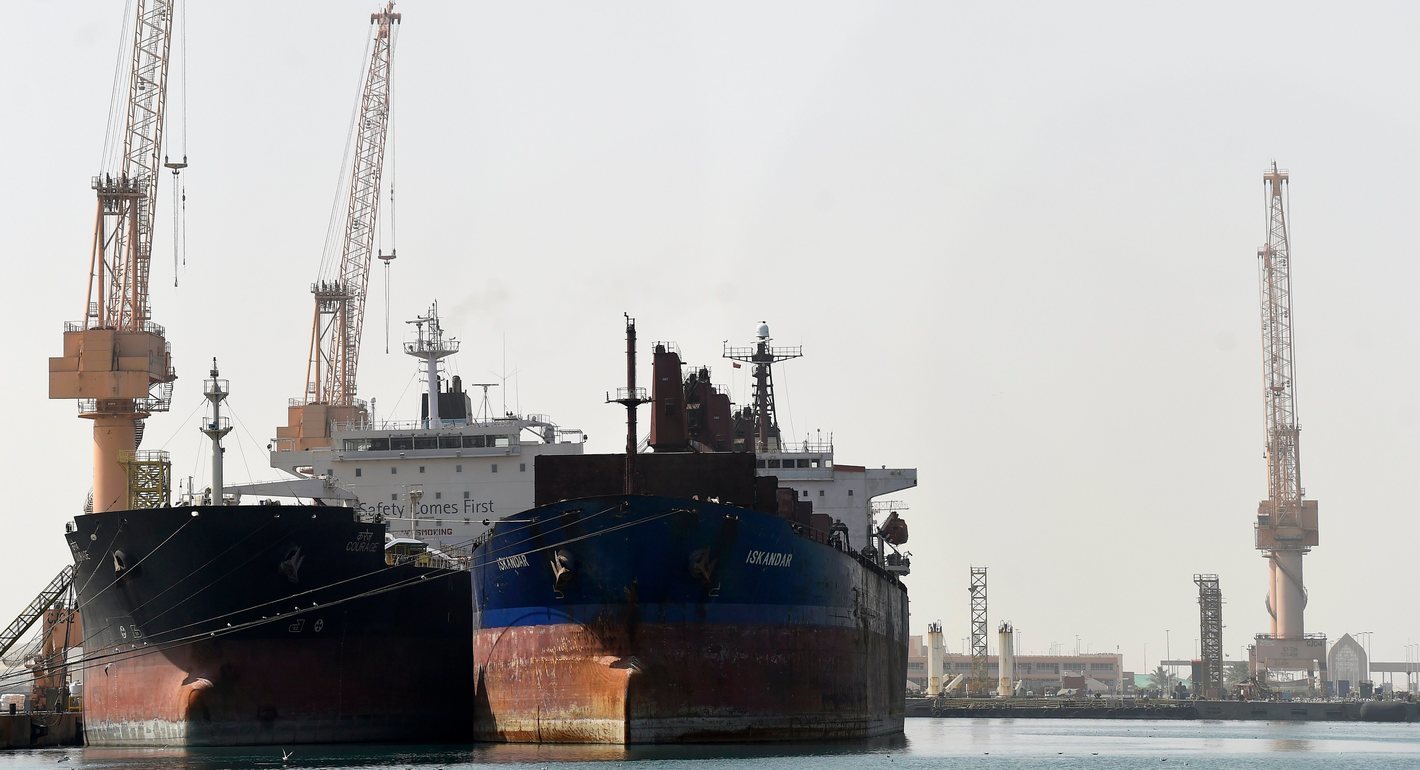
First, during 2015, Egypt began receiving shipments of liquefied natural gas (LNG) from a number of international oil and gas firms, including BP, Shell, and PetroChina, through two floating storage and regasification units (FSRUs). With these FSRUs, Egypt is currently able to import an additional 0.70 bcf per day through each, and plans are underway to rent a third FSRU with an import capacity of up to 0.75 bcf per day during late 2016 or 2017. In addition to buying gas directly for the national grid, Egypt has also agreed to allow cement and iron factories to import some of their natural gas needs through the FSRUs, paying for half of their gas consumption at the government contract rate and the rest at global market rates. While this may increase consumption of natural gas overall, it will reduce the pressure put on Egypt’s already limited supplies of domestically produced gas.
Second, in August 2015, the Italian energy company Eni discovered a “super giant” gas field in the Mediterranean Sea in one of its exploration concessions from the Egyptian government. Drilling began on December 26, and the first gas from the Zohr field is expected to come online at some point in 2018 or 2019. However, according to a presentation given by Khaled Abu Bakr, co-founder of the Egyptian gas trading company Dolphinus Holdings, to the American Chamber of Commerce in Egypt on October 15, 2015, the initial yields will be very low and peak production will not be reached until 2024. According to Abu Bakr’s presentation, once the Zohr field reaches peak production, it will produce somewhere between 2.5 to 2.7 bcf per day, with production finally petering out in the 2040s. Additionally, other gas fields—such as BP Egypt’s acquisition of a deep-water concession in the Mediterranean from DEA Deutsche Erdoel AG—are likely to begin production in the coming years.
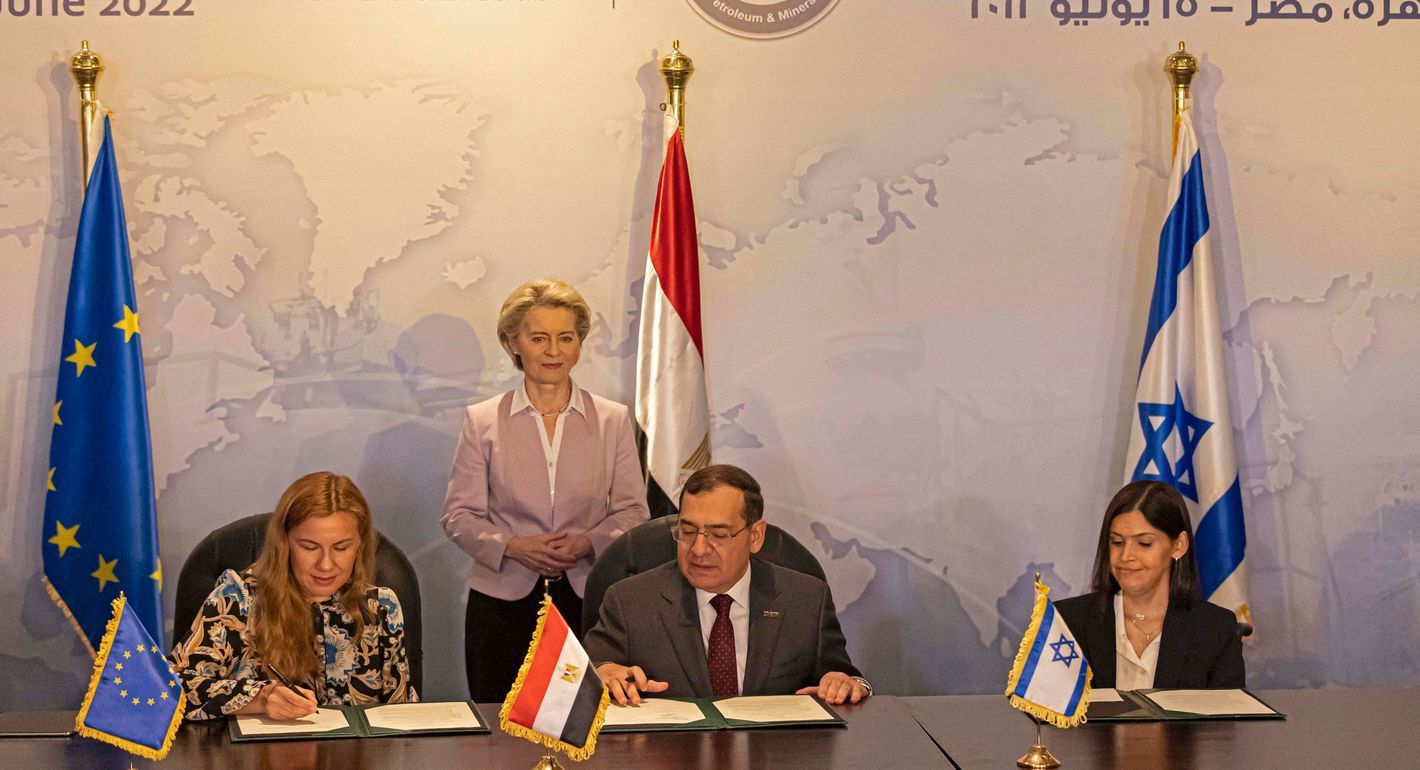
Third, substantial progress has been made toward an agreement between Egypt, Israel, and a number of private sector energy firms for the export of gas from Israel’s Leviathan field through an existing pipeline to Egypt. The agreement could supply the Dolphinus Holdings with 4 billion cubic meters of natural gas per year, or 0.387 bcf per day. However, an international arbitration decision related to Egypt’s 2012 decision to shut off gas exports to Israel could result in Egypt paying $1.76 billion to Israel Electric and could delay the delivery of natural gas from the Leviathan field to Egypt. Despite this, it is evident that both Israel and Egypt see the Leviathan deal as potentially beneficial, as Israel has dispatched an envoy to Egypt to smooth the way for an agreement, and there has been talk of turning the East Mediterranean region into a global natural gas hub due to the large discoveries in the waters of Egypt, Israel, and Cyprus.
All of these developments could bode well for Egypt in the medium term by alleviating the current natural gas shortage. What remain in question are Egypt’s natural gas supply situation for 2016 and the government’s commitment to avoid the supply shortage problems that have plagued it in recent years. Although consumption varies with the seasons—Egyptians use much more electricity, and as a result natural gas, when they are running their air conditioners—the supply–demand deficit as of September 2015 stood at 0.7 bcf per day and Egypt is estimated to lose an average of 1.2 bcf per day each year in output from existing natural gas wells as the wells reach the end of their production cycles and the gas dries up.
At least for Summer 2016, Egypt is almost certain to cut natural gas supplies to heavy industry again. While the FSRUs may take some of the pressure off, these are restricted to 1.4 bcf per day in imports until a third can be rented—by the end of 2016 at the earliest, assuming Egypt can scrounge up enough foreign currency to pay the bills. Given Egypt’s current foreign exchange crisis—and the fact that the government is already overdue on its payments for infrastructure and LNG and is facing the risk of default—this seems like a stretch.
The long-term outlook is equally uncertain. Egypt does have more sources of natural gas coming online after 2016 from the Zohr field, as well as pipeline imports from the Leviathan field likely to materialize at some point later in the decade. However, the government has shown a lack of appetite for the kind of restraint and structural reform necessary to avoid future shortages. The much-lauded plans to eliminate petroleum subsidies, which even Minister of Petroleum Tarek Molla admits Egypt is “suffering” from, have been scaled back, and more intensive consumers of natural gas, such as power plants and cement factories, are coming online.
Egypt’s economic position at the moment is not enviable. Despite the developments during 2015, the future is all but certain to be worse if Egypt cannot access a reliable and sufficient quantity of natural gas to provide power. Egypt needs to continue with energy subsidy cuts in order to match demand with supply and focus on diversifying its sources of power. The post-revolution period was an unfortunate setback for the economy, but Egypt can no longer afford to rely on the revolution as an excuse for the economy.
Brendan Meighan is an economic researcher at the American Chamber of Commerce in Egypt.