After surprising developments in November, Saad Hariri of the March 14 alliance’s Future Movement endorsed Sleiman Frangieh of March 8’s Marada Movement for president, bypassing March 8’s favored candidate, Michel Aoun. Hariri’s support for Frangieh—who had previously indicated he would not stand in the way of Aoun’s candidacy before he announced his bid on December 17—was meant to drive a wedge between members of the March 8 alliance, but is now backfiring on Hariri’s own March 14 alliance.
March 14 was endorsing its own candidate, Samir Geagea of the Lebanese Forces (LF). However, Hariri endorsed Frangieh, seeking to showcase him as a consensual candidate from the very heart of March 8—and attract parties from all sides to a possible deal without granting a victory to Aoun’s Free Patriotic Movement (FPM). Initially, the strategy appeared to work: at first, March 8’s Amal Movement and the independent Progressive Socialist Party (PSP) rallied around the new bid. Meanwhile the FPM was left blindsided as Aoun suddenly appeared a less serious candidate than Frangieh, formerly a junior ally from the weakest of the four main Maronite parties. Moreover, by supporting Frangieh, the Future Movement was trying to lure Hezbollah away from Aoun. They hoped that open support for Frangieh, who has close ties with the Syrian regime, would encourage Hezbollah to switch its votes toward Frangieh and in so doing destroy the Hezbollah–FPM alliance that forms the cornerstone of the March 8 coalition.
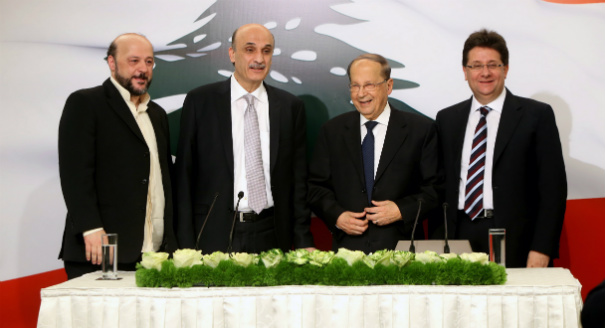
But realizing that support for Frangieh would have shattered their ties with the FPM and discredited the party in Christian popular opinion, Hezbollah stood with Aoun. Instead, Hariri’s endorsement of a March 8 candidate drove wedges within his own March 14 alliance. The Lebanese Forces, the leading Christian party of March 14, saw Hariri’s act as a betrayal. Not only was the party humiliated when its ally endorsed a different candidate than Geagea, Frangieh’s strong backing in northern Lebanon would threaten the LF’s influence in its most important region. The LF, and Geagea himself, retaliated by endorsing Aoun—a wartime rival—keeping Geagea’s 2007 promise that if it came to it, he would “preserve his Christian credibility by breaking with Hariri” rather than support a “weak figure” for president.
While Geagea’s endorsement of Aoun is a huge moral boost for the latter’s presidential bid, it is in fact of little practical significance. The Lebanese Forces have only 8 MPs—with Frangieh abandoning support for the Aoun candidacy, Aoun loses the 3 MPs from the Marada Movement and is in the end only getting 5 more votes. As Aoun is 81 years old—and Gebran Bassil, his recently appointed political heir, has twice in a row lost parliamentary elections in his home district of Batroun to the LF’s Antoine Zahra—an alliance between the LF and FPM would make Geagea the natural presidential favorite for the next presidential elections.
Geagea’s endorsement of Aoun was also driven by concerns over the LF’s parliamentary clout. The Lebanese Forces, though the second-largest Maronite party after the FPM, commands only 8 out of 128 MPs in parliament and had limited leverage when it came to Lebanese politics. For the past ten years, they had relied on their alliance with the much larger Future Movement. So when the Future Movement abandoned the Geagea candidacy, it was clear that the alternative is to enhance their parliamentary share through a potential alliance with the FPM. While it is still too soon to know if the presidential endorsement will effectively turn into an electoral alliance, such a move could benefit both parties in the next parliamentary elections if they unite against the other Maronite lists.
The goal of Hariri’s endorsement was to bring down the March 8 alliance, but instead, the three biggest parties of the March 14 alliance are now divided. The Lebanese Forces party is supporting Aoun, the Future Movement is supporting Frangieh, and the Kataeb Party is refusing to support either of them. It is now too late for the Future Movement to endorse Geagea again, who formally dropped his candidacy when he backed Aoun’s bid, and Frangieh is refusing to withdraw from the race unless the Future Movement endorses Aoun. By contrast, the main alliance of March 8 is still holding together—at least for now. Nasrallah’s speech on January 29 reiterated Hezbollah’s support for Aoun, and the party has not lost its ties with the FPM. Though the Amal Movement’s stance is still unclear, these other two largest March 8 parties remain united.
Aoun, Geagea, and Hezbollah are now on one side of parliament, with Frangieh and Hariri on the other side. In the middle are parties like the PSP, who went back to endorsing their original candidate, Henri Helou, and the Amal Movement, which has yet to make a formal endorsement. This means that Aoun’s bid is not yet certain to gather the absolute majority in parliament. Without these 65 votes guaranteed, presidential politics go back to square one.
Ramez Dagher is a Lebanese political blogger. He regularly comments on Lebanese political affairs at Moulahazat.