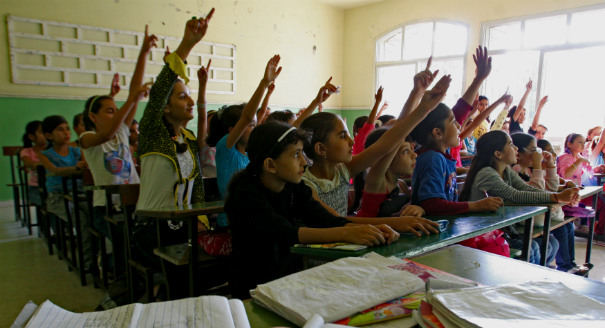
Roughly one of every two Syrian refugee children aged five to seventeen in Lebanon is currently out of school, or more than 180,000 children. In 2015, international donors gave more than $1.1 billion to Lebanon to aid with the Syrian crisis—including $61.3 million to Lebanon’s Ministry of Education and Higher Education (MEHE) and Lebanese public schools and $260.7 million to UNICEF, which funnels this aid to both MEHE and a range of NGO partners such as Save the Children. However, with so much money flowing into the country, government and civil society actors often compete for resources, and some view the refugee response as an opportunity for funding. This competition has deprived MEHE of the technical expertise and operational advantages that local and international civil society actors have to offer.
Over the past couple years, significant progress has been made to increase Syrian refugees’ access to formal education in Lebanon, for which MEHE deserves much credit. With the backing of international donors—including the European Union, USAID, the UK Department for International Development (DFID), and several UN agencies—MEHE launched the Reaching All Children with Education (RACE) strategy in 2014, a three-year program. RACE set ambitious targets, including enrolling 200,000 Syrian refugees in public schools and providing community-based instruction in reading and math for 45,000 students, among other goals. Under RACE, MEHE explicitly takes the lead role in quality assurance and control of non-formal education (NFE) with the understanding that NFE content should be designed to help students integrate into the formal education system in the future. RACE has been successful on many fronts: the refugee out-of-school rate is down from an estimated 78 percent in 2014 to 49 percent in November 2015, for example. However, RACE never intended for the Lebanese government to be the only provider of NFE, delegating that role largely to civil society.
When RACE launched in 2014, approximately 400,000 school-age refugees were then out of school, and RACE’s goal was to enroll half of them (the rest, having been out of school for upwards of one to two years, were deemed to need additional remedial, foreign language, and basic reading and math programming to re-enter formal schooling). Yet only 158,500 refugee students were enrolled in public schools by the end of the 2015. That number has declined into 2016, in part due to transportation costs and long distances to second-shift schools, which serve Syrian students in the afternoon after the end of a normal day of schooling for Lebanese students. With no end in sight to the Syrian conflict, many refugee families want their children to receive the certified educational opportunities that are only available in Lebanese public schools. But even for students who do manage to enroll, many barriers remain, including a curriculum taught in English or French, discrimination, and bullying. These contribute to dropout rates among Syrian students as high as 70 percent.
To fill these gaps, various non-state actors have been providing NFE in the form of remedial and catch-up classes, language support, community outreach, and homework help. Many smaller NGOs even run full-fledged community schools in refugee communities where public schools are far away or full. However, NFE cannot offer degrees, and its programming varies greatly in quality and scope. Many NFE programs operate under the radar, and some are aligned with Syrian opposition movements, teaching the curriculum of the National Coalition for Syrian Revolution and Opposition Forces. Under the January 2016 NFE Framework—a more detailed set of procedures for meeting RACE’s broader framework of goals—MEHE must regulate the quality of all education in Lebanon and shut down sectarian or ideological schools. Furthermore, any organization providing education outside of the NFE framework is considered to be operating outside MEHE regulations and could be shut down.
These recent moves have alienated NGOs and created a real impasse for civil society. The government is taking on the provision of non-formal education, which almost by definition typically operates outside state control. At the same time, the government is preventing other actors from providing similar programs, despite the public sector’s inability to meet its own targets. Furthermore, in September 2014 MEHE disbanded the UNHCR’s Education Sector Working Group, though UN agencies and civil society organizations have continued to meet and exchange information in the framework of an “education partners” group. Because MEHE disbanded the official working group, minutes or reports tracking developments in policy changes are no longer published, a real blow to public transparency. MEHE replaced the working group with the RACE Executive Committee, which it considers the only official coordinating mechanism in education for the Syria crisis, even though it consists only of UN agencies, ministry officials, and international donors—with no voice for local NGOs or civil society. This has effectively cut official communication channels between MEHE and NGOs as well. Elections for an NGO sub-committee took place in January, but MEHE was allegedly unhappy that NGOs were selected that had no prior experience working with MEHE and plans to revise the terms to make this a requirement before holding elections again.1
MEHE itself has stated in interviews that in the future, the only roles it envisions for NGOs will be in providing outreach to refugee communities and transportation to and from schools. Yet by taking on formal and non-formal education itself, the government of Lebanon would divert funds from other important social services. According to UNESCO, Lebanon’s public spending on education already increased from roughly 5.73 percent of all government spending in 2011 to 8.5 percent in 2013. But even before the Syrian crisis, only 30 percent of Lebanese children were enrolled in MEHE-run public schools. Additionally, government policies are often contradictory, and while MEHE has been opening the doors of its public schools to Syrian refugee students, Lebanese General Security has raided refugee communities and settlements.
For their part, international NGOs can better complement the efforts of MEHE by finding their own strategic niches. For example, one severely underserved area is secondary and higher education programming. It is estimated that only 2 percent of Syrian refugees are enrolled in secondary school, due partly to restrictions regarding who can sit for secondary exams and partly to children leaving school to join the labor force or get married. RACE does not commit MEHE to providing secondary education, and donors’ focus on basic education have made them much less willing to fund secondary and post-secondary education. However, NGOs could help fill this gap as well by providing short-term vocational and life skills programs or offering scholarships to Syrians to attend private secondary schools. Many NGOs are already trusted and legitimate sources of education within refugee communities that could provide curricular support, teacher training, and alternative learning programs for students who have missed years of schooling. Given the public sector’s limited capacity and resources, strong partnerships between MEHE and civil society are essential to expanding such services.
Elizabeth Buckner is an assistant visiting professor of International Comparative Education at Teachers College, Columbia University. Dominique Spencer is an MA Student in International Educational Development at Teachers College, Columbia University.
1. Interviews with several employees of NGOs working on Syrian refugee education in Lebanon.