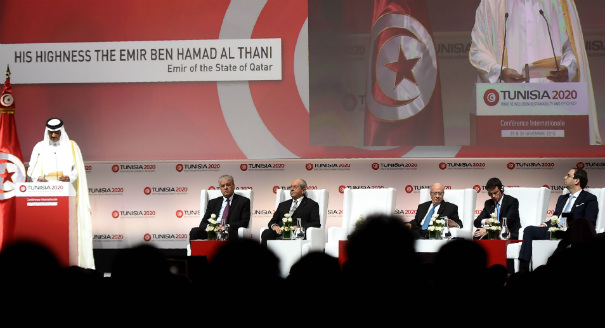
The weak Emirati attendance at Tunisia 2020, Tunisia’s investment conference held between November 29 and 30, 2016, highlights the country’s uneven relations across the Gulf. The only Emiratis present were two executives from Dubai Holding, a company owned by Emir of Dubai Sheikh Mohammed bin Rashid Al Maktoum. They were deferentially received by Prime Minister Youssef Chahed, like heads of state. Yet though more than $14 billion in loans, grants, and investments were pledged during the conference, and several large-scale projects were announced, the UAE’s only announcement at the conference was that EIT (part of Dubai Holding) was selling its 35 percent stake in Tunisia’s phone operator Tunisie Telecom.
By contrast, Qatari Emir Sheikh Tamim bin Hamad Al Thani, the only foreign head of state attending, announced a financial package of $1.25 billion, and the Qatari ambassador to Tunisia signed an additional $2.2 million check to cover the costs of the conference. Overall, Tunisia 2020 looked like Qatar’s response to the UAE-organized Egypt Economic and Development Conference (EEDC) in March 2015, which had allowed the UAE to expand its influence in that country.
Tunisia’s relationship with Qatar grew closer after the 2011 revolution, partly because Al Jazeera had criticized Zine El Abidine Ben Ali’s policies in previous years. Under the Ennahda led-coalition between 2011 and 2013, cooperation between the two countries grew across various sectors, including the economy, social and political development, and military and security. For example, in 2012 former Emir Hamad bin Khalifa Al Thani signed ten agreements with the Tunisian government, including investment and construction deals and to provide humanitarian services and vocational training. Later that year, the Tunisian Ministry of Defense announced that Tunisian armed forces participate in military drills in Qatar even as Doha supplied vehicles to the Tunisian army. Ennahda’s opponents alleged that Qatar was showering money on Islamist organizations like Ennahda and, to a lesser extent, on other political parties like the Congress for the Republic (CPR). At the time, Tunisia was counted as a main Qatari ally, together with Turkey, Egypt, Libya, and non-state actors including Hamas and some segments of the Syrian and Yemeni opposition.
Once Ennahda resigned from government in January 2014 following a protracted domestic impasse and growing tension, Qatar’s standing in Tunisia became less certain. However, Qatar could still claim Tunisia as a foreign policy success—it had supported a country whose democratic transition seemed to work. Qatar has kept backing Tunisia through loans and donations, and continues to provide positive media coverage through influential state-supported outlets such as Al Jazeera and Al-Araby Al-Jadid.
In contrast, the UAE, which had been Tunisia’s second-largest trading partner in the Arab world (after Libya), saw its bilateral ties grow tense after 2011. On the pretext that the future of Tunisia’s politics and security were too uncertain, it halted its investments in the country and gradually distanced itself diplomatically from Tunisia, a divide that peaked with the withdrawal of the Emirati ambassador to Tunis in September 2013. Tunisia’s inclusion of Islamists in politics, its policy of neutrality in Libya, and the alliances the country joined were in opposition to the UAE’s own strategic interests.
However, as Qatar’s favored actors in Tunisia—Ennahda and the CPR—were weakening, the UAE opened channels of communication with the opposition, mainly Nidaa Tounes. Once the latter came to power in early 2015, the UAE sent Foreign Minister Abdullah Bin Zayed Al Nahyan to Tunis, his first visit since May 2011. He met with President Beji Caid Essebsi, the founder of Nidaa Tounes, inviting him to visit Abu Dhabi, as several Tunisian officials did later that year. Essebsi also visited to the UAE’s client Abdel Fattah el-Sisi, inviting him to visit Tunisia. The Emirati leadership was looking to move Tunisia into its own camp and away from Qatar’s. They had calculated that their support for Nidaa Tounes would exclude Islamists from the political scene and lead Tunisia to recognize Libya’s eastern government and Khalifa Haftar, its military strongman and Abu Dhabi’s ally. Neither outcome materialized. Furthermore, the government formed by Nidaa Tounes kept excellent ties with Qatar.
As a result, Emirati–Tunisian relations remained tense. By mid-2015, many Tunisian businessmen complained that their visa applications to the UAE were refused for unclear reasons, and Tunisian expatriates living there had difficulties renewing their work permits. The Emirati ambassador to Tunis argued that this was merely the result of increased measures against violent Islamist extremism, given the large number of Tunisian youth leaving to fight in Syria. Many among those whose applications were turned down, however, had no known links to either radical movements or Islamist politics, and the Emirati response seemed instead a means of pressure on the Tunisian government.
President Essebsi attempted to improve the situation in September 2015 by flying to Dubai for the funeral of Sheikh Rashid bin Mohammed bin Rashid Al Maktoum, son of the Emir of Dubai, but he was unable to arrange a meeting with Mohammed Bin Zayed Al Nahyan, the Crown Prince of Abu Dhabi and the country’s de facto leader. Essebsi was later scheduled to visit Abu Dhabi in October 2015, but the Emiratis reportedly postponed this meeting.
In September 2015, perhaps in an attempt to strike back, Prime Minister Habib Essid suddenly called for a ministerial meeting to examine Emirati mega-projects that had been announced prior to 2011 but never implemented due to subsequent corruption investigations involving Ben Ali’s family. Yet the Emiratis did not want to abandon these projects, hoping to make them bargaining tools to influence Tunisian party politics. They would make promises that once the political crisis was resolved—meaning once their preferred Tunisian allies were secure in power—they would again invest in those projects, keeping their Tunisian partners running after a mirage. Yet Essid threatened to cancel the deals altogether and find other investors if the Emiratis were not willing to move forward.
As tensions continue, Emirati media and research outlets remain critical of Tunisia’s ongoing transition, also encouraging a number of Tunisian journalists, prominent figures, and intellectuals to share these criticisms. For example, stories and opinions previously expressed by Emirati channels are frequently reproduced by some Tunisian outlets. Meanwhile stalled economic cooperation is costing Tunisia billions of dollars in frozen investments, and visas remain an issue. As evidenced by the UAE’s small showing at Tunisia 2020, there are no signs of improvement.
Yet Tunisia hopes to move away from being dependent on Qatar alone and has been courting the UAE in order to balance out this relationship. Given the uncertainty of future U.S. and E.U. support, Tunisia is looking to strengthen its ties across the Gulf. Tunisia hopes that scaling back ties with Qatar will also calm its internal political tensions—calculating that perhaps greater Emirati support for leading secular parties could counterbalance Qatari support for Ennahda.
The Emiratis have so far favored a zero-sum game: either the Tunisian government accepts their conditions of keeping Islamists out of government and building stronger ties with the pro-Haftar government in eastern Libya, or it gets nothing. But Saudi Arabia, the UAE’s main ally, might be able to influence the UAE’s approach to Tunisia. Riyadh already pledged $850 million during Tunisia 2020 after years of cold relations between the two countries.
However, tensions between Saudi Arabia and the UAE are mounting regarding Riyadh’s warming relations with Qatar and Turkey; its growing rift with Egypt, the UAE’s client regime; and other foreign policy disagreements over Libya, Syria, and Yemen. Even if the Saudis have lost their political leverage over the UAE, they could still assume their former place as one of Tunisia’s largest Arab trading partners—as least so long as Saudi Arabia’s ongoing financial strains allow it to invest significant amounts abroad.
Youssef Cherif is a Tunisian commentator and consultant on North African politics. Follow him on Twitter @faiyla.