A Syrian family looks west across the Mediterranean from Izmir. Photo by Charles Simpson, August 8, 2016.
Syrians and Turks plant a garden at a relief NGO in Izmir. Photo by Charles Simpson, August 9, 2016.
In Izmir, loose labor regulations, a familiar culture and religion, established Syrian communities, and geographic
Show More >
proximity to Syria give refugees reasons to stay. Photo by Charles Simpson, August 9, 2016.
< Show less
Istanbul’s Sultanbeyli neighborhood, which has been relatively effective at integrating Syrian refugees. Photo by
Show More >
Zeynep Balcioglu, August 29, 2016.
< Show less
Syrian women at an outdoor market in Sultanbeyli, Istanbul, a venue for social networking and empowerment. Photo
Show More >
by Zeynep Balcioglu, June 8, 2016.
< Show less
The Syrian-owned Pages Café in Fatih, where books of multiple languages, a mixed menu, cultural events, and
Show More >
language courses in Arabic and Turkish cater to a diversity of ethnicities. Photo by Charles Simpson, August 16, 2016.
< Show less
Syrian Kurds who moved from Istanbul to the farmland surrounding Manisa. Photo by Charles Simpson, August 12, 2016.
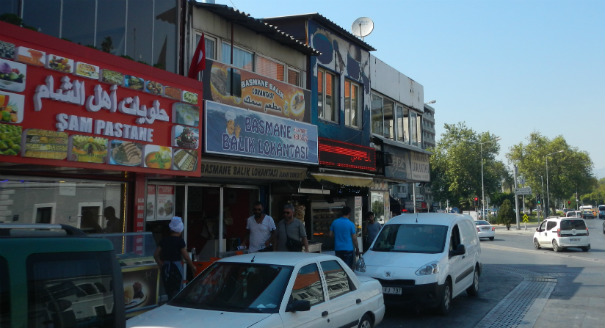
Izmir’s Basmane Square has Syrian restaurants, cafes, clothing shops, and
saraf moneychangers for handling
Show More >
remittances. Photo by Charles Simpson, August 11, 2016.
< Show less
A dense network of smugglers to Europe still exist in Turkey, and life preservers can still be found in many clothing
Show More >
shops, like this one in Izmir, though the market is drying up. Photo by Charles Simpson, August 11, 2016.
< Show less
Ayvalik’s coastline provides a perfect opportunity for smugglers to transport refugees across the Mediterranean.
Show More >
Photo by Charles Simpson, August 13, 2016.
< Show less
A man in the Turkish town of Dikili looks out at the Greek island of Chios—and the EU. Photo by Charles Simpson, August 14, 2016.
Syrian refugees at a camp of tents in a converted warehouse near Thessaloniki, Greece. Photo by Charles Simpson, August 4, 2016.
Rotten and insect-ridden meal handouts, such as those that have caused food riots, at a camp west of Thessaloniki,
Show More >
Greece. Photo by Charles Simpson, January 19, 2014.
< Show less
At a refugee camp outside of Thessaloniki, an Islamic NGO distributes meals out of an abandoned bus. Photo by
Show More >
Charles Simpson, August 5, 2016.
< Show less
In Horgos on the Hungary-Serbia border, refugees live in tents and shelters built from tree limbs while they wait for
Show More >
borders to reopen. Photo by Charles Simpson, July 25, 2016.
< Show less
An Arab market in Hamburg, Germany. Syrians here still face language barriers, unemployment, and limited
Show More >
housing. Photo by Elisabeth Schmitz, March 29, 2017.
< Show less
Syrian children play at a camp in Thessaloniki, Greece. Photo by Charles Simpson, August 1, 2016.
At first glance, the March 2016 EU–Turkey deal, which gives visa-free travel and 3 billion Euros ($3.3 billion) in relief aid to Turkey if it stems the flow of refugees to Europe, seems to have worked. Turkey now hosts three times the number of Syrian refugees as all of Europe, and according to data from the European Border and Coast Guard Agency (Frontex), there has been a dramatic drop in the number of refugees moving from Turkey to Greece since the deal was enacted. However, for many refugees, the real reason behind the decrease in refugee flows into Europe lies in their own widespread preference to remain in Turkey, where they perceive a better life is possible.
Earlier statistical analysis by Oxford University researchers found the drop in migration predated the EU-Turkey deal and therefore could not be causally connected. A series of interviews with Syrian refugees confirm this trend, indicating most refugees interviewed wanted to stay in Turkey and were using their socioeconomic resources to facilitate integration. Many of those who did travel to Europe found life there was not necessarily the paradise they anticipated and in many cases communicated back to Syrians in Turkey that the journey’s risk was not worth the reward.
Those refugees in Turkey with the resources to do so are buying homes, learning Turkish, starting businesses, enrolling in schools, and forming communities. They face a range of obstacles, including health service inadequacies, a language barrier, and racism. Not all refugees in Turkish cities are lucky: while many refugees in Turkey have found informal work, most are underemployed, underpaid, and have a difficult time finding jobs that meet their qualifications or educational level. Still, most of those interviewed—even those who had lived in Europe or had close relatives living there—reported a preference for life in Turkey over Europe. Turkey offers them looser enforcement of employment regulation, more established Syrian communities, a familiar religion and culture, and geographic proximity to Syria that gives hope for return. Three communities are particularly illustrative of the appeal Turkey holds: Fatih and Sultanbeyli in Istanbul, and Manisa near Izmir.
In Istanbul’s Fatih neighborhood, a Syrian entrepreneur runs Pages Café, catering to a diversity of ethnicities with books of multiple languages, a mixed menu, cultural events, and language courses in Arabic and Turkish. The café is decidedly not exclusive to refugees or hosts, and has patrons and workers from both communities. A 27-year-old Syrian who leads a theater group at Pages said his decent quality of life in Turkey prompted him to stay there while some of his friends migrated to Europe, adding that he would only leave “when there is nothing left for me to believe in here. But so far I believe in the fact that this place will not defeat me.” Like the owner of Pages, many Syrians in Fatih have created livelihoods by building carts to sell pastries or finding work in the informal economy that build on existing skills like software engineering.
Likewise, Mulfide, a 26-year-old female Syrian nurse at a health facility, has found opportunities in Sultanbeyli, a working-class neighborhood of Istanbul across the Bosporus from Fatih, saying, “I like my life here in Istanbul. People are nice to me and our cultures are very much alike. I feel lucky that I can do my job here… and I believe I will have the chance to advance in my career in Turkey.” Sultanbeyli has integrated various ethnicities relatively effectively due to its long history with diverse immigration. The neighborhood also provides health services, education, housing, and cultural events like Syrian concerts and iftar dinners during Ramadan.
Turkey’s rural regions provided a better migration option than Europe for the Syrians who found Turkey’s urban lifestyle challenging and prohibitively expensive. In the farmland surrounding Manisa, 25 miles (40 kilometers) outside of Izmir, a Syrian Kurdish community settled after emigrating away from urban congestion and high housing costs in Istanbul and Sanliurfa, near the Syrian border. This diffusion to rural or suburban sites is a common migration pattern for refugees facing high costs of living across Turkey’s cities—as well as urban resettlement sites in the United States, the Middle East, and Europe. Amid simple cinderblock houses covered in plaster and surrounded by greyish olive trees, this community offers reliable employment in construction and farming. As one man said: “I am free. If I want to work, I can work... that means we’re comfortable.”
In each of these communities, many Syrians express no desire to go to Europe. One man in the Manisa community said succinctly: “I am not willing to go to Europe under any conditions. If I leave Turkey, I will be going to Syria.” He perceived that Europeans have more negative attitudes than Turks toward refugees: “They have an image of the refugee… They think they are of a different planet or of a different people. They aren’t welcoming of refugees. In Germany they had protests against accepting refugees.” Though many Syrians from Istanbul to Berlin attributed these attitudes mostly to EU policies, not European people themselves, Turkey presents a sharp contrast: “We do not feel we are foreigners. We feel we are just like the Turkish citizens… If we go downtown, am I a Syrian, or aren’t I? They don’t look at me like I’m Syrian; they treat me like their brother.”
These interviews show that the factors pushing Syrians out of Turkey are inflated. On the other side of the Mediterranean, factors pulling them toward Europe also appear exaggerated. Interviews with Syrians in Athens, Belgrade, Horgos, Lesbos, Presevo, Sophia, and Thessaloniki corroborate reports that Syrian refugees face widespread and worsening problems across the Balkans route, including food riots, lack of medical care that leads to hospitalization, and inadequate shelters. Even in destination countries like Germany, Syrians face challenges with language barriers, unemployment, and limited housing. These Syrians are communicating with Syrians in Turkey via Facebook, Skype, or WhatsApp about these experiences, further deflating the pull of the “European dream.”
While the Syrian diaspora is diverse, the weakness of the factors pushing Syrians out of Turkey into Europe undermines the claim that the EU-Turkey deal was the cause of reduced migration. The deal was not conclusively effective in managing the flow of refugees across the Mediterranean, as the European Commission has claimed. Evidence of refugees’ lived experiences and attitudes from Izmir to Frankfurt, not assumptions in Brussels or Ankara, can form the basis of more effective policies for managing migration, border security, humanitarian aid, and refugee integration.
Charles Simpson is the assistant director of the Boston Consortium for Arab Region Studies (BCARS). Zeynep Balcioglu is a PhD student at Northeastern University and a researcher with BCARS. Abdullah Almutabagani is a research assistant and a BA candidate at Boston College.
* This article is based on extensive fieldwork conducted between May and December 2016 by researchers from the Boston Consortium for Arab Region Studies—including structured interviews with hundreds of Syrian refugees, aid workers, community leaders, government representatives, and security personnel in sites across Turkey, the Balkans route, and EU destination countries.