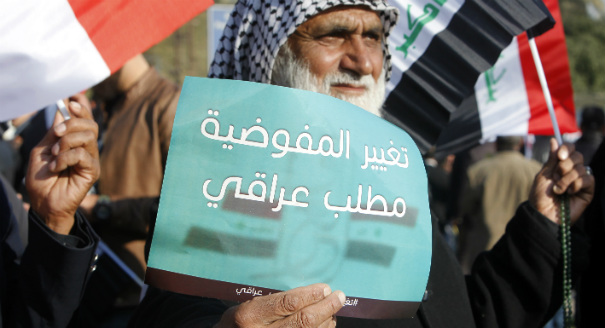
In his third year, Iraqi Prime Minister Haider al-Abadi is facing another political fight in Baghdad over provincial elections (set for this year) and national parliamentary elections (set for next). While the constitution requires that provincial elections take place by the end of April and parliamentary elections by April 2018, the uncompleted effort to liberate Nineveh and Anbar, two key Sunni-majority provinces, is only part of the problem. There are also conflicts over passing necessary election laws and over the selection of a new electoral commission board. Muqtada al-Sadr, having coopted the anti-corruption protest movement, is threatening street action and a boycott if his own policy proposals are not accepted.
Provincial elections were last held in April 2013 (and in June 2013 in Nineveh and Anbar for purported security reasons). Thus the Iraqi High Electoral Commission (IHEC) initially set the next elections for April 20, 2017. But there has yet to be a new election law for each, and preparations take about six months, although IHEC can complete some of them without the law passing. Moreover, the government failed to allocate necessary funds. On November 28, 2016, IHEC therefore announced the April date for the provincial elections implausible. Having missed that deadline, Abadi’s cabinet belatedly approved an elections bill on December 4, which is currently undergoing parliamentary review. In the meantime, on January 23 the cabinet approved an IHEC proposal to reschedule the election for September 16.
IHEC has treated the September 16 date as firm, giving parties until April 16 to register, referencing a 2015 parties law. Muhsen al-Saadun, chair of the Legal Committee in parliament, said on March 30 that since the new election law had passed two of the three readings and amendments were almost completed, parliament would soon pass it, an assessment reiterated by MP Ahmad Talal al-Badiri on April 9. IHEC Deputy Chairman Kati al-Zoubi reported that same day that the government had provided it with funds and thus elections in September were possible.
Despite these preparations, a further provincial elections delay is now likely. The primary provincial election law dispute is tied to seat allocation, based on the Sainte-Lague method that aims to provide an objective formula for allocating seats where there are multiple parties with fractions of the vote. In the first round of the method’s standard application, each party’s total votes are divided first by 1.0, with the first seat going to the best-performing party. As each seat is allocated, each party’s total votes are then divided by larger divisors proportional to the number of seats it has already secured, and new seats are allocated based on which party has the highest resulting quotient for that round. Under this formula, which Iraq first used in the 2013 provincial elections, small parties won a substantial number of seats. In the 2014 national elections, leaders of large blocs passed what is referred to as “modified Sainte-Lague,” raising the initial divisor from 1.0 to 1.7. This increases the number of votes necessary for a party to obtain an initial seat. And thus some small parties that won seats in 2013 failed to get seats in 2014.
This debate has returned in 2017. Article 12 of the bill Abadi sponsored in December sides with the large blocs and keeps the Sainte-Lague divisor of 1.7. Of the large blocs, only the Sadrists—as part of their populist line—have sided with small parties in demanding a return to the 2013 rule. Thus a nominal majority supports the modified rule, but parliament has yet to vote on the law. According to MP Ibtisam al-Hilali, who is on the Legal Committee, the large parties are debating whether to further increase the initial divisor from 1.7 to 1.9. In other words, with a majority of MPs favoring putting small parties at a disadvantage, the dispute is between those satisfied with Abadi’s measures to maintain large blocs’ advantage and those who want to make the bill work even more in large blocs’ favor.
Even if the provincial law is passed, this does not mean elections will be held this year. On April 12, IHEC told parliament that it could currently conduct elections in only 83 out of Iraq’s 137 districts for security reasons. Given that elections were held in Anbar in April 2014 despite the state of the province at that time, there is some flexibility on this issue. But IHEC generally needs six months to prepare for elections, and it is only five months to the September date. Some blocs favor just merging the provincial and parliamentary elections next year, an option that is looking likelier by the day.
A different dispute relates to the bill for national elections, which according to Article 56 of the constitution need to be held by May 16, 2018 (that is, 45 days before parliament’s four-year term expires). President Fuad Masum introduced a bill on February 21 that departed from past election laws. It divided the seats accorded to each province into two allocations, with half apportioned proportionately by bloc with an initial Sainte-Lague divisor of 1.5, and half going to the individuals with the most votes, regardless of their bloc.
Shia factions rejected Masum’s proposal in March, leading to a stalemate. They oppose the individual vote provision, which some said Amir al-Kinani, a former Sadrist MP and one of Masum’s advisors, copied from Sadr’s electoral proposal in January. An individual vote provision may benefit factions like the Sadrists and Masum’s Patriotic Union of Kurdistan (PUK), which have strong local organization. Because parliament lacks the authority to amend legislation without executive approval, this deadlock can only be broken if either Masum backs down or Abadi sponsors an alternative bill through the cabinet.
In addition to these electoral law disputes, there is an additional fight over appointments to the Iraqi High Electoral Commission. Since its establishment, IHEC’s positions have been divided between political factions, creating a balance of biases that make it politically neutral overall. The legal mandate of the current board expires on September 20, just days after elections are presently scheduled to be held. For it to have time to complete the vote count, its mandate would need to be extended, which parliament can do. But either way a debate would remain over the formation of the new board, which Sadrists demand be entirely non-political, threatening to boycott the elections otherwise.
The committee to choose the new IHEC, which was established by parliament and whose members are divided between the blocs, has already had its work disrupted by internal disputes. Parliament initially made Deputy Speaker Aram Sheikh Mohammed, of the Kurdish Gorran party, the chairman. But in early March he was forced out, and on March 12 the committee voted in a new leadership with Amer al-Khuzaie of the (Shia) State of Law Coalition as chairman and Saleh al-Jabouri of the (Sunni) Arabiyya Coalition as deputy. Khuzaie is known as a confidant of Vice President Nouri al-Maliki, who remains head of the State of Law Coalition, and Jabouri’s faction is headed by former deputy prime minister Saleh al-Mutlaq. Khuzaie’s selection is notable because it ensures a direct conflict between Maliki and Sadr over the next IHEC board.
The unquantifiable factor is a likely showdown with Sadr and his large, mostly lower-class base, which he has shown he can mobilize as needed. Sadr’s nationalistic statements showing his independence from Iran have led some observers to consider his movement as representing a middle ground. This is some basis for this, as his rhetoric has been genuinely non-sectarian, for example in his call on April 8 for Syria’s Bashar al-Assad to resign. Yet Sadr’s egocentric antics—constantly portraying himself as the legitimator of governments and claiming in March to be subject to death threats for pushing reform—has isolated him among the political class. As an example of this, his effort to impeach Minister of Health Adila Hammoud, who belongs to a rival Shia faction, failed despite the public’s near-universal derision toward her administration.
Yet Sadr can still mobilize his base as he did in May 2016, when his followers sacked government buildings in the Green Zone twice and reached the brink of a confrontation with rival Shia militias. And if Sadr follows through on his pledge to boycott the election if his demands for a non-partisan IHEC are not granted, this could lead to permanent popular tension in Baghdad. If nothing else, his threats are another reason to let provincial elections slide into 2018.
Kirk H. Sowell is a political risk analyst and the publisher of Inside Iraqi Politics, a biweekly newsletter.