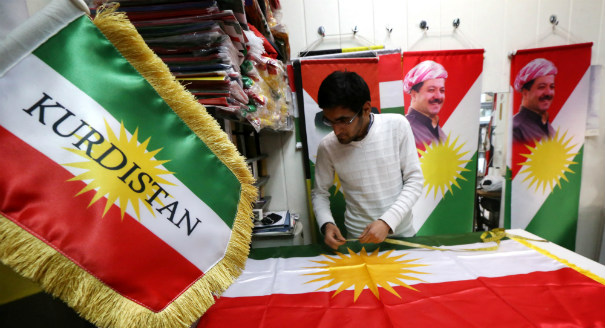
The Iraqi Kurds’ independence referendum, planned for September 25, reflects unresolved disputes over political authority between Baghdad and Erbil. It is embedded in the “right to self-determination” and a salient sense of Kurdish nationalism that has deepened since the campaign against the Islamic State (IS). Even if the referendum is non-binding, the Kurdistan Regional Government (KRG) will attempt to use the results to leverage the Iraqi government. One priority is to capitalize on Kurdish territorial gains and enhance KRG influence in the disputed territories, particularly Kirkuk and the Nineveh Plains. This effort requires convincing local communities—Kurds and non-Kurds—that their future will be more promising under the KRG and not Baghdad.
Yet Kurdish self-determination—which may include the referendum exercise—is not only a contestation between Erbil and Baghdad, but among Kurdish factions as well. The first dynamic involves what the Kurds can gain from the Iraqi state. The second is about Kurdish factions’ competition for power, revenue, and resources. Intra-Kurdish competition has increased since the anti-IS campaign began, and while the dominant Kurdistan Democratic Party (KDP) led by Masoud Barzani is challenged by the Kurdistan Workers’ Party (PKK) and its affiliates, as well as other Iraqi Kurdish groups. The key post-referendum issue is not whether a “yes” vote will alter official Iraqi borders or the status quo, but rather how Kurdish parties’ competition for political relevance can incite conflict among Kurds or other sub-state groups.
Most astute observers, as well as Kurdish officials, know that the referendum will not lead to independence. Despite an intense lobbying campaign in Washington, DC and Europe, the KRG has failed to gain key regional and international actors’ official support for the referendum or Kurdish secession. Governments and institutions may affirm the Kurds’ right to self-determination, like all peoples of the world, and recognize the significant contributions that the Kurdish peshmerga have made to the fight against the Islamic State. Yet they remain committed to Iraq’s territorial integrity and state sovereignty. Even the U.S. Congress—where Iraqi Kurds enjoy important influence—has conditioned future military support to the Kurdish peshmerga on the KRG remaining part of the Iraqi state.
A unilateral referendum lacking Iraqi and international support is unlikely to alter the status quo in Iraq. Even if the KRG secures a majority “yes” vote in the disputed territories, it will remain a de facto authority without official recognition or increased financial support from Baghdad. The absence of a negotiated settlement between the KRG and Baghdad approved by the Iraqi parliament, will also leave KRG claims to oil exports and revenues subject to the same legal and political constraints as they are today. Nor will the referendum change political geography. The Kurdistan Region will remain landlocked and dependent on Turkey’s goodwill for most of its oil exports.
In fact, without sufficient concessions to Baghdad, Ankara, and local Arab groups, the referendum could heighten the political risks of exporting crude oil to Turkey from Kirkuk and areas fully controlled by the KRG. This is particularly important given depressed oil prices and the fact that the KRG relies heavily on Kirkuk for its revenues. According to Iraqi officials, at least half of the nearly 600,000 barrels of oil per day exported by the KRG to Turkey are from Kirkuk and not the Kurdistan Region proper. Kirkuk revenues have temporarily replaced the KRG’s portion of the Iraqi budget that was cut off by Baghdad in 2014, an agreement that will likely be revisited in the months ahead.
KRG overreach in the disputed territories could undermine its autonomy and ability to leverage Baghdad. At minimum, a “yes” vote will increase the KRG’s operating costs and financial pressures. Three years after launching its “independent” oil exports, the KRG still cannot fully pay civil servant salaries or provide electricity to populations in the three provinces of the Kurdistan Region. Without a viable revenue source, it will be hard-pressed to do so for an additional 40 percent more territory and over two million people in disputed areas of Nineveh, Kirkuk, and Diyala. Under these conditions, the KRG will have to make more concessions on Kurdish autonomy and not fewer, to sustain its expanded territories. It has already negotiated investment deals with Gulf states, Russia, and regional states, as well as security arrangements with Sunni Arab communities that will give these actors greater influence in the Kurdistan Region. Another likely post-referendum scenario is the redistribution of oil revenues to political party-based constituencies, with a majority going to the KDP-affiliated groups.
The referendum also reflects the competition for political power inside the Kurdistan Region. Its timing is intentional and important. It is being conducted as Masoud Barzani, also president of the KRG, faces important domestic crises and needs to authenticate his credentials as a nationalist leader. Barzani’s KDP may have become the dominant faction, but other Kurdish groups continue to challenge his authority. This includes the Patriotic Union of Kurdistan (PUK), the Gorran Movement, Islamic parties, and the PKK and its local affiliates—despite recent KDP-PUK unification efforts. All these factions may dream of Kurdish statehood and identify as Kurds first, but they have different political agendas, regional allies, and paths toward independence. These dynamics frustrate an ethnically homogenous self-determination project.
For instance, Gorran insist that the KRG president law be amended and internal political issues resolved before a referendum can occur. Some Kurdish nationalist groups oppose the referendum altogether. Those in the No to the Referendum movement, initiated by independent activists in Sulaimaniya, argue that the referendum is really about extending Barzani’s power and not Kurdish independence. The newly launched “No for Now” channel is encouraging people to vote “no” in the referendum. For these groups, the referendum has become as much or more a vote against Barzani-KDP rule and for political reform as it is for Kurdish statehood. Different political priorities and agendas have also split minority groups—such as Yezidis, Assyrians, Sunni Arabs, Turkomans—into pro- and anti-KDP factions. Those who oppose the KRG or KDP generally support Baghdad, or an Iraqi state where they can have greater local autonomy. Overlapping these divisions are pro-Turkey and pro-Iran factions, which can change based on the issue or territory involved.
Indeed, Kurdish opposition voices are unlikely to stifle the referendum or prevent a majority “yes” vote. Barzani may face domestic opposition, but most other groups are too weak and fragmented to pose a significant challenge to his authority at this time. Still, internal fissures have reaffirmed divisions between the pro- and anti-KDP camps and enhanced opportunities for violence. Kurdish independent activists who oppose or criticize the referendum have been threatened, arrested, and accused of treason. In reacting to the KRG’s political restrictions and ongoing economic crisis, many Kurdish youth are driven by a sense of hopelessness and not dreams of independence. Some have become apathetic, others seek to migrate, and still others are becoming radicalized and joining Salafis or the PKK. These trends are occurring in a hyper-fragmented Iraqi state whereby some non-state actors and their militias are seeking to push back Kurdish territorial gains.
Internal Kurdish dynamics have implications for the referendum and its outcomes. They show that the competition among Kurds can have as much, if not greater influence on self-determination then tensions between the KRG and the Iraqi government. Without KRG political reform and financial incentives, even a “yes” vote will challenge stability inside the Kurdistan Region and disputed territories. Fissures within the Kurdish nationalist movement also undermine the Kurds’ bargaining power with Baghdad, despite the KRG’s efforts to use the referendum to increase its leverage. The Kurds’ ability to influence Baghdad is further challenged by an enhanced sense of Iraqi nationalism, Baghdad’s gradual rapprochement with Saudi Arabia and Turkey, and the KRG’s lack of an independent revenue source.
Given these realities, the efforts of the United States and international community can fuel or mitigate power struggles and conflict between Baghdad and Erbil, as well as within the Kurdistan Region. Avoiding such turmoil would not mean backing a Kurdish referendum at this time, but rather, enhancing institutions of the Iraqi state, supporting Iraqi nationalist narratives that are less ethno-sectarian, and helping decentralize power in Iraq, to include the Kurdistan Region. Support to the KRG should continue to be conditioned on its status as an integral part of the Iraqi state—and channeling this support through Baghdad. Neutral third party actors could be effective in mediating power, resource, and revenue sharing between Baghdad and Erbil, as well as at provincial levels and in disputed areas.
Denise Natali is a distinguished research fellow at the Institute for National Strategic Studies (INSS) at National Defense University. The views expressed are her own and do not reflect the official policy or position of the National Defense University, the Department of Defense, or the U.S. government. Follow her on Twitter at @DnataliDC.