On March 21, activist Mustafa al-Hasan was released from prison, having been arbitrarily detained since September 2017 with several other intellectuals and public figures who called for religious and political reform. The arrests seem to target moderate religious voices that embraced democratic change and threatened to break the state’s monopoly over religious discourse, which was solidified when the late King Abdullah bin Abdulaziz Al Saud issued a royal decree in 2010 that made the state-sponsored Council of Senior Scholars the only body allowed to issue public fatwas. By monopolizing fatwa issuance, the state—which ostensibly wanted to protect Saudi society from unqualified or extremist scholars—abolished the “free market of fatwas” that would have otherwise provided a variety of interpretations and left it to citizens to evaluate each fatwa’s value and legitimacy.
The 2010 decree also ushered in the current phase of the Saudi state fatwa policy by restricting and dictating the content of the council’s fatwas in furtherance of the state’s own goals. This monopoly on fatwas was particularly evident in the reaction to women’s rights advocates’ call for freedom of movement and the Women2Drive campaign. After decades of effort by Saudi activists, on September 26, 2017 a royal decree granted women the right to drive. The decree’s wording was especially striking: “We… refer to the view of the majority of the members of the Senior Scholars regarding women driving vehicles that its legitimacy, in terms of origin, is permissible.” This decree invokes a fatwa the state-sponsored Council of Senior Scholars had drafted for the express purpose of giving the decree a legal basis for allowing women to drive, but that was not subsequently published.
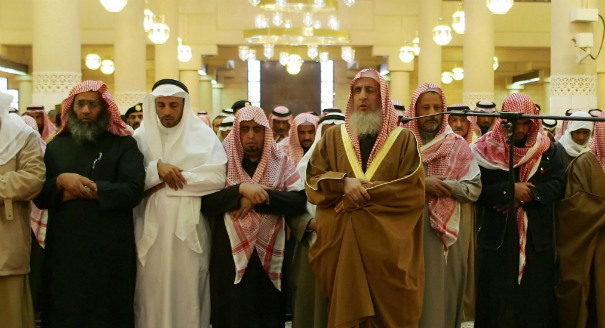
This unpublished fatwa does not present an honest, sudden change of opinion, but shows the state’s blatant manipulation of religious institutions. For more than thirty years, state-sponsored fatwas released by the General Presidency of Scholarly Research and Ifta, a subcommittee of the Council of Senior Scholars, warned women against driving cars, mixing with men, or uncovering their faces. Saleh al-Fawzan, an influential member of the Council of Senior Scholars, did not just warn against women driving cars, but also against women driving motorcycles, and the council’s grand mufti, Abdul-Aziz Al ash-Sheikh, had also said the disadvantages of women driving far outweighed the advantages. The state specifically managed to overcome entrenched opposition to women driving by giving the impression they had a change of heart rather than following the state’s own varying stance. The decree was careful not to reference non-state actors and, more importantly, not to credit the civil activists and feminists who struggled for decades for women’s rights. By referencing the Council of Senior Scholars and their fatwa, the state gave the decree more religious legitimacy and allowed it to present the change as royal largesse.
In other instances, the state tolerates any odd or extremist fatwas by the council because the state depends on these senior scholars for legitimacy. In 2017, the Grand Mufti issued more than eight fatwas and statements warning against disobeying the legitimate ruler (meaning the king), and preaching the virtues of allegiance to the current ruler—further bolstering the monarchy’s religious authority. In one such fatwa from March 2016, Grand Mufti Abdul-Aziz Al ash-Shiekh said that it is binding upon the believer to love the ruler, defend him, and not insult him. Each fatwa or statement has been versatile and able to fit changes in the political hierarchy. When Muqrin bin Abdulaziz was named crown prince in March 2014, obeying the ruler meant pledging allegiance to him, but as of January 2015 it meant pledging allegiance to Muhammad bin Nayef as crown prince. As of June 2017, these fatwas refer to Mohammad bin Salman. Despite these political changes over the past four years, the Council of Senior Scholars has been able to use the same Qur’anic verses and traditional texts in its regular fatwas encouraging allegiance to the crown prince.
The state’s monopoly over Islamic law also prevents the issuance of fatwas by independent muftis who advocate a more moderate and democracy-friendly interpretation of Islam. Independent scholar and former judge Sulaiman al-Reshoudi, co-founder of the Saudi Civil and Political Rights Association, was arrested in November 2011 after publishing a fatwa on the right of assembly and the Islamic bases for human rights and liberties. Likewise, prominent scholar and independent mufti Salman al-Odah was arrested in September 2017 as part of the state’s sweeping crackdown on dissident figures. Al-Odah is particularly known for signing and promoting a 2011 petition that demanded elections, the prosecution of corruption, the protection of civil liberties, and the release of prisoners who had been detained arbitrarily and held without trial. Yet the Council of Senior Scholars was more engaged in justifying the status quo, regardless of religious principles. The council’s role has often been to convey the state’s message in the form of classical fatwas, for example to ban and warn against public demonstrations and “deviant political parties” in 2017. But the state’s increasing instrumentalization of the council weakens its role and legitimacy.
If the true object of the council was to prevent extremist or theologically unsound fatwas, the place to start would be with one of its prominent members, Saleh al-Lohaidan, famous for issuing a fatwa in 2008 calling for the death penalty to be imposed on the owners of TV channels that “corrupt Saudi society.” In 2017 his fellow council member Saleh al-Fawzan announced that any who doubt that the Shia are infidels are themselves infidels. Even more outlandishly in 2014, al-Fouzan claimed that “open buffets” are forbidden in Islam. Because the state is dependent on such religious figures and their discourse to legitimize its power, it tolerates such extremism as long as it does not threaten to undermine loyalty to the ruler. The state’s fight against non-state fatwas is therefore less about preventing extremism than about restricting independent reformist voices that may pressure the state for political reform and greater individual liberties.
Strangling moderate independent Islamic discourse may succeed in silencing democratic voices within Islam in Saudi Arabia, but it will also create a vacuum for the less moderate discourse that the state has shown it tolerates.
Abdullah Alaoudh is a post-doctoral fellow in Islamic Law and Civilization at Yale Law School and the son of Saudi cleric Salman al-Odah. Follow him on Twitter @aalodah.