In rare public rebuke in February 2018, the Saudi Shura Council criticized the Ministry of Municipal and Rural Affairs (MOMRA) for wasting government resources, one of the very few times that the appointed body openly criticized a Saudi government institution. This illustrates the disparity between what the state aspires to achieve—most notably Vision 2030, the pivotal economic plan put forth by Crown Prince Mohamad Bin Salman—and the capacity and authority the disempowered Saudi governance structure, such as MOMRA, has to implement it. And although Vision 2030 mandates that regional and municipal authorities contribute to planning and implementing its programs, it does not explain how and lacks a clear plan to reform bureaucratic structures and decentralize power.
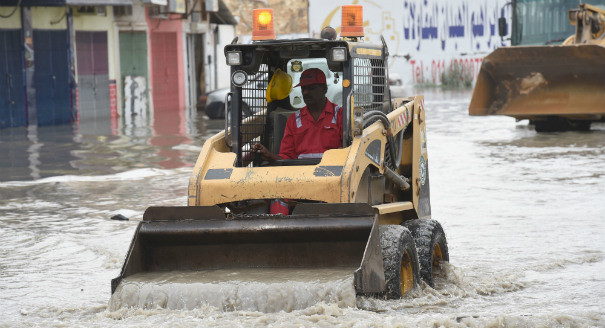
The inability of the current bureaucratic system to resolve development issues has been evident for some time—from the implementation of the central government’s grand administrative and development plans under Vision 2030 even to the provision of simple services such as waste management, food safety, and water. Four died in flooding in Jeddah, Saudi Arabia’s second-largest city, in November 2017—a persistent issue since the beginning of the Hajj pilgrimage in 2009, when floods killed more than 130 and inflicted billions of dollars’ worth of damage to local infrastructure.
At the time, the Saudi government announced a major investigation and issued tenders for new projects to avoid future damage from floods. Bypassing regional and local authorities, the diwan (the office of the king and the crown prince and its army of advisors and consultants) sent in Aramco—Saudi Arabia’s national oil company, which is entrusted with a wide range of development contracts unrelated to oil production—to oversee and manage improvements to local infrastructure. Even though new projects were implemented and a group of municipal government officials and local businessmen were indicted in 2013 for their mismanagement of the response to the floods, Jeddah continued to flood almost every year since, most recently in February 2018.
The central government in Riyadh placed the most blame on Khalid bin Faisal, the emir of the region of Mekkah, who had tried to take ownership of the new projects—even though he did not have any legal authority over the municipality of Jeddah, which is responsible for its own urban development and reports directly to MOMRA in Riyadh. Despite exerting his personal power as son of the late King Faisal, his local administration’s limited authority meant the emir failed to obtain the financial, legal, and organizational resources needed to govern the region. The emir in turn blamed the local municipality, which blamed Aramco and the contractors. All three were fighting for authority while shirking blame. The unresolved infrastructure problem of Jeddah reflects the continued failure of the current Saudi governance structure, including centralization of decisionmaking in Riyadh, institutions’ overlapping legal authority, and complex organizational structures at the regional and local levels.
The range of regional and local institutions, which are supposed to implement most of Vision 2030, are particularly complex. They are inefficient and at times dysfunctional, partly because they have not been reformed since the 1980s and do not reflect the country’s demographic and social changes. Saudi Arabia is divided into thirteen emaras (regions), governed by an emir and assisted by a regional council, all of which report to the Ministry of Interior. Each region is further divided into governorates led by a mohafez (governor) and a local council that report to the emir and the regional council.
The emirs are appointed by the king to govern the regions but have no real power to implement development projects. In the kingdom’s early days, the emirs were appointed from local tribes as both a means to ensure their political representation and help cater to local development needs. Starting in the 1960s, and formalized in the Law of the Provinces in 1992, the crown started to appoint the emirs—usually from among members of the royal family—as a means of consolidating central power over the regions. As “foreign” governors often unfamiliar and disinterested with the needs of the regions, the emirs lost touch with the needs of the people and with the tribal networks that would facilitate development projects. Even though the emirs, mohafez, and their associated regional and local councils are held accountable by the crown for economic development and social stability, they have become almost ceremonial governmental entities.
In parallel to this regional government structure overseen by the Ministry of Interior, MOMRA runs a duplicate governance structure at the local level. Each region’s capital (in addition to major cities such as Jeddah) has an amanah (secretariat), a bureaucratic entity that oversees the region’s cities and towns. Additionally, MOMRA oversees hundreds of baladiyat (municipalities), which are responsible for the provision daily services such as waste management and issuing building permits. The budget and financial transactions of these entities—the regions, amanat, and baladiyat—are then reviewed and approved by municipal councils, whose boards are half appointed by MOMRA and half elected. These councils have some limited authority to reject proposals for projects but have no say in how public land is used or how services such as health, education, and sewage are provided. These services are controlled alternately by the amanat, relevant ministries’ regional branches, special development authorities appointed by the council of ministers or the king (such as the Arriyadh or Almadina Development Authorities), royal commissions controlled directly by the diwan, or simply by Aramco.
With such a labyrinth of national and local governmental entities—themselves governed by laws that are issued by different ministries—not only is there much confusion over hierarchy and legal authority, these entities compete for resources, power, and visibility. For example, after Mohamed Ben Nayef was removed as Minister of Interior on June 21, 2017, the government slashed the share of the ministry’s budget allocated to regional governance, shifting the resources to newly established entities such as the General Entertainment Authority, which the crown tasked with creating a national entertainment policy and calendar of events for Saudi society. Local authorities, who have to contend with the daily needs and demands of the population, have been left with highly restricted budgets, and the state has earmarked many of the resources they do have for cultural events and festivals. Local bureaucrats have neither the tools nor funding to deliver more than the most essential local services, let alone meet broader administrative or developmental responsibilities such as upgrading roads, because of the ongoing competition for resources.
At the highest level, there are myriad government institutions working on planning and delivering services, including the crown, the diwan, the Council of Economic and Developmental Affairs (CEDA), assorted ministries, a range of strategy committees and project management offices for Vision 2030 and the National Transformation Program, as well as national authorities (such as the General Authority for Culture and the General Entertainment Authority). All these institutions have overlapping responsibilities—sometimes complementing, bypassing, or competing with each other—and ad hoc legal authority that grows and shrinks based on the resources allocated to the institution or the personal connections of its leadership. This complex system is also dominated by newly established entities such as the Royal Commission for Jubail and Yanbu and the Royal Commission for Mecca City and Holy Sites.
Jizan region, a province on the west coast of Saudi Arabia that promises to be a new major oil exporter, provides a glaring example on the failure of centralization. Sidelining the regional and local authorities overseen by the Ministry of Interior and MOMRA, in 2015 the central government mandated that the Royal Commission of Jubail and Yanbu (established in 1975 to manage cities in Eastern Province) manage and operate the Jizan City for Primary and Downstream Industries, a new industrial port city on the Red Sea to be built by Aramco. This is the only major development project in Jizan province, making the development of the whole region hinge on its success. But aside from overseeing and reviewing it, no local institutions will be involved in planning, budgeting, or implementing it, leaving the local tribes—some of which are originally Yemeni, part of a geopolitically volatile region of Saudi Arabia—without a say.
Crown Prince Mohammed bin Salman’s push to centralize all decisionmaking, as illustrated by the top-down process that produced Vision 2030, can only be viewed as an attempt to minimize political criticism and potential social unrest. However, this very centralization and the overlap of local governance are obstructing the implementation of the envisioned projects, thereby eroding the credibility of both local and central institutions. Without empowering local governments and consolidating competing institutions, Saudi Arabia will not be able to carry out the necessary reforms and projects to save Jeddah from flooding, let alone achieve the transformation envisioned by Vision 2030.
Hadi Fathallah is an economist and policy adviser at NAMEA Group focused on energy, food security, and political risk in the MENA region. Follow him on Twitter @Hadi_FAO.
* Correction: This article has been updated to clarify that the Shura Council is appointed, not elected.