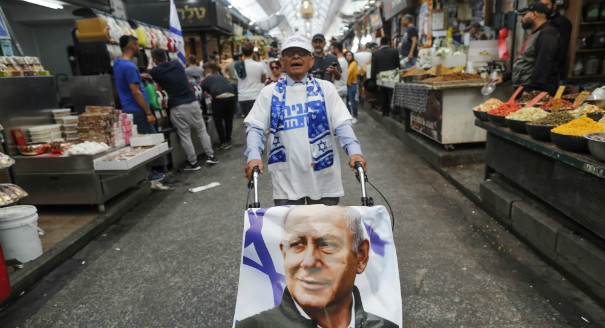
On April 16, Israeli Prime Minister Benjamin Netanyahu spoke at a victory rally in Tel Aviv, proclaiming that “this night, everything is sweet, and nothing is bitter,” modifying a well-known passage read on the upcoming Passover holiday. Victory should look sweet for Netanyahu: under his leadership, Likud won the April 9 national elections with 35 seats as per the final tally. This is the party’s best result out of the past five elections (since 2003). Netanyahu was re-elected for a fifth term in total after ten consecutive years in office, and in July, he stands to become the longest-serving prime minister in Israel’s history.
Analysts representing the opposition tried to find a different angle: the Geneva Initiative, a left-leaning civil society organization that supports a two-state solution with the Palestinians, pointed out that the bloc of right-wing and religious parties shrunk by two seats (winning 65 out of 120 seats in Knesset, compared to 67 seats in the 2015 elections). The main challenger, the ad hoc Blue and White party, put up a decent fight. Cobbled together hastily in time for the elections and unable to stake out clear positions among its disparate factions, the party still summoned all those determined to oust Netanyahu. Like Likud, Blue and White won 35 seats—trailing Likud’s vote share by less than 1 percent—making it the toughest challenger to Netanyahu since he took office again in 2009.
Nevertheless, the broader context is weighted heavily towards Netanyahu and the right wing in general. The lion’s share of Blue and White’s votes came from other center and left-wing parties. The Labor party received a historic low of six seats. The smaller left-wing party Meretz got four, and two Arab–Palestinian electoral alliances combined received ten seats. Fifty-five percent of all voters chose right wing parties (including two that did not cross the electoral threshold, Moshe Feiglin’s libertarian-nationalist Zehut Party, and the New Right, led by charismatic outgoing ministers Naftali Bennett and Ayelet Shaked).
Citizens who voted for the opposition now lament that Israel is hurtling down a far-right path of extremism, in the form of expansionist policies in the West Bank and racist policies at home, while chipping away at the pillars of Israel’s democratic structure. For them, nationalist Jewish triumphalism and illiberal, democratic backsliding is wreaking havoc on society, but the right-wing majority is an unstoppable juggernaut.
Yet these elections do not necessarily spell the end of liberal democracy in Israel. The most accurate reading of election results is that little has truly changed in Israeli politics. The right wing’s loss of two seats in the direction of the “opposition” is minimal. After Orly Levy pulled out of the Yisrael Beytenu Party, part of the previous coalition, the last government had 66 seats—almost the same as the 65-seat victory finalized on Tuesday.
In the broader context of Israeli society, there is in fact a silver lining for the opposition. Even though neither the center nor left saw great gains, the right wing could have done even better. For about a decade, young people in Israel have begun to tilt considerably and consistently further to the right. By the end of the current campaign cycle, the Israel Democracy Institute released a study showing that among the youngest respondents, nearly two-thirds preferred Netanyahu as the next prime minister. Surveys show that approximately two-thirds of people 18–34 define themselves as right-wing. Yet even though this has been the case for roughly a decade, the number of seats seems to have leveled off. Six right-wing parties entered the Knesset in 2019, just as in 2015. Perhaps something happens to the young right wingers as they grow older; it seems possible that as a voting bloc, the right wing may have maxed out.
This analysis might comfort the opposition parties that the right has reached its maximum the quantitative potential—which is what matters for elections. But what happens after elections is no less important. Qualitatively, the meaning of being a right-wing party in Israel today is becoming ever more extreme. This matters for the kind of policies that can be expected from the coalition government currently under negotiation.
If there are no surprises, the next government is expected to include all of the right-wing parties. It will be a government that at the very least intends to expand settlements, accelerating a years-old trend of annexation on the ground. At least two parties—the extremist United Right Party and the ruling Likud, based on Netanyahu’s statements on the issue just days before the elections—expressed open support for annexing parts of the West Bank. Yet neither one has given any indication that they plan to determine the status of the millions of Palestinians living there who are either directly or indirectly governed by Israel. And the situation in Gaza is a rapidly escalating humanitarian disaster due to the same unresolved political quagmire.
The right-wing parties are not bothering to provide answers to how Israel will face the unfavorable international response to this increasingly explicit expression of Israel’s permanent military rule over millions of noncitizens. At best, they say that the world will lose interest, and anyway “the world” was never on Israel’s side.
But under a decade of Netanyahu’s leadership, there have been more significant efforts to change Israel’s own democratic institutions and norms in ways that make such a situation increasingly acceptable. Israel has not seen a wholesale slide into autocracy, fascism, or anything else that might generate true rebellion among its majority-Jewish citizens.
Rather, the changes to date have been a targeted attack on elements of liberal democracy. This includes the erosion of the judiciary, where minorities go for protection against the legislature’s majority rule. This in turn establishes the primacy of ethno-national identity, thus anchoring Israel as the Jewish state, alienating the current minority of Arab–Palestinian civilians, and perhaps setting the tone for continued annexations, formally or quietly.
The new coalition members are also expected to demand protections against institutional checks on the power of the Knesset or the executive. For example, various right-wing parties are expected to demand the new government pass an “Override Bill” limiting the power of the Supreme Court to rule that laws or policies are illegal. Another much-discussed possibility is that the next government will advance the “French Law,” which would provide immunity to the prime minister—ensuring that he can move stridently in the far-right directions of illiberal democracy and permanent annexation, even as possible indictments for corruption hang over his head.
As of Tuesday, parties have told Israel’s President Reuven Rivlin that they categorically reject forming a national unity government that might have headed off these efforts. The only way to prevent the most extreme version of these policies is for the opposition to band together actively, creatively, and effectively. Nearly 44 percent of voters supported parties of the center or left (including Orly Levy’s centrist Gesher Party, which received 1.73 percent of votes but did not cross the threshold of 3.25 percent).
Even after a decade of young Jewish Israelis tilting to the right, the total voting population is not as right-wing, meaning that something is balancing out society over time. It is the opposition’s role to commit itself to the grassroots, work with young people, and accelerate this “balancing out.”
Israel also has a 20 percent minority of Arab–Palestinian citizens who have been profoundly alienated by the decade of legislative assaults and race-baiting rhetoric. Their vote could shift the balance of the blocs, yet only about half of them voted. Any opposition that wishes to win will have to commit itself to including Arab citizens in Israeli society and politics, making them part of the national conversation in an ongoing process spanning years, not just ahead of elections. Otherwise, the opposition will not have sufficient numbers to win for a long time, if ever.
The hardest task for the opposition will be to propose a genuine alternative path for Israel. Blue and White was unable to do this in a serious way, and it still received 35 seats. Perhaps if the next leading opposition party can select just a few core propositions of their own—democracy, equality, and an end to 52-year military rule over the Palestinians would be the obvious start—they might actually excite voters, rather than banking on hatred of Netanyahu. The latter clearly wasn’t sufficient to win. And if the opposition fails to deliver, the next elections could easily be worse.
Dahlia Scheindlin is a public opinion expert and political analyst who advises electoral and social campaigns in Israel and internationally. Follow her on Twitter @dahliasc.