The Palestinian Authority (PA) is currently facing a crippling financial crisis. On February 17, the Israeli government withheld $138 million of the Palestinian tax and customs money, known as clearance revenues (CRs), that it collects on PA’s behalf and transfers monthly to the Palestinian coffers in accordance with the 1994 economic arrangement commonly referred to as the Paris Protocol.
The decision to withhold part of the CRs was approved by a law passed by the Israeli Knesset on June 27, 2018, and is equivalent to the payments the PA makes to the families of Palestinian “martyrs and prisoners,” about $11.5 million per month according to Israel’s own estimates. In response, the PA refused to receive the CRs altogether unless Israel reverses its decision—which it has not, thus triggering the current PA financial crisis.
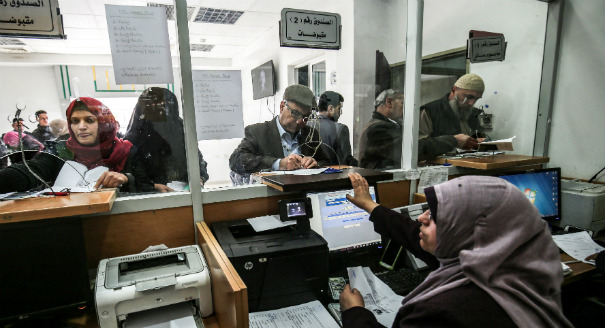
Estimated at $2.4 billion annually (15 percent of GDP), CRs constitute the backbone of the PA budget. They account for 65 percent of total PA revenues and cover over half of its expenditure. Because of this sudden cash crunch, the PA was unable to pay the full salaries of its civil and police staff, estimated at $150 million per month in 2018, and was only able to pay 60 percent of these salaries since February. A more serious and far reaching implication of the sharp fall in PA revenues is the impact on its ability to deliver basic services, and on the size of the PA fiscal gap (the budget deficit after external financing), which could exceed $1 billion by the end of 2019 (6.5 percent of GDP), according to an April 2019 World Bank report.
Israel’s CRs deductions notwithstanding, the current PA fiscal crisis has been looming for some years now. Periodic reports by the World Bank and the IMF on the state of the Palestinian economy have been warning of harsh fiscal times unless urgent mitigating measures are taken. Their recommendations have typically included calls for the PA to continue its fiscal consolidation measures to reduce its deficit; for the international community to increase budgetary support for the PA; and for Israel to ease its restrictive policies and practices that are suffocating the Palestinian economy. The World Bank’s assessment of the implementation of these recommendations reveals a consistently poor progress record.
The gravity of the PA fiscal crisis is compounded by the few policy options it has at its disposal to manage it. In the past, when faced with financial crises, the PA traditionally resorted to three policy measures: appeal to donors and to Arab states for more budgetary aid, implement austerity measures, and increase domestic borrowing. This time, however, the PA has very limited room for action on all three fronts.
Donors’ direct budget support to PA has declined over the past five years by a hefty 58 percent—from $1.24 billion in 2013 to only $516 million in 2018. At the annual spring meeting of the Ad Hoc Liaison Committee (the international donor group for Palestine) in Brussels on April 30, donors stated that they “cannot cover the financial gap that has arisen” from the CRs crisis. Instead, they proposed mediation between Israel and the PA to help defuse the stalemate. Moreover, the record of Arab financial assistance to the PA in the context of the “Arab Financial Safety Net,” a mechanism established during the Arab League meeting in March 2012 to provide the PA with $100 million per month in response to Israel’s repeated withholdings of CRs, has largely been disappointing. The Arab League’s March 31 pledge to renew commitments to the safety net is unlikely to fully materialize either.
Furthermore, the PA’s ability to pursue stringent fiscal measures has already reached its safe limits. For over a decade now, the PA has been implementing a very ambitious, IMF-supported fiscal reform program to achieve fiscal sustainability. As a result, the budget deficit decreased from 28 percent of GDP in 2007 to 8.4 percent in 2018. More actions on this front will not be cost-free. This is because in a Palestinian economy where public and private consumption are the main engine of growth, continued austerity measures will reach a point beyond which it will negatively affect an already anemic economic growth, which the IMF projects will total 1.5 percent in 2019, and consequently worsen unemployment, poverty rates, and per capita income level.
Finally, domestic borrowing is no longer a viable option. In mid-2018, the PA’s total domestic debt reached $4.25 billion, including $1.6 billion owed to domestic banks and $2.65 billion in accumulated arrears to the private sector and the National Pension Fund. Bank borrowing, however, is fast approaching the limits set by the Palestinian Monetary Authority, while continued accumulated arrears to the private sector will negatively affect the sector’s ability to repay loans, thus potentially extending the current fiscal crisis to the banking sector. Moreover, banks are being increasingly exposed to risks arising from PA debt and consumer loans by PA employees whose salaries are affected by the current crisis and who currently hold $1.5 billion in bank loans.
With the traditional policy options virtually exhausted or very limited, it is not obvious how the PA will navigate its way out of the current crisis if both Israel and the PA stick to their positions on CRs deductions. What is clear, however, is that even if Israel releases the withheld funds and resumes the transfer of CRs in full and on a regular basis, a return to the pre-crisis situation will not solve the PA’s continued fiscal difficulties that the IMF and the World Bank have been warning about for the past three years.
This is because the PA’s financial troubles are deeply rooted in an extremely unfavorable political setting in which persistent budget deficits are merely its byproducts. More specifically, since the PA’s establishment 25 years ago, it has been operating under a military occupation in total control of all aspects of the Palestinian economy. In this context, a complex web of Israeli policies and practices have hindered the free movement of Palestinian people and goods; restricted free access to national natural resources, mainly land and water; and limited Palestinians’ ability to reach regional and international markets.
Continued conflict conditions, heightened political instability, and occasional renewed episodes of violence have added a high degree of uncertainty and risks to this already volatile context, discouraging the Palestinian private sector from playing its vital role as an engine of economic growth. These factors have produced a weak economy that is increasingly unable to generate enough resources to finance its national budget and made it chronically dependent on international aid for fiscal survival.
Unless and until this context is changed—a highly unlikely possibility in the near future given the complete absence of any meaningful political negotiations between Israel and the PA since mid-2014—Palestinian fiscal troubles will continue to mount, edging the PA ever closer to the brink of financial collapse, with unforeseen consequences.
Mohammed Samhouri is a Palestinian economist and academic, a former senior economic adviser in the Palestinian Authority, and a former senior fellow and senior lecturer at Brandeis University’s Crown Center for Middle East Studies. Follow him on Twitter @msamhouri.