Egypt’s ongoing expansion of military jurisdiction under the pretext of economic development and public safety is yet another indicator that its revolution was stillborn. Although the military has long been a key political player, President Abdel Fattah el-Sisi’s regime has promoted the military to the helm of Egypt’s political and economic affairs. In parallel, there has been an unprecedented expansion of military trials of civilians to serve the interests of the military generals governing the country.
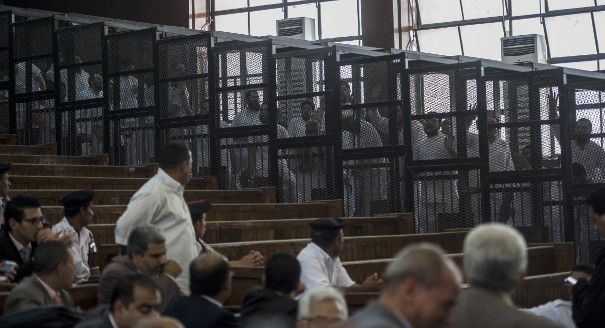
Concerns over trying civilians in military courts have long been a priority for Egypt’s human rights community. Established by Law 25 of 1966, military courts were used extensively by the Gamal Abdel Nasser, Anwar Sadat, and Hosni Mubarak regimes to try political dissidents. Pursuant to Article 6 of Military Judiciary Law, Mubarak frequently exercised his discretion to transfer civilians to military courts when emergency law was in effect—nearly all thirty years of his tenure. As a result, under Mubarak, military courts tried over 12,000 civilians. Since his removal, the number has only gone up. In 2011 alone, the Supreme Council of the Armed Forces aggressively exercised its executive authority to order an additional 12,000 civilians tried in military courts for crimes ranging from “thuggery” to insulting the military. After eighteen months of vocal protest, the loathed emergency law—which authorized military trials of civilians—was left to expire in May 2012. This explains in part why Mohamed Morsi’s regime did not try as many political dissidents in military courts.
Since coming to power, Sisi has not needed an emergency law to legalize military trials of civilians. Strong public support and the absence of a parliament allowed Sisi to issue hundreds of presidential decrees unilaterally, many of which undermined the rule of law. Among them were laws that effectively guarantee an increase in civilians tried in military court. The first came on October 27, 2014, after a deadly attack killed 22 soldiers in North Sinai. Sisi issued Law 136 of 2014, which granted the military the authority to protect public and state facilities for two years. Military courts were granted jurisdiction over any alleged crimes occurring on public land, including electric towers and stations, gas pipelines, roads, bridges, and other undefined public facilities.
A few weeks later, then Prosecutor General Hisham Barakat ordered prosecutors to review applicable case files that fall under the new law and refer them to military courts. Any disputes or crimes, no matter how trivial, would be resolved by military judges unfettered by basic due process rights afforded in civilian courts. Hence it comes as no surprise that in the two years since Law 136 was passed, over 7,000 civilians have been tried by the military, of which 3,000 were tried in the first five months. Many of the defendants are accused of belonging to the Muslim Brotherhood or took part in university student protests.
The most recent expansion of military jurisdiction came in June 2016, when President Sisi granted the military the authority to police public lands up to 2 kilometers (1.2 miles) from the nation’s public roads and highways. Purportedly aimed at preventing attacks on state-owned land, the presidential decree authorized military courts to prosecute violators. Not to be outdone by a hawkish executive, in August 2016 the new parliament approved extending Law 136 of 2014 for an additional five years until 2021.
Coupled with a series of amendments to the Military Judiciary Law that counted state properties and institutions as military property, the military courts’ jurisdiction has become troublingly vast. Buildings, factories, companies, or roads owned by the government have been transformed into military spaces that strip ordinary courts of jurisdiction. The severe curtailment of due process rights and the military judiciary’s ingrained loyalty to the military means an indictment by a military court is a near guarantee of conviction, especially in contrast to the comparatively more independent civilian courts. Although Article 204 of the 2014 Constitution nominally grants independence to the military judiciary, Article 1 of the Military Judiciary Law grants an administrative entity within the Ministry of Defense the authority to regulate it. Thus, military officers serving as judges are restrained—by institutional structure and culture—from meaningful independence.
Human rights advocates and lawyers have critiqued both laws as violating Article 204 of the 2014 Constitution, which prohibits military trials of civilians. However, Article 204 has a broad exception for “crimes that represent a direct assault” against whatever falls under military authority. As the military expands its economic activities and replaces internal security forces in protecting public facilities, the constitutional prohibition of military trials of civilians becomes toothless.
The government defends the laws as a means of preserving security and bolstering economic development. But such claims are belied by numerous military trials of political dissidents. The most glaring is the prosecution of 26 civilian workers in the Alexandria Shipyard Company, which is owned by the Ministry of Defense, in retaliation for their protests against low wages and inadequate health and safety procedures in May 2016. The proceedings are being conducted outside public purview in the Alexandria Military Court, with intelligence officers serving as witnesses.
The push to grant military courts greater jurisdiction over civilians is driven in part by the military’s economic ambitions. Soon after it ousted elected president Mohamed Morsi on July 4, 2013, the military began shifting its role from operating a shadow economy on the side to overseeing major economic projects. By the time Sisi was elected in what was effectively a referendum in May 2014, the military had subordinated the private sector as the economy’s subcontractors, also serving as the nation’s general contractor.
The military’s pre-existing businesses have expanded their operations in a wide range of industries, including agriculture, hotels and resorts, manufacturing of consumer goods, and housing. As a result, public property and public institutions now fall under the military justice system. As the Egyptian military’s role in civilian affairs expands, so too does the jurisdiction of military courts. Thousands of civilians are swept into an opaque forum absent due process, deterring others from challenging the military’s economic hegemony and political abuses.
When millions of Egyptians took to the streets in January and February 2011, stopping military trials of civilians was among their top priorities to preserve freedom and dignity. But with laws that link military courts’ jurisdiction with the increasing dominance of the armed forces in the economy, this human rights violation will only get worse. At stake is not only the trial of civilians by military courts, but the rule of law in Egypt. Without access to civilian courts, fundamental due process rights, and independent judges, law becomes subordinated to the whims of military politics.
Sahar Aziz is a professor of law at Texas A&M University School of Law and a nonresident fellow at the Brookings Doha Center. She is the author of “Independence without Accountability: The Judicial Paradox of Egypt’s Failed Transition to Democracy.”